---
title: "One Step Behind: How Many Months Do Chinese Open Models Trail the Closed Ones?"
url: "https://blog.sf-paris.dev/en/chinese-open-models-lag-closed-models-months/"
lang: "en"
translations:
it: "https://blog.sf-paris.dev/modelli-aperti-cinesi-ritardo-modelli-chiusi/"
author: "Simone Flavio"
published: "2026-11-17T11:00:00+00:00"
updated: "2026-11-16T16:10:16+00:00"
categories:
- "News"
tags:
- "artificial intelligence"
- "DeepSeek"
- "Epoch AI"
- "Kimi"
- "Open models"
summary: "How long does an open model, mostly Chinese, take to match a top closed model? In 2026 the average is 6.5 months on Epoch AI's capabilities index."
reading_time_minutes: 12
word_count: 2670
---
# One Step Behind: How Many Months Do Chinese Open Models Trail the Closed Ones?
GPT-5 came out on August 7, 2025. For months no model that anyone could download matched its level; then, on April 7, 2026, GLM-5.1 arrived: Chinese, downloadable by anyone, on a par. Eight months had gone by.
Is eight months a lot or a little? It is among the slowest of the catch-ups we will see, against an average of 6.5 months in 2026, but it depends on how many times it has happened and on what you count. The suspicion is that the Chinese are always one step behind the leading American models; to test it, the calendar is enough. On one side, the release dates of the closed models, those of OpenAI, Anthropic, Google, xAI, and Meta; on the other, the release dates of the open ones, from any company, Chinese or American. In between, a common yardstick. Here a step means months: let’s see how many, and who covers them.
In short
According to Epoch AI’s ECI index (data of November 16, 2026), in 2026 the best open model has on average the level that the top closed models had reached 6.5 months earlier, with a range between 5.9 and 7.6; in its study of May 29, 2026, the institute writes 4 months, and with its rule on today’s data it comes out at 4.9. After Microsoft’s Phi-4 (December 2024), every new record among open models belongs to a Chinese lab; counting only open models from other countries, the 2026 lag rises to 12.5 months. The result changes with the test chosen: from 2.5 to 8.1 months.
## What yardstick measures the lag?
To line up different models you need a common score. Here it comes from the Epoch Capabilities Index (ECI), the index of an AI research institute, Epoch AI, which publishes its data under an open license. The ECI condenses dozens of standard tests, called benchmarks, into a single number for each model, on the same scale even if the models did not take the same tests: it is the principle of the decathlon, where running, jumping, and throwing become a single score. The method is a statistical model that accounts for how hard each test is, so a high score on a hard test counts for more than on an easy one. Two fixed points anchor the scale: Claude 3.5 Sonnet is at 130 and GPT-5 at 150.
The words matter too. A model is closed if its weights, the numbers that make it up, cannot be downloaded and you use it only through an app or a programming interface, the so-called API. It is open (an open-weight model) if the weights can be downloaded, under a free license, with usage limits, or non-commercial only: open, therefore, does not mean open source in the strict sense. A model’s country is that of the organization that released it. Meta is in both columns: its models from Muse Spark onward are closed and count among the top closed models, while Muse Spark Open is among the open ones.
The data, downloaded on November 16, 2026, cover 231 models released from 2023 to today: 118 closed and 113 open, 56 of them Chinese.
## Which open models caught up with the closed ones, and when?
Since 2024 the best closed model has gone from about 122 to 173 points; the best Chinese open models reach 161.
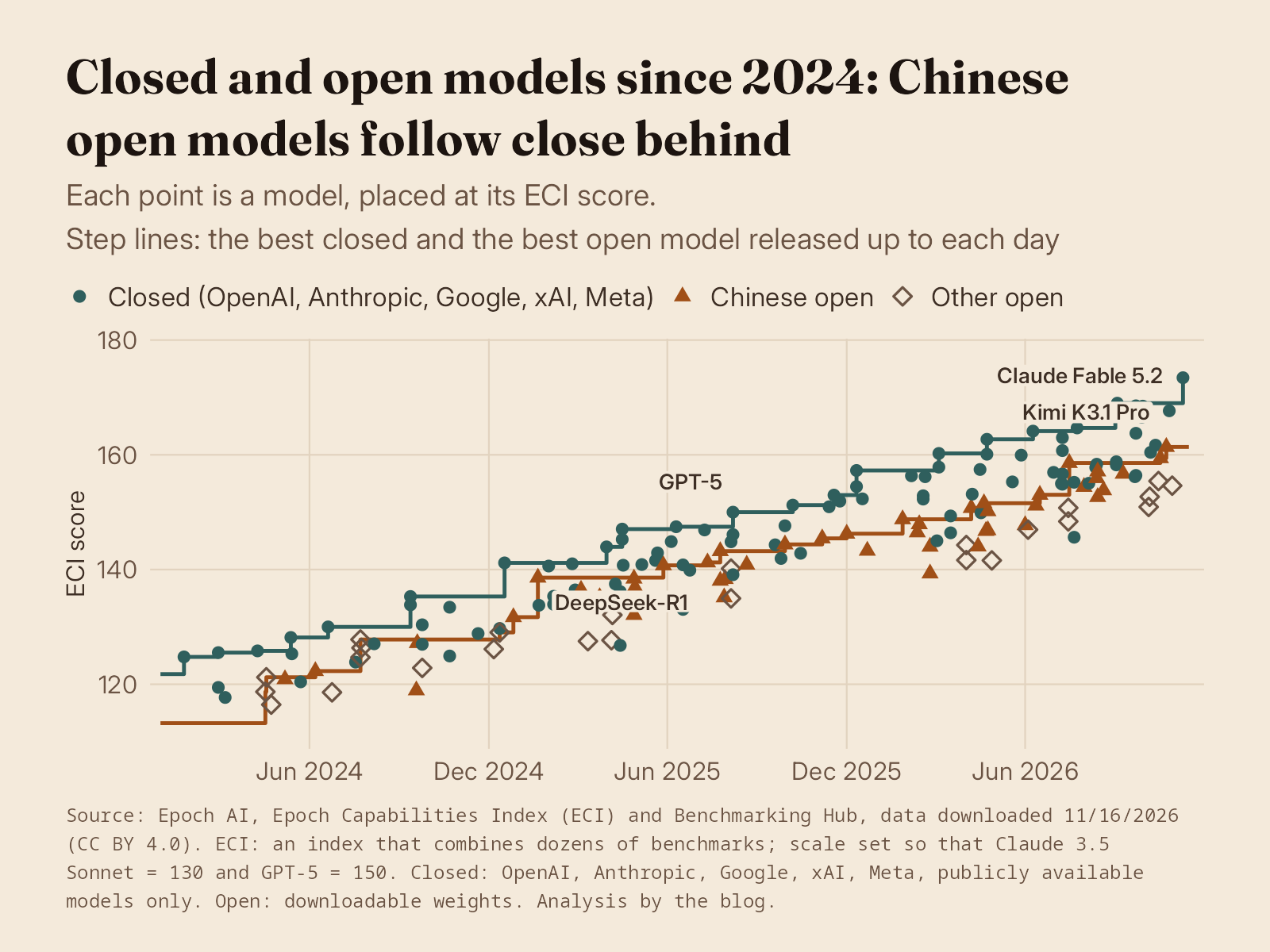
Closed and open models by release date and ECI score. Source: Epoch AI, data as of November 16, 2026.
A catch-up is counted like this: you take a closed-model record, that is, the highest score a closed model had reached up to that day, and look for the first open model that gets to the same point. The oldest catch-ups are almost all American: Meta’s Llama 3.1-405B, released on July 23, 2024, caught up with three of them in 3.4-5.9 months. Microsoft’s Phi-4 caught up with one in 7.0 months, and the very first, March 2023’s GPT-4, was taken by the Chinese Qwen2-72B after 14.8 months.
From June 2024 the story changes. The record Claude 3.5 Sonnet set on June 20, with 130 points, is reached by DeepSeek-V3 on December 26, 6.2 months later. The fastest chase is DeepSeek-R1’s: released on January 20, 2025, it caught up with OpenAI’s o1-mini, which scored 135.3 points when it came out on September 12, 2024, in 4.3 months. The slowest is Kimi K2.5’s, released on January 27, 2026, which reached o3 (April 16, 2025, 147.1 points) after 9.4 months.
In between are the other eight catch-ups, all between 6.0 and 8.0 months: you can find them one by one in the chart below. The closed-model records between June 2024 and March 2026 number eleven, and each was caught up with by an open model after 4.3-9.4 months.
The eleven catch-ups are the work of ten models, because Kimi K2.5 took two, o3 and o3-pro. The ten are all Chinese: three from DeepSeek, five from Moonshot, with its Kimi models, and two from Z.ai, with the GLM ones.
The later records are still waiting. GPT-5.5 Pro, released on April 23, 2026, scores 162.7 points; after it came Claude Fable 5, Claude Opus 5, Claude Fable 5.1, GPT-6 Astra, and Claude Fable 5.2, between June 9 and November 9, with scores from 164.1 to 173.4. That makes six records no open model has touched yet. The closest is the first: Kimi K3.1 Pro, with 161.4, reaches it in 17 of every 100 reconstructions of the scores that Epoch computes to account for uncertainty, but not in the central estimate.
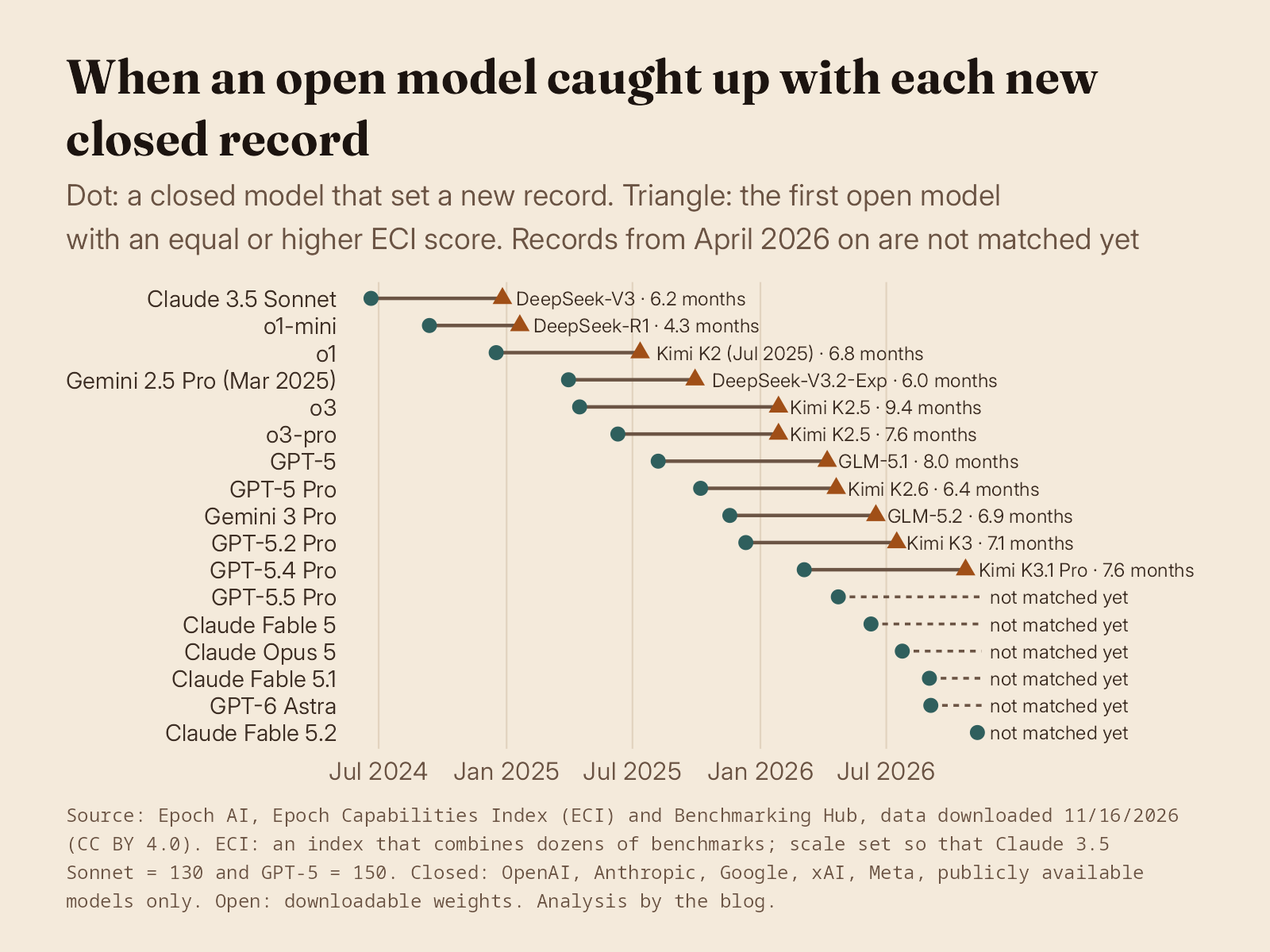
How many months an open model took to reach each closed-model record. Source: Epoch AI, ECI, data as of November 16, 2026.
## What is the average lag?
A catch-up is a single point on the calendar, and two or three lucky or unlucky dates are enough to change the impression. That is why you need an average that looks at every day.
The lag can be computed for every day. You take the best open model released up to then and look for when a top closed model already had the same score. The distance between the two dates, in months, is the lag. In the chart it climbs slowly, because the closed models stand still, and drops suddenly when an open model reaches a new level: it is a sawtooth.
The 2026 average is 6.5 months, with a range between 5.9 and 7.6 (nine times out of ten the value falls within it), obtained by redoing the calculation on each of the 500 reconstructions of the scores that Epoch makes available. In 2024 it was 8.4 months (from 5.1 to 9.3) and in 2025 4.7 (from 4.0 to 5.0): the gap had narrowed, then rose again. In that first year the lag reached almost 15 months; since 2025 it stays between 1 and 9.4.
There is a detail the number hides. In months the lag stays in the same order of magnitude, but in points it does not. The best closed model is ahead of the best open one by 6.9 points in June 2024, 9.5 in January 2025, 11.0 in January 2026, and 12.1 on November 15, 2026. The closed models climb faster, so six months of lag today are worth more points than six months in 2024. How much a point is worth over time is the weakest part of the calculation.
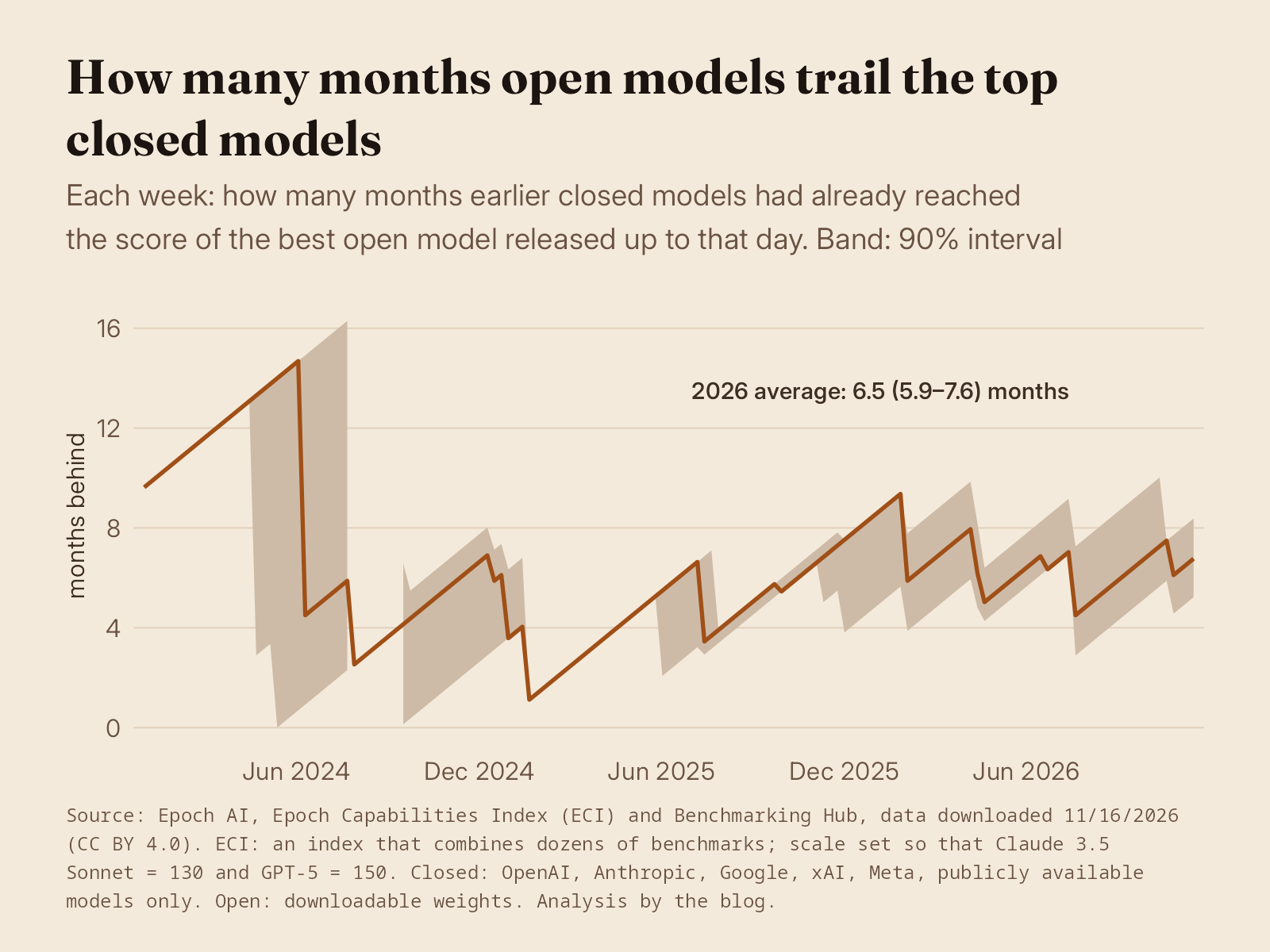
The lag of open models behind the top closed ones, in months. Source: analysis of Epoch AI (ECI) data as of November 16, 2026.
## What changes if the yardstick changes?
The right number, really, does not exist: there is a range, and it is worth seeing where it comes from. Six months, or four? In its study of May 29, 2026, Epoch writes 4 months with its rule, which counts an open model as “plausibly caught up” if it has at least a one-in-twenty chance of beating the closed one. If instead you require the open model’s central score to be higher, the months are 6: they are the two numbers of the same page. On its own window, from January 1 to May 28, with today’s data the two ways give 4.9 and 6.8. Almost a month of difference comes from the scores, which the institute recalculates with every update: the values on its May page are lower than today’s by 2.5-3.4 points for the top closed models and by less than 1 point for the best open ones. In any case the lag stands between about 5 and about 7 months: it is not 2 months and it is not a year.
Epoch’s earlier analysis, from October 2025 and covering the whole period since January 2023, saw about 3 months; the windows are different, so the two figures cannot be compared on equal terms.
The test chosen moves the result more. Taken alone, ARC-AGI-2, an abstract-reasoning test, gives a lag of 8.1 months in 2026; WebDev Arena, where people vote on websites generated by the models, gives 2.5. The order of magnitude holds, but “how many months” depends on what is measured, and the ECI sits in the middle.
Other choices do not shift the picture. Counting all closed models, including Qwen Max and Mistral Medium, still gives 6.5 months, because no closed model outside OpenAI, Anthropic, Google, xAI, and Meta, Chinese or European, has ever set a record. Without the open models under a non-commercial license, that is, Kimi K3, the lag rises to 7.2 months.
## Is the step behind a Chinese step?
The sharpest part concerns names. After Microsoft’s Phi-4, a record from December 12, 2024, every new record among open models bears the signature of a Chinese lab: DeepSeek, Alibaba with Qwen, Moonshot with Kimi, or Z.ai with GLM. The last 15 records, from DeepSeek-V3 to Kimi K3.1 Pro, are all Chinese, and 6 are Moonshot’s: more than the 5 Kimi models that caught up with a closed one, because not every open-model record reaches a closed-model record. The best American open model today is Meta’s Muse Spark Open, with 155.4 points, behind 6 Chinese open models.
Counting only open models from other countries (the United States, France, the United Kingdom, the United Arab Emirates), the 2026 lag rises to about a year: 12.5 months, with a range between 11.3 and 13.0. The step behind, in short, is a Chinese step; whoever is not Chinese and opens its weights falls one step further behind. The two-line chart shows it: with only the Chinese open models the lag since 2025 stays between 1 and 9.4 months, with only the open models of other countries it runs from 7 to 15.
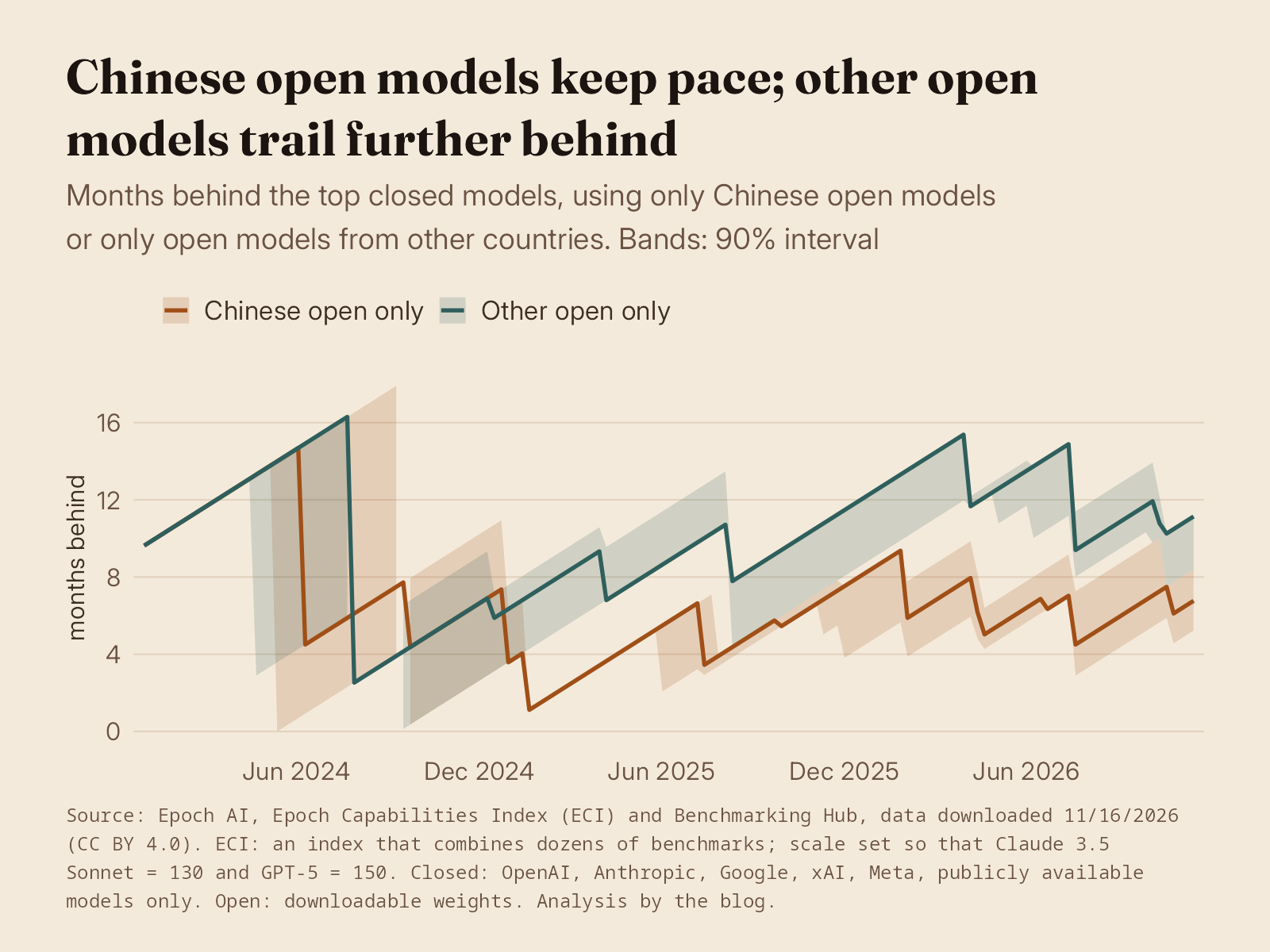
The lag computed with only Chinese open models or only the others. Source: analysis of Epoch AI (ECI) data as of November 16, 2026.
## What does the calendar not say?
The closed models may be further ahead than this: the index sees only models that have been released and measured, and a lab can keep better models in house, as Epoch acknowledges among its limits. The open ones, on the other hand, risk being overrated: according to the institute they do worse on private tests, perhaps because they are tuned to the public ones, and this makes the gap look smaller. The two effects go in opposite directions, and the final number blends them.
Scores change with every update of the index, by a few points (since May the top closed models have risen by 2.5-3.4). The lag, then, measures who has arrived and not who will arrive: the catch-up calendar stops in March 2026, and the records of the seven months after have not yet been reached by any open model. Four of the closed-model records are “Pro” versions from OpenAI, the costliest formula, with more computing per answer: the comparison does not account for it. Without them the 2026 average lag falls from 6.5 to about 5.9 months, a calculation on Epoch AI data. And “open” does not mean the model runs on a home computer, nor that the license allows every use: several top open models have usage limits, among them Kimi K3.1 Pro, GLM-5.3, and Muse Spark Open.
One question remains that the numbers do not settle: why do the Chinese chase so closely? The calendar does not say: it shows a correlation, not a cause.
Meanwhile one date is already marked. GPT-5.5 Pro came out on April 23, 2026, and as of November 16, 6.8 months have gone by without any open model reaching it: it is the next catch-up to watch, and it will tell whether six months remain the measure of the step.
## Frequently asked questions
How many months behind the closed models are the open ones?
According to Epoch AI’s ECI index, in 2026 the best open model has on average the level that the top closed models had 6.5 months earlier, with a range between 5.9 and 7.6. With the institute’s rule, which in its May 29, 2026 study gave 4 months, it comes out at 4.9; with other tests the lag runs from 2.5 to 8.1 months.
Which open models have caught up with the top closed ones?
According to Epoch AI’s data, after Microsoft’s Phi-4 (December 2024) all new records among open models belong to Chinese labs: DeepSeek, Alibaba (Qwen), Moonshot (Kimi), or Z.ai (GLM). Counting only open models from other countries, the 2026 lag rises to 12.5 months, with a range between 11.3 and 13.0.
Is an open model the same as an open-source model?
Not necessarily. Open means the weights, the numbers that make up the model, can be downloaded, under a free license, with usage limits, or non-commercial only. Several top open models have limits, among them Kimi K3.1 Pro, GLM-5.3, and Muse Spark Open, and Kimi K3 is non-commercial only.
What is Epoch AI’s ECI index, and where is the data?
A single score for each model, computed from dozens of standard tests with a statistical model that accounts for the difficulty of each. The scale has two fixed points: Claude 3.5 Sonnet is worth 130 and GPT-5 is worth 150. Epoch AI publishes scores and dates at epoch.ai under a CC BY 4.0 license, and describes the method in its documentation.
Why do the lag estimates range from 2.5 to 8.1 months?
Because it depends on what is measured. The ECI, which condenses dozens of tests, gives 6.5 months; ARC-AGI-2, an abstract-reasoning test, 8.1; WebDev Arena, where people vote on generated websites, 2.5. The order of magnitude stays the same; the scores, which Epoch AI updates, change by a few points with every update.
Why are Chinese models so close to the closed ones?
The calendar does not say: it shows a correlation, not a cause. It measures only the lag in months, with Epoch AI’s ECI index: after Phi-4 the new records among open models belong to Chinese labs, but the data do not explain why.
## Related reading
- [Let’s Do the Math on Revolut: What Does a Chinese AI Model Cost to Run In-House, and Would It Be Worth It for Us Too?](https://blog.sf-paris.dev/en/cost-of-running-glm-in-house-revolut-math/): GLM, one of the Chinese open models on the calendar, put to the test on costs.
- [Taking the brakes off a model like GLM-5.3 costs about $1,200, Anthropic estimates: who benefits?](https://blog.sf-paris.dev/en/abliterated-models-october-2026-flaws/): what happens when an open model like GLM-5.3 loses its safeguards, according to an Anthropic estimate.
## Sources
Data downloaded and pages accessed on November 16, 2026. The data are Epoch AI’s, reworked by the blog.
1. Epoch AI, Epoch Capabilities Index (ECI) and Benchmarking Hub, data package , downloaded November 16, 2026; CC BY 4.0 license (), data reworked by the blog. Primary.
2. Epoch AI, “Epoch Capabilities Index: methodology,” . Primary.
3. Jack Edwards and Luke Emberson, Epoch AI, “Open models lag state-of-the-art closed models by 4 months,” May 29, 2026. . Primary.
4. Luke Emberson, Epoch AI, “Open-weight models lag state-of-the-art by around 3 months on average,” October 30, 2025, accessed November 16, 2026. Primary.
5. ARC Prize, ARC-AGI-2, and WebDev Arena: results collected in Epoch AI’s data package (arc_agi_2_external.csv, webdev_arena_external.csv).