---
title: "According to Ember, Solar and Batteries Cost Up to 49% Less Than Gas: The Report’s Numbers, Assumption by Assumption"
url: "https://blog.sf-paris.dev/en/ember-italy-batteries-solar-gas-cost-report/"
lang: "en"
translations:
it: "https://blog.sf-paris.dev/ember-batterie-solare-gas-conti-rapporto/"
author: "Simone Flavio Paris"
published: "2026-11-28T07:00:00+00:00"
updated: "2026-11-27T08:06:12+00:00"
categories:
- "News"
tags:
- "Batteries"
- "Ember"
- "Energy storage"
- "MACSE"
- "Terna"
summary: "According to Ember, solar or wind stored in a battery costs €106-122 per MWh against €210 for gas in October 2026; the 49% saving is the solar result."
reading_time_minutes: 15
word_count: 3214
---
# According to Ember, Solar and Batteries Cost Up to 49% Less Than Gas: The Report’s Numbers, Assumption by Assumption
On November 26, Ember, together with Energy Square and Cleantech for Italy, wrote that solar and wind power shifted to the evening with a battery can cost up to 49% less in Italy than electricity produced with gas: €106 per megawatt-hour against €210. The title of the press release is “Stored solar and wind power could cost up to 49% less than gas power in Italy.” The 49% is the result with solar; with wind the saving is 42%.
A megawatt-hour (MWh) is a thousand kilowatt-hours (kWh), the unit you read on an electricity bill.
In brief
According to the report by Ember, Energy Square and Cleantech for Italy, published on November 26, solar or wind electricity stored in a battery and used in the evening costs €106-122 per megawatt-hour, against €210 for electricity produced with gas at October 2026 prices. The 49% saving is the result with solar and with a conservative charging price; with wind the saving is 42%. The calculation adds the price at which the battery charges (€57 with solar, €73 with wind) and about €49 for the cost of the battery itself. On MACSE, Italy’s mechanism for procuring electricity storage capacity, through which Terna, Italy’s grid operator, buys batteries at auction, the report writes that it “could cost Italian bill payers nothing,” but for the first auction only, and only if the price gap stays at 2026 levels, if the price of Terna’s contracts reflects it, and if every battery completes at least 200 cycles a year. According to pv magazine, which cites Terna’s results, the second auction, on November 24, awarded 16 gigawatt-hours at an average price 12% lower than the first.
## Who wrote the report, and what does it compare?
Ember describes itself as an independent think tank that aims to accelerate the clean energy transition; Energy Square as a think tank that brings together research, business, finance and institutions on Italy’s energy future; Cleantech for Italy as a coalition of innovators, investors and research institutions that promotes industrial policies for Italian leadership in clean technology. The conclusions call for more renewables, more batteries and a national plan for storage.
The comparison is between two production costs. On one side is the energy of a typical gas plant, which in the report costs on average €210 per megawatt-hour at October 2026 gas prices. On the other is the energy of a solar or wind plant, charged into a battery when it is cheap and returned when it is expensive. It is not the price on the bill, which includes other items.
During the day, with the sun, wholesale electricity is cheap. In the evening, when solar fades and demand rises, it is expensive: according to the report, Italy still runs its evenings on gas, the most expensive way to produce electricity. A battery buys in the cheap hours and sells in the expensive ones, and with more batteries the gap between the two prices narrows.
## How does the report get to €106 and €122?
The cost of energy that passes through a battery has two parts. The first is the price at which the battery buys the power to charge. The report estimates it from the results of the 2025 FER X auctions, in which renewable plants won a price fixed at auction: on average €57 per megawatt-hour for solar and €73 for wind.
The second part is the cost of shifting that energy in time, which Ember calls the levelized cost of storage: how much it costs, on average, for each megawatt-hour the battery charges and then returns, taking into account what the battery cost and how hard it works. The report calculates it with a calculator published by Ember. There are two assumptions: the battery is used at 90% and has an investment cost of $120 per kilowatt-hour. The report says this is equivalent to the results of the first MACSE auction, the one in which Terna, Italy’s grid operator, bought batteries, published in October 2025. A 90% utilization, if it means one full cycle on 90% of days, amounts to about 330 cycles a year, while the MACSE calculation assumes 200. The result is about €49 per megawatt-hour.
The rest is an addition. With solar, 57 plus 49 makes 106; with wind, 73 plus 49 makes 122. Compared with the 210 for gas, 106 is 49.5% less and 122 is 41.9% less; the report writes “up to 49%.” “Up to” is the result with solar: with wind the saving is 42%. The press release writes “on average up to 49%.” The charging price is “conservative” and, in the methodology, an “upper-bound” estimate, that is, a ceiling: if the battery charged at a lower price, the cost would be lower.
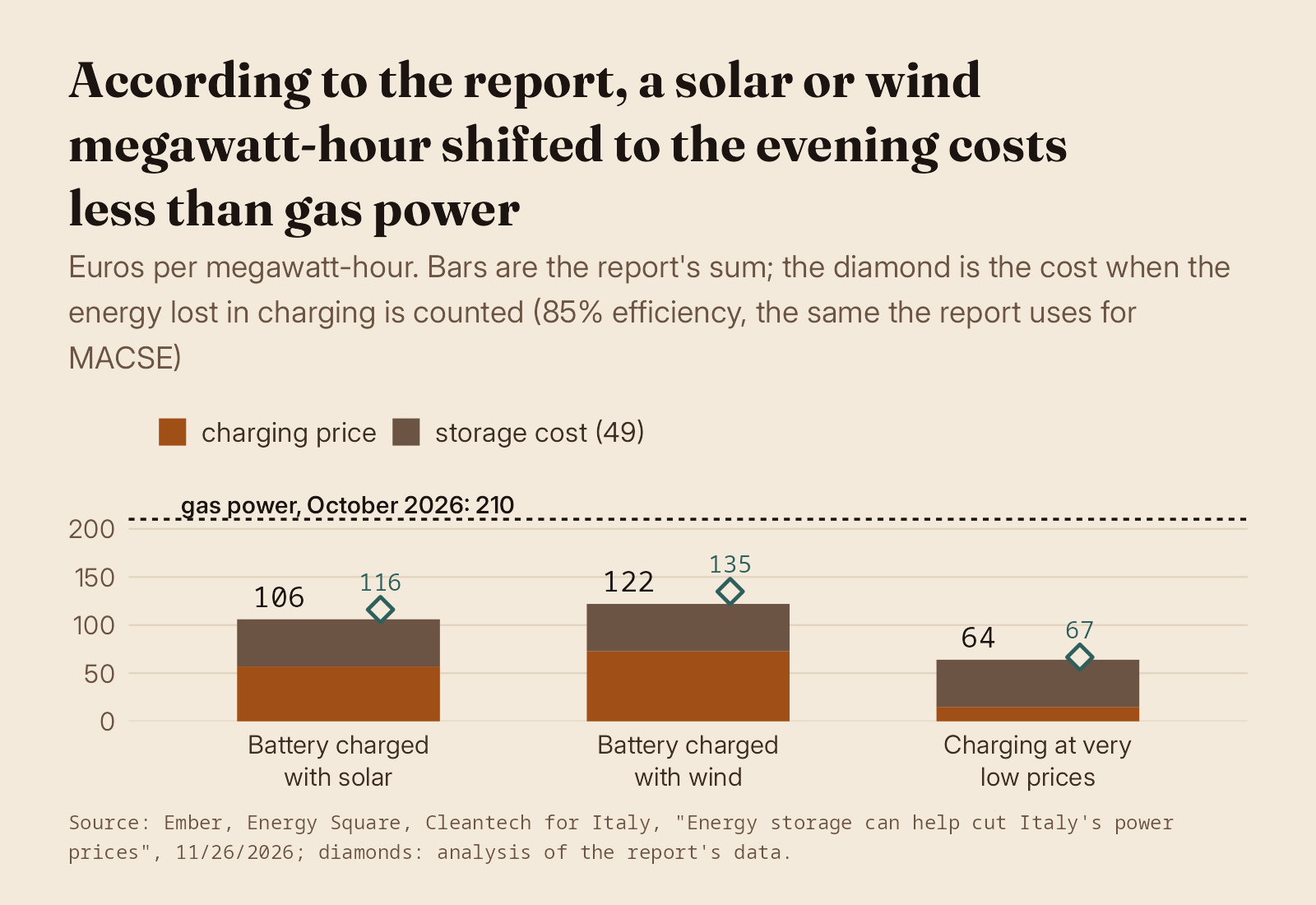
The cost of a solar or wind megawatt-hour shifted to the evening according to the report, against 210 euros for gas power in October 2026; the diamonds count the energy lost in charging, in an analysis of the report’s data that holds only if the 49 euros do not already include it. Source: Ember, Energy Square, Cleantech for Italy, November 26, 2026; analysis of the report’s data.
## What happens if an assumption changes?
The report calls the charging price of €57-73 “conservative,” and explains why: in hours with a lot of sun, the wholesale price of electricity in Italy can fall below €20. In those hours, it writes, solar or wind shifted to the evening could cost “as low as €64/MWh.” Subtracting the 49 for storage leaves about 15 euros of charging price, and 64 euros is 30.5% of the 210 for gas: the saving would be about 70%.
With the 85% efficiency the report uses for MACSE, that is, also counting the energy lost in charging, the shifted megawatt-hour would cost €116 with solar and €135 with wind, and the saving compared with gas would fall to 45% and 36%. This is an analysis of the report’s numbers, and it holds only if the €49 for storage does not already include these losses.
The assumptions can also move the other way. Every extra 10 euros on the charging price or on the cost of storage adds 10 euros to a cost of 106-122, and takes about 4.8 percentage points off the saving compared with gas (10 divided by 210). The price of gas matters too: the 210 euros are October 2026’s. If electricity produced with gas fell to €122 per megawatt-hour, that is, 42% below today’s price, the battery powered by wind would have no advantage left.
The report adds two conditions for bringing wholesale prices down. Solar and wind must keep growing: without energy to shift, batteries are of little use. And battery operators must compete with one another, including with projects that sell on the market without public contracts.
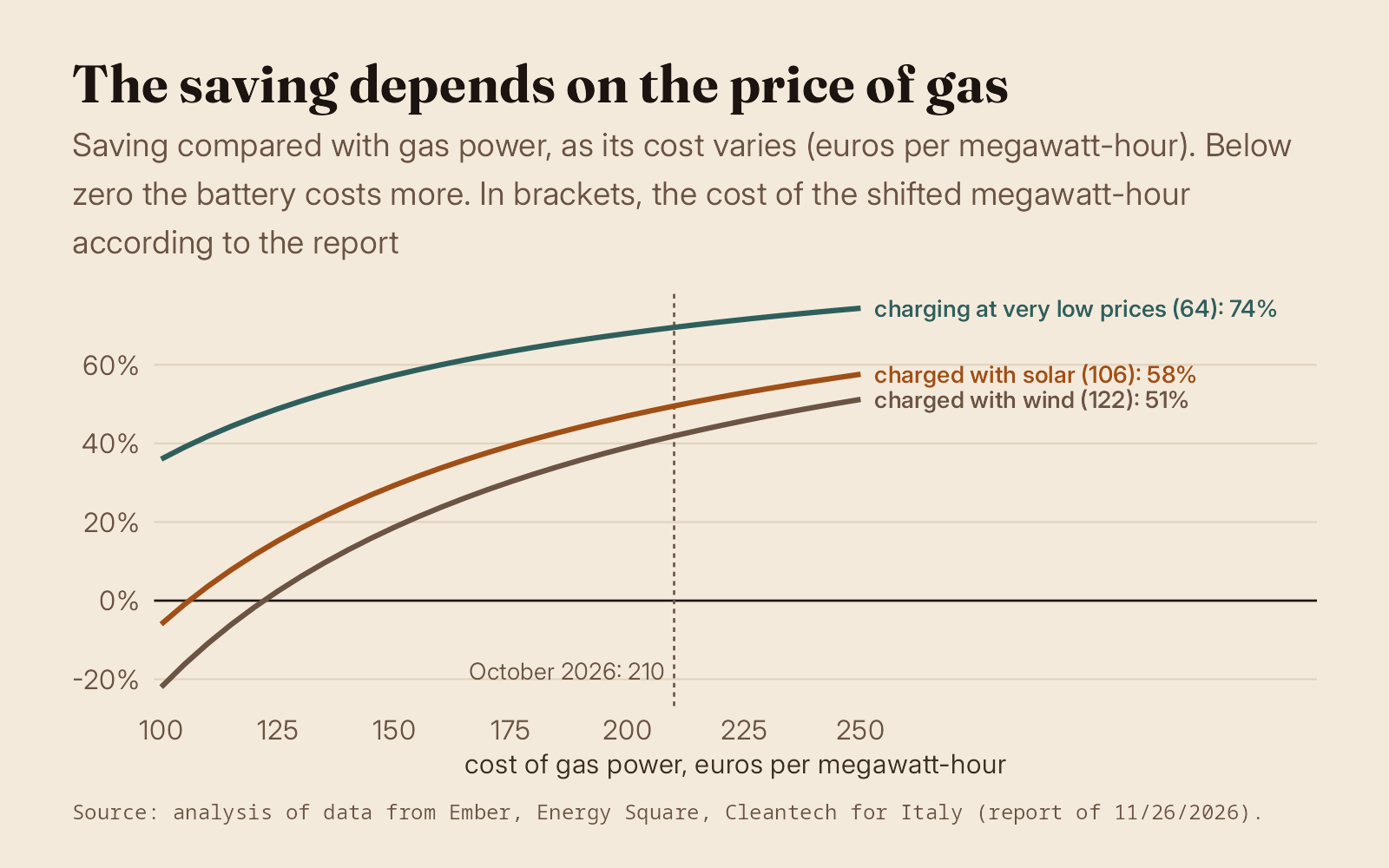
The saving compared with gas depends on the cost of gas power: below 106 euros per megawatt-hour a battery charged with solar no longer pays off. Analysis of data from Ember, Energy Square and Cleantech for Italy.
## What is MACSE?
MACSE stands for Meccanismo di Approvvigionamento di Capacità di Stoccaggio Elettrico (Italy’s mechanism for procuring electricity storage capacity). It is the system through which Terna, Italy’s grid operator, buys storage capacity at auction. Anyone who wants to build a battery can take part. A winner receives a fixed premium every year, in euros per megawatt-hour of capacity per year, in exchange for building it and making it available to the grid.
Terna pools the capacity of all the winning batteries and resells it through time-shifting contracts, open to any producer or trader: a solar plant can thus shift its output to the evening without owning a battery. What is not sold this way goes to the grid’s balancing services. With the revenue from the contracts, plus 80% of that from grid services, Terna covers the premium. If that revenue is not enough, the difference ends up in a levy on electricity bills, inside the dispatching charges. These are the bill items that cover the service Terna uses to keep the energy fed into the grid and the energy drawn from it in balance at every moment.
The first auction was held on September 30, 2025: Terna awarded 10 gigawatt-hours (GWh, a thousand megawatt-hours) for 2028, all the capacity it sought, with bids more than four times the capacity sought. The weighted average price was about €13,000 per megawatt-hour per year, a third of the €37,000 cap. For the grid the premium is a certain cost, while the revenue depends on the market: that is why the question of whether MACSE costs consumers anything has no single answer, and the report ties it to precise conditions.
## When could MACSE cost nothing, according to the report?
The report writes that MACSE “could cost Italian bill payers nothing.” The report’s summary speaks of “auctions” in the plural; the calculation covers only the first. The statement holds only if three things stay true: the price gap between sunny hours and the other hours stays at 2026 levels; the price of the time-shifting contracts that Terna sells reflects that gap; and batteries complete at least 200 cycles a year, that is, 200 full charges and discharges.
The report considers the threshold “very reasonable”: a four-hour battery averages 1.2 cycles a day, about 440 a year, and an eight-hour one a cycle a day; 200 is less than half of 440. The calculation rests, however, on precise assumptions: an 85% efficiency between energy charged and returned, and a battery that catches the most expensive and the cheapest hours every day, that is, one that operates with what the report calls “perfect foresight.” The daily gap is the difference between the average price of the seven most expensive hours and that of the seven cheapest: in 2024 it was about €46 per megawatt-hour and in 2025 about €48.
The calculation covers the first auction. The second came after, and the report’s page, published on November 26, still speaks of it in the future: if it is fully subscribed, it will bring a capacity equal to double that of July 2026. The press release of the same day notes that the auction was held on November 24.
According to pv magazine, a magazine about photovoltaics, which cites Terna’s results, all 16 GWh put up for the 2029 auction were awarded on November 24. The weighted average price is €11,382 per megawatt-hour per year, against the €12,959 of the first auction: 12% less, and well below the €27,000 cap. Bids came to about 43 GWh, almost three times the need.
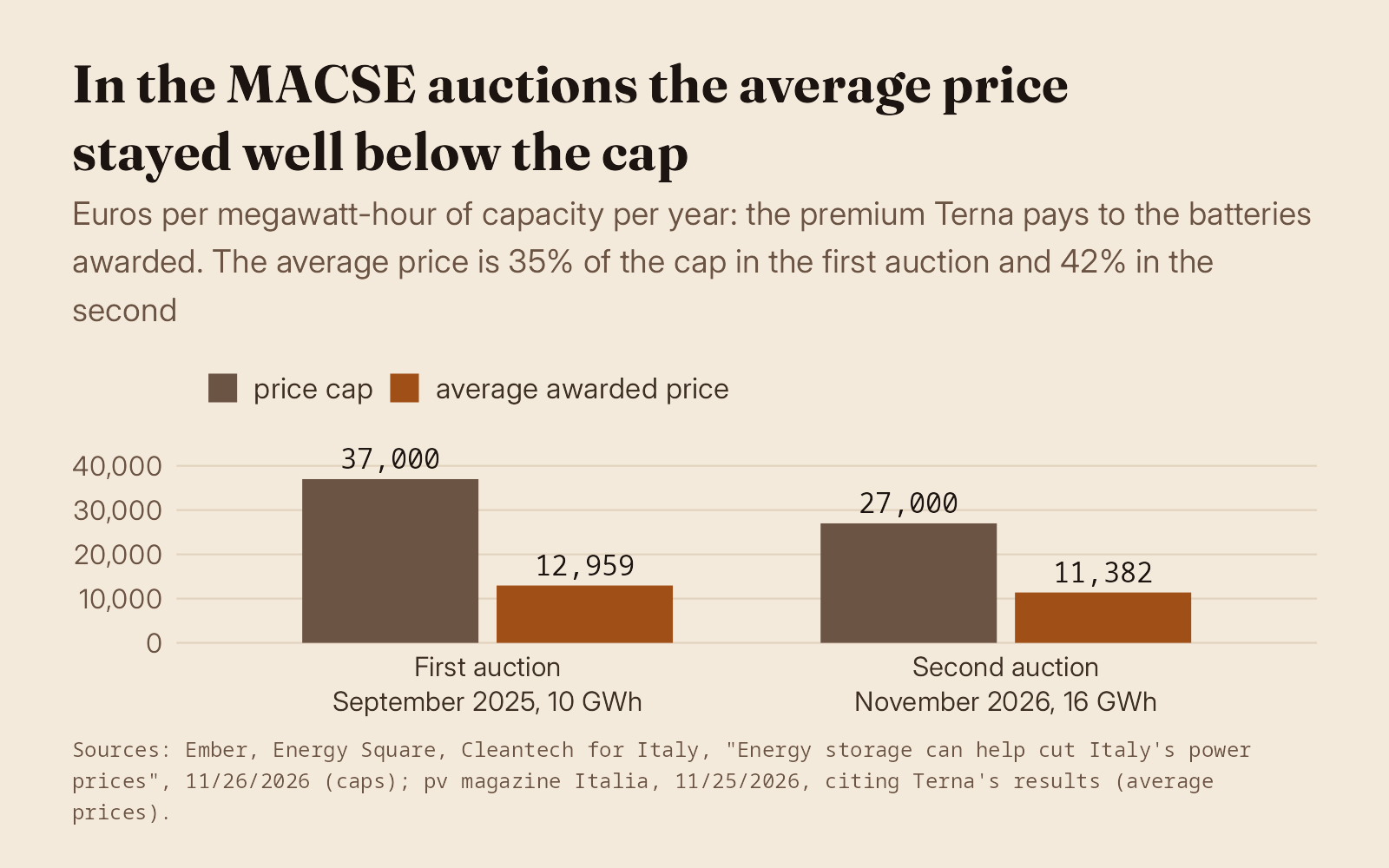
Average awarded price and cap in the two MACSE auctions: 35% of the cap in the first, 42% in the second. Sources: Ember for the caps; pv magazine, citing Terna’s results, for the prices.
## How much do batteries weigh today, and how many are needed?
In the first half of 2026, batteries met on average 2.8% of demand in the evening peak hours, more than double the 1.3% of the same period in 2025. In the same hours, according to the report, the share of fossil fuels is still around 40%.
In June 2026 Italy had 919,000 battery installations: 11 GWh of small systems, often residential, and 7 GWh of batteries connected to the grid, of which more than 85% belong to Enel. With the two MACSE auctions and the capacity market, the report forecasts at least 38 GWh of grid batteries by 2029. Terna and Snam, the operator of Italy’s national gas network, estimate that by 2035 between 76 and 96 GWh will be needed, and up to 134 GWh with gas prices around €32 per megawatt-hour.
To show what can happen, the report gives two examples. Bulgaria went from almost no batteries in 2024 to 16 GWh in August 2026. In the first half of 2026 batteries routinely supplied more than a quarter of demand at 8 p.m. (28%), against 4% a year earlier, and the share of fossil fuels at the evening peak fell from 35% to 31%.
In Australia, in the third quarter of 2026, the energy shifted by grid batteries more than tripled in a year. Batteries set the price in 48% of intervals, against 18%, and the average wholesale price fell by 27%: a drop to which, according to the report, storage contributed.
Italy, the report writes, can follow that path under two conditions: more solar and wind, and real competition among those who run the batteries. The authors also call for a national storage plan, with an auction calendar that extends beyond 2030, capacity market rules that do not penalize batteries, and faster grid connections.
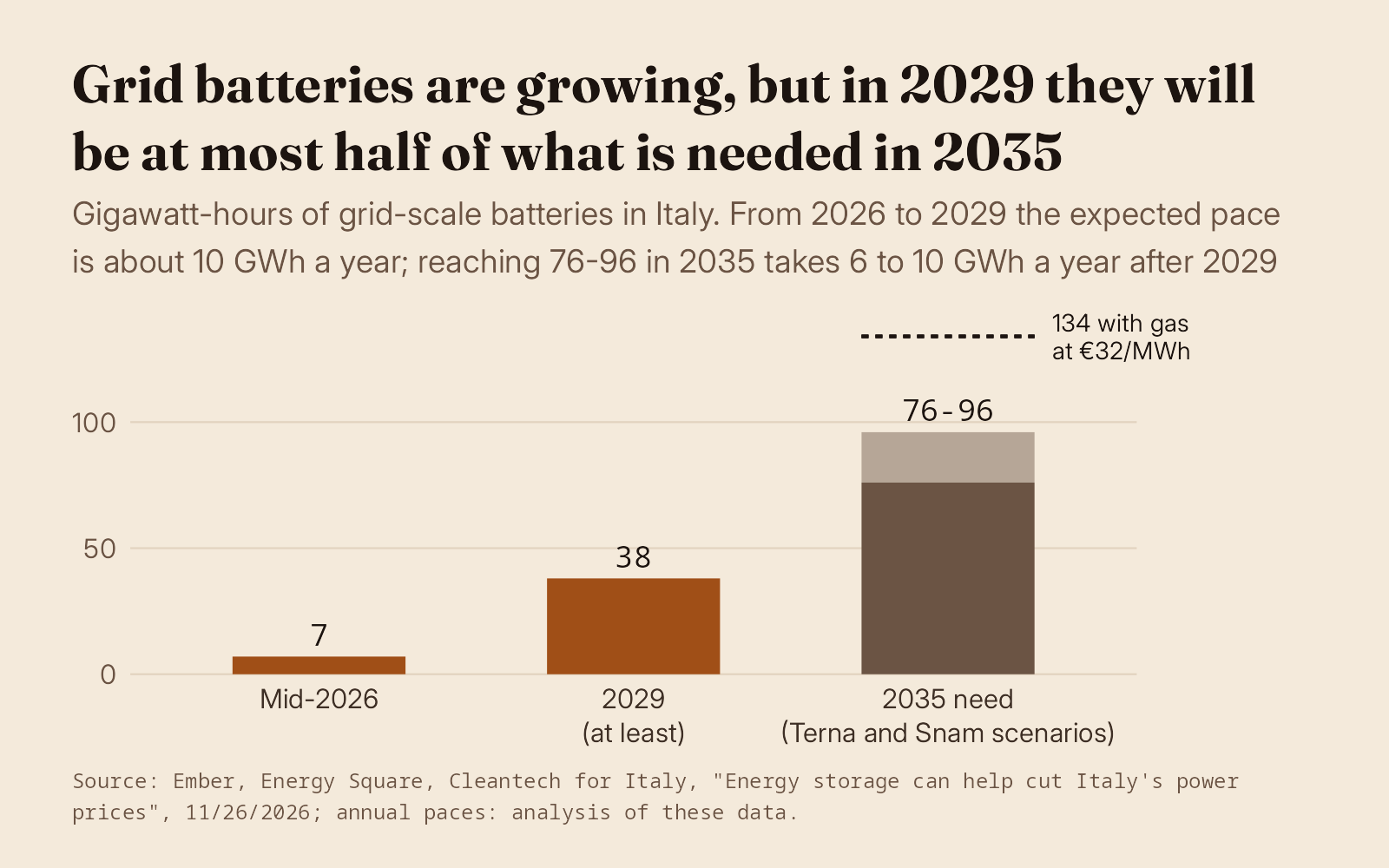
Grid-scale batteries in Italy and the 2035 need according to Terna and Snam’s scenarios. Source: Ember, Energy Square, Cleantech for Italy, November 26, 2026.
## Who builds the batteries?
More than 90% of the stationary storage installed worldwide in 2025 uses a type of lithium battery, lithium iron phosphate, and China produces more than 98% of the cells of this type. MACSE sets no origin requirements, and the batteries awarded in the auctions rely largely on Chinese cells, because they cost less.
Then there is Italian production. The factories planned at Teverola, by Seri Industrial, and at Brindisi, by Eni together with the same company, could reach 16 GWh of cells a year by 2030. That is more than the 11 GWh of storage that, on average, Italy is expected to add each year under Terna and Snam’s scenario. The report says that predictable orders would be needed: a multi-year auction calendar and guaranteed purchases.
## What does the report not say?
It says what it costs to produce a megawatt-hour, not what a household will pay: between the production cost and the bill there are other items, and the report does not estimate the saving on the bill. The assumptions on battery cost are those of the first auction, of October 2025, and the charging price is the average value of 2025 contracts. The 210 euros for gas are one month, October 2026.
The MACSE estimate is the report’s own: the 2026 price gaps and the 200-cycle threshold come out of its calculations, and the reference is a single battery from the first auction under 2026 market conditions. The 2026 gap is calculated on the first nine months of the year, and the calculation applies to the Center-South and South zones, where much of the first auction was awarded. None of the three sources recalculates the report’s numbers: the €49 for storage and the 200-cycle threshold are its own. None of this contradicts the 49%. It puts it in context: it is the result with solar and a conservative charging price, in a range that reaches 42% with wind and that rises if the charging price falls, with declared assumptions and a gas price that can change.
One question the numbers do not close: how much of the advantage, if there is one, reaches those who pay the bill, and not those who own the batteries. The batteries of the first MACSE auction come into operation in 2028: then it will be clear whether they really complete at least 200 cycles a year, and whether the difference between the sunny hours and the evening hours is still that of 2026.
## Frequently asked questions
Does solar with batteries really cost 49% less than gas?
According to the report by Ember, Energy Square and Cleantech for Italy, up to 49% less: €106 per megawatt-hour against €210 for electricity produced with gas at October 2026 prices. It is the result with solar and with the report’s conservative charging price (€57); with wind the costs are €122 and the saving is 42%. With the lowest charging price the report cites, €64 in all, the saving would be larger.
How does the report get to €106 and €122?
The report adds the price at which the battery charges, €57 per megawatt-hour for solar and €73 for wind, and about €49 for the cost of storage, calculated with a 90% utilization and with an investment cost that the report says is equivalent to the results of the first MACSE auction, published in October 2025: $120 per kilowatt-hour.
Does MACSE cost anything to those who pay the electricity bill?
The report writes that MACSE, for the first auction, could cost nothing, if three things stay true: the price gaps stay at 2026 levels, the price of Terna’s contracts reflects them, and batteries do at least 200 cycles a year. If Terna’s revenue is not enough to cover the premiums, the difference goes into a levy on bills.
What happened in the second MACSE auction?
According to pv magazine, which cites Terna’s results, on November 24 all 16 GWh put up for 2029 were awarded, at a weighted average price of €11,382 per megawatt-hour per year, 12% less than the first auction. Ember’s report, published on November 26, still speaks of it in the future.
How many batteries are there in Italy today, according to the report?
In June 2026, according to Ember’s report, Italy had 919,000 battery installations: 11 GWh of small systems, often residential, and 7 GWh connected to the grid. The report forecasts at least 38 GWh of grid batteries by 2029, while Terna and Snam estimate a need of between 76 and 96 GWh in 2035.
Who wrote the report on batteries?
Ember, Energy Square and Cleantech for Italy. Ember describes itself as an independent energy think tank that aims to accelerate the clean energy transition; Energy Square as a think tank on Italy’s energy future; Cleantech for Italy as a coalition that promotes industrial policies for clean technology. The conclusions call for more renewables, more storage and a national plan.
## Read Also
- [But Why Do We Italians Pay So Much for Energy?](https://blog.sf-paris.dev/en/why-italy-electricity-costs-more-than-europe/): what the price of electricity in Italy is made of, and how it compares with Europe.
- [Solar PV in Italy: 2030 Is Close to Today’s Pace](https://blog.sf-paris.dev/en/italy-solar-pv-2030-target-yearly-pace/): how much solar Italy installs and how much it would take to reach the 2030 target.
- [Italy’s budget and energy: where the MASE’s €14 billion comes from](https://blog.sf-paris.dev/en/italy-energy-14-billion-mase-budget-2027/): the funds of the Ministry of the Environment and Energy Security for energy, and where they come from.
## Sources
Accessed November 27, 2026. Each source is marked primary (whoever produces the analysis) or secondary (whoever reports it).
- Ember, Energy Square, Cleantech for Italy, “Energy storage can help cut Italy’s power prices,” November 26, 2026. Primary (the three organizations are interested parties); the PDFs were not read, the page with the text and the methodology was. https://ember-energy.org/latest-insights/energy-storage-can-help-cut-italys-power-prices
- Ember, press release “Stored solar and wind power could cost up to 49% less than gas power in Italy,” November 26, 2026. Primary. https://ember-energy.org/latest-updates/stored-solar-and-wind-power-could-cost-up-to-49-less-than-gas-power-in-italy
- pv magazine Italia, Sergio Matalucci, “Macse 2029, assegnati 16 GWh di BESS: prezzo medio scende del 12% rispetto alla prima asta” \[“MACSE 2029, 16 GWh of BESS awarded: average price falls 12% from the first auction”\], November 25, 2026. Secondary; it cites Terna’s results, which were not read. https://www.pv-magazine.it/2026/11/25/macse-2029-assegnati-16-gwh-di-bess-prezzo-medio-scende-del-12-rispetto-alla-prima-asta/
The report also exists in Italian; the quotations here are from the English original. The divisions behind the 49.5%, the 41.9%, the 70% and the 4.8 points per 10 euros, the costs of €116 and €135 with charging losses, and the roughly 330 cycles are calculations on the report’s numbers.