
Yesterday a press conference was held in the Auditorium of the Gestore dei Servizi Energetici (GSE) in Rome, where Minister Pichetto shared the National Strategy, which sets the goal of “Net Zero” by 2050.
Italy seems determined to carve out a leading role in the renewable energy landscape, focusing in particular on hydrogen as a strategic energy carrier for the future.
The strategic role of hydrogen
The Italian strategy recognizes hydrogen as a key element for decarbonizing sectors that are hard to electrify, such as heavy transport, shipping and aviation. With its ability to store energy and transport it over long distances at competitive costs, hydrogen represents a complementary solution to renewable sources, which suffer from some intermittency.
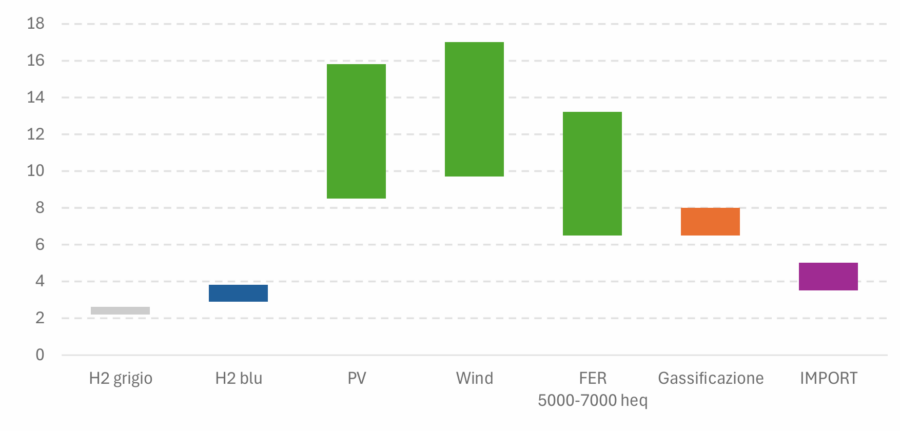
Note that hydrogen can mainly be divided into five categories, which are not official but are increasingly used:
- Green hydrogen: produced through water electrolysis powered by renewable energy (photovoltaic, wind, hydroelectric, etc.)
- Blue hydrogen: derived from natural gas with CO₂ capture, utilization and storage (CCUS). It could be considered as a transitional option, but Italy does not seem to have a large geological CO₂ storage capacity.
- Gray hydrogen: produced from fossil sources without CO₂ capture. The most polluting, and therefore not a viable choice in a “green” context.
- Pink hydrogen: produced from nuclear sources.
- White hydrogen: of geological origin.
Currently, however, the national landscape is dominated by gray hydrogen, produced mainly through industrial processes such as Steam Methane Reforming (SMR) without CO₂ capture. This type of hydrogen is used mainly in refineries and in the production of ammonia for fertilizers. The transition toward low-emission hydrogen, whether blue or green, is one of the main goals of the plan.

Innovations and synergies
Ammonia (NH3) is emerging as a particularly interesting alternative in the Italian context. This compound, obtained by combining green hydrogen and atmospheric nitrogen through the Haber-Bosch process, offers significant advantages over pure hydrogen, both in terms of energy density and logistics. Indeed, ammonia:
- Is easier to store and transport: it liquefies at higher temperatures (−33 °C compared with −253 °C for liquid hydrogen), reducing energy consumption during these phases, and it has established transport infrastructure (such as ammonia tankers).
- Is chemically stable: difficult to ignite and easier to store than pure hydrogen.
- Avoids the boil-off problem: while liquid hydrogen tends to evaporate over time, ammonia maintains greater stability.
- Has direct industrial applications: besides serving as an energy carrier, it is used without further transformation to produce fertilizers.
Tools and outlook
Italy has deployed a varied portfolio of tools, funded through the PNRR, to support the development of the hydrogen supply chain. These include:
- Projects for Hydrogen Valleys, pilot areas for the local development of hydrogen.
- Initiatives in rail and road transport, aimed at introducing alternative fuels.
- Production of electrolyzers, essential for green hydrogen.
- Support for research and development to accelerate innovation.
In addition, emphasis is placed on the synergy between hydrogen and CCS technologies, which could broaden decarbonization opportunities, including through low-carbon hydrogen.
The future of hydrogen in Italy
Among the strategy’s flagship projects, the Southern Hydrogen Corridor stands out: an international infrastructure project that will position Italy as a European hub for hydrogen. This project will facilitate import flows, strengthening energy cooperation in the Mediterranean and beyond.
In a world increasingly oriented toward sustainability, the vision outlined by Italy fits into a framework of international cooperation and technological innovation. It remains to be seen how these ambitions will take shape in the coming years, turning hydrogen from a promise into a pillar of the energy transition.