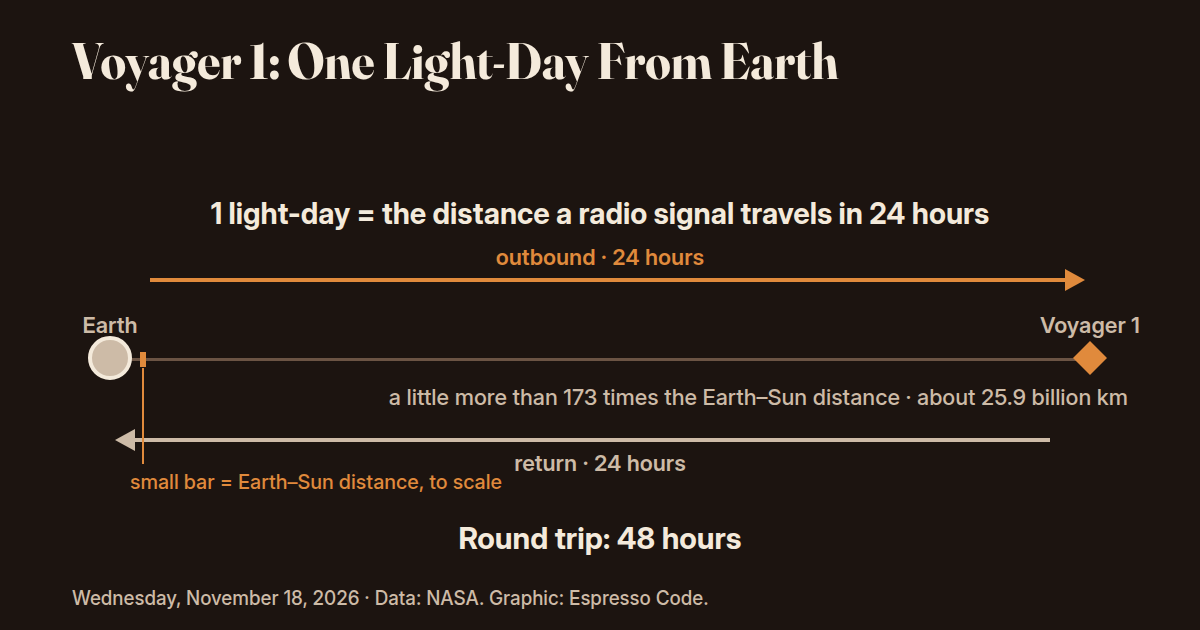
How far away is Voyager 1? So far that from Wednesday, November 18, a message sent to the probe will take twenty-four hours to arrive, and another twenty-four for us to hear the reply.
That is the distance of one light-day, the distance that light, and a radio signal with it, covers in a full day. It is a milestone of round numbers, and NASA is celebrating it with an invitation to everyone; but behind the figure there is a probe launched in 1977 with ten instruments, of which only two are still on.
In short: One light-day is about 25.9 billion kilometers, and on November 18 Voyager 1 reaches that distance from Earth. Two of its ten instruments are still on, and NASA, in the conditional, speaks of contact through about 2036. For NASA, moreover, the probe is in interstellar space but has not left the solar system.
What “one light-day” means
One light-day is the distance light travels in twenty-four hours: about 25.9 billion kilometers, a little more than 173 times the distance between Earth and the Sun.
To feel it you need comparisons, and NASA supplies them. Light reaches us from the Moon in 1.3 seconds, while the Artemis II astronauts took about three days to get there. From the Sun it takes about eight minutes, and to Neptune, the farthest planet, about four hours.
A radio signal travels at the speed of light, so sending a command and receiving the reply takes about 48 hours. “If you want to say ‘hello’ to Voyager,” says Suzanne Dodd, the project manager at JPL, NASA’s laboratory in California, “you send your message and then you go home and you wait two days before you finally get a response.”
NASA gives the milestone as Wednesday, November 18, at 5:16 a.m. on the U.S. East Coast, which is 11:16 a.m. in Italy. The probe will not feel any change: the milestone’s significance, NASA writes, lies in showing how vast the universe is and how enduring humanity’s most distant explorer is.
Since 1998, after overtaking Pioneer 10, it has been the farthest human-built object from Earth, writes Science News.
And where is it headed? Voyager 1 is aimed at Gliese 445, an obscure star in Ursa Minor more than 17 light-years away: it will pass within about 1.7 light-years of it in 40,000 years.
What still works aboard
The mission launched in 1977 with ten science instruments, some turned off after the planetary encounters and others left on to study the edges of the heliosphere.
According to NASA’s table, two are still on: one measures the magnetic field, the other listens to the vibrations of an electrified gas. The other eight are off: the cameras since 1990 and, to save power, two more instruments, one in February 2025 and one in April 2026.
Power is the constraint: the generator that supplies the probe draws electricity from the heat of decaying plutonium, and produces 4 watts less every year.
The voice is faint, too. According to PopSci, the radio transmitter has 23 watts, about as much as a small refrigerator lightbulb. Only the 70-meter-wide antennas of NASA’s network can hear so faint a signal: without them, the probe would have fallen silent years ago.
The cameras’ last shot was, on February 14, 1990, the “Solar System Family Portrait”: the Sun and the planets seen from outside. Then they were turned off to save power and memory. They could be turned back on, but it is not a priority: it is very dark out there, and with the cameras you would see only some of the brighter stars and planets, which are better seen from Earth with an amateur telescope.
And in October there were two pieces of news. JPL reported that on October 18 and 19 the antenna network was unable to detect the probe’s signal. The signal came back on October 20 and contact has been continuous since.
The cause is still being investigated: so far the engineers have determined that one group of thrusters went offline and their backups turned on. For Kareem Badaruddin, the mission manager at JPL, it is the first time the probe has behaved this way, “but we are also at a point in the mission where we have to expect the unexpected.”
Before that, in early September, the engineers had replaced three devices with lower-power alternatives, in an operation called “Big Bang.” The swaps had to happen all together: the devices help keep the probe warm enough in the cold of space, and only by swapping all three could the power use be reduced without unbalancing the heat.
How long will we be able to listen?
NASA answers in the conditional: the two probes could remain within range of the antenna network through about 2036, depending on the power they will have left to transmit. Even when science data are no longer collected, engineering data could keep arriving for several more years.
PopSci reports NASA’s estimate as a date: the network will lose contact with Voyager 1 around 2036.
Science News, by contrast, speaks of ten or fifteen years before the power sources run out.
The nearest threshold is another: without the September operation, another instrument would have been shut off as early as summer 2027.
Inside or outside the solar system
One point changes the idea many people have. The astronomy site EarthSky writes that Voyager 1 has left the solar system.
By the scientific definition cited by NASA, that is not so: the solar system also includes the very distant Oort cloud, whose inner edge the probe will reach in about 300 years.
What Voyager 1 crossed on August 25, 2012, is the heliosphere, the bubble of solar wind around the Sun: interstellar space begins there, but that does not mean having left the solar system.
The confusion, moreover, is NASA’s too. One of its pages, “What Is a Light-Day?”, writes that the probe left the solar system and became the first to enter interstellar space; its frequently asked questions say instead that it has not left it.
Voyager 1 reached interstellar space in 2012, Voyager 2, on a different trajectory, in 2018.
What you can do on November 17 and 19
On Tuesday, November 17, after sunset, NASA invites everyone to “Shine Bright for Voyager’s Light-Day”: a symbolic wave of golden light around the planet. On NASA’s website, smartphones and tablets can flash “VGR” in Morse code, and people are invited to share photos or videos. The time is that of sunset in each place.
On Thursday, November 19, at 6:00 p.m. Italian time, there is a discussion with members of the mission, live from JPL; where to watch is listed at nasa.gov/live.
To see where the probe is at this moment, NASA offers the interactive tool “Eyes on the Solar System.”
For its twin, Voyager 2, the light-day will come in November 2035. The two probes set out thanks to an alignment of the planets that NASA says recurs once every 176 years: for the next one you have to wait for the 2150s.
One light-day is just a round number: the real news is that, 25.9 billion kilometers away, two instruments out of ten are still talking to us.
Frequently asked questions
How many kilometers is one light-day?
According to NASA, about 25.9 billion kilometers: the distance light travels in 24 hours, a little more than 173 times that between Earth and the Sun.
What time will Voyager 1 be one light-day from Earth?
Wednesday, November 18, 2026, at 11:16 a.m. in Italy, 5:16 a.m. on the U.S. East Coast. A signal takes a day to arrive, so a command and its reply take about 48 hours.
Has Voyager 1 left the solar system?
By the scientific definition cited by NASA, no: the solar system includes the Oort cloud, whose inner edge the probe will reach in about 300 years. It has, however, crossed the heliosphere, and so it has been in interstellar space since August 25, 2012.
Which Voyager 1 instruments still work?
Two of ten: one measures the magnetic field, the other listens to the vibrations of an electrified gas. The other eight are off.
Methodology note
NASA pages read on November 11, 2026: the November 10 release, “What Is a Light-Day?”, “Where Are Voyager 1 and Voyager 2 Now?”, the frequently asked questions, the JPL release and the October 29 blog post. NASA gives 5:16:07 a.m. EST; the Italian time is a calculation (EST = UTC−5, Italy = UTC+1), like the 173 astronomical units in one light-day and the 48 hours. The distance is 25,902,068,356 kilometers on the November 10 page and 25.89 billion in the October 29 release. JPL Horizons ephemerides confirm the light-day on November 18. Quotations are in the original English.
Sources
Accessed November 11, 2026. Titles are in the original English.
- NASA, release “NASA Invites Media, Public to Join Voyager 1 One-Light Day Activities,” November 10, 2026. Primary. https://www.nasa.gov/news-release/nasa-invites-media-public-to-join-voyager-1-one-light-day-activities/
- NASA Science, “What Is a Light-Day?”, updated November 10, 2026. Primary. https://science.nasa.gov/mission/voyager/voyager-1/voyager-1-what-is-a-light-day/
- NASA Science, “Where Are Voyager 1 and Voyager 2 Now?”, updated November 10, 2026. Primary. https://science.nasa.gov/mission/voyager/where-are-voyager-1-and-voyager-2-now/
- NASA Science, Voyager blog, “NASA’s Voyager 1 Conserves Power, Resolves Brief Communications Pause,” October 29, 2026. Primary. https://science.nasa.gov/blogs/voyager/2026/10/29/nasas-voyager-1-conserves-power-resolves-brief-communications-pause/
- NASA Science, “Voyager Frequently Asked Questions.” Primary. https://science.nasa.gov/mission/voyager/frequently-asked-questions/
- NASA/JPL, Horizons System, ephemerides of Voyager 1 and 2. Primary. https://ssd.jpl.nasa.gov/horizons/
- Science News, Lisa Grossman, October 14, 2026. Secondary. https://sciencenews.org/article/voyager-1-light-day-exploration
- EarthSky, Kelly Kizer Whitt, November 10, 2026. Secondary. https://earthsky.org/space/voyager-1-1-light-day-from-earth-november-17-18-2026/
- PopSci, Ben Guarino, November 9, 2026. Secondary. https://www.popsci.com/science/voyager-1-one-light-day-away/
Have your say