On November 11, Google presented an artificial intelligence model that does not write a word. You ask it a closed question, for example “is this message about a refund?”, and it answers with a number between zero and one. It is called a decision model.
It is not an isolated experiment: OpenAI already has an API, the service with which a program uses a model on the producer’s servers, with the same idea, and the company TypeSafe offers a cheaper one. The price, according to the producers, is low, but the advantages being talked about, speed and accuracy, are for now only their word.
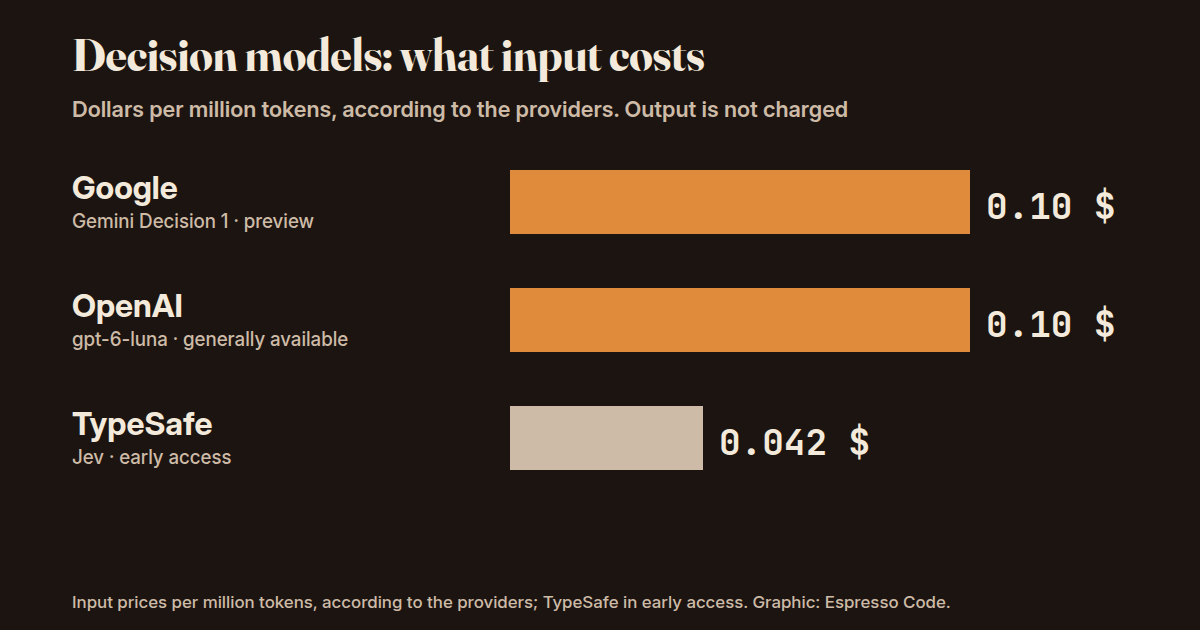
In short: A decision model answers with a probability, not with text. At Google and OpenAI it costs $0.10 per million tokens, small pieces of text; the answer is not charged: a million support messages comes to about $50. The producers declare the performance, and on Google’s free tier the data may be used to improve its products.
What a decision model is, and who offers it
The model receives a text and a question with the allowed answers, and returns the probability of each. Hugging Face’s example, from the site where artificial intelligence models are published and downloaded, is a support message: “I was charged twice for my order and want a refund.” Which department should it go to, among billing, technical support and sales?
The model answers “billing” with a probability of 99.8%.
The program compares that value with a threshold, that is, the value beyond which it decides: for example, above 0.9 it forwards. These are jobs in which the program needs a closed answer, such as routing messages.
Who got there first? TypeSafe: it presented its model, Jev, on September 15, in early access. TypeSafe called it “System One,” after fast, intuitive thinking; Hugging Face writes that the community chose “decision model” instead, because it says what the model does.
Then, writes Simon Willison, who covers artificial intelligence on his blog, came Google. OpenAI offers its API, generally available.
And what do they accept? Jev only text. OpenAI also images. Google’s model, Gemini Decision 1, also audio, video and PDFs, up to a thousand questions per request: if the data is a video, only Google will do.
The questions are of three types, at both Google and OpenAI: yes or no, a choice among several options, a score on a scale of levels. For each answer the model also says how sure it is, and the program can send the doubtful cases to a person.
Hugging Face also cites models to download, such as GEV-26B, JEV-9B and Kev-4B-GGUF, which are used with the Transformers and llama.cpp tools. Whoever does not want to send data to a provider therefore has another route.
Prices and providers
Google and OpenAI charge the same input price. Output is not charged, because the model does not write text; the questions, however, count as input. A support message of 500 tokens costs $0.00005, a million messages $50.
| Provider (model) | Input, per million tokens | Output | Status |
|---|---|---|---|
| Google (Gemini Decision 1) | $0.10 | not charged | in testing: the version may change |
OpenAI (gpt-6-luna) | $0.10 | not charged | generally available |
| TypeSafe (Jev) | $0.042 | free | early access, with a waiting list |
The equal price holds only for the base input. OpenAI charges $0.01 per million tokens for text already read and kept in memory, the cache, which it reuses on every request; writing it to the cache costs more, depending on the duration. The text to reuse must be at the start and have at least 1,024 tokens, and the questions stay outside.
Endpoints that keep the data in one region cost 10% more, for models released since March 5, 2026.
Google, by contrast, does not offer the cache and does not accept requests in bulk, called batch. Text and questions, together, must fit in a window of 262,144 tokens.
Google’s free tier
Google offers a free tier, useful for prototypes. In its pricing table, on the free tier the data may be used to improve the company’s products; for the paid tier the same table says the opposite.
For that reason, with real customers’ messages the paid tier is the better choice, and for tests fake data is enough. Anyone with obligations on personal data should read the terms of service first.
Probability, confidence, calibration
In Google’s documentation the answer to a yes/no question is the probability of yes. Next to it is the confidence, that is, how sure the model is of the top answer. With the probability of yes at 0.03 the confidence is 0.97: it does not mean “not very sure,” it means “almost certainly no.”
For those who program there is a warning. Google keeps the probability of yes between 0.01 and 0.99, and the threshold must be set inside that range: a check above 0.99 never fires.
“Calibrated” is the word Google uses for these probabilities. In general it means that, among the answers given at 90%, about 90% are right.
Those who do not program can skip the code block. It is the example from Google’s documentation:
curl -X POST "https://generativelanguage.googleapis.com/v1beta/decisions" \
  -H "x-goog-api-key: $GEMINI_API_KEY" \
  -H "Content-Type: application/json" \
  -d '{
    "model": "gemini-decision-1",
    "input": "The blue mug I ordered on Monday arrived cracked on Wednesday.",
    "questions": {
      "is_damaged": {
        "type": "noul",
        "instructions": "Did the item arrive damaged?"
      }
    }
  }'
and the response reported by the documentation:
{
  "answers": {
    "is_damaged": { "type": "noul", "noul": 0.99, "confidence": 0.99 }
  },
  "usage": {
    "total_input_tokens": 100,
    "input_tokens_by_modality": [{ "modality": "text", "tokens": 100 }],
    "total_output_tokens": 0,
    "total_tokens": 100
  }
}
What the producers say
The performance figures are declared by those who sell.
Google writes that Gemini Decision 1 leads in its tests and has the lowest calibration error. The median response time, it writes, is 150–250 milliseconds, on inputs that can include images, audio and video and contexts up to 16,000 tokens.
On the same test suite, it adds, the cost is almost five times lower than Gemini 3.5 Flash-Lite, another of its models, used with another of its APIs, the Interactions API: it is not a comparison of price lists, but of costs measured in Google’s tests.
OpenAI, too, speaks of speed: it writes that its API is about ten times faster than the one for text.
TypeSafe promises more. It writes that Jev, on tasks of this kind, is faster and more efficient by two orders of magnitude, with responses between 70 and 500 milliseconds.
It also writes that it cannot hallucinate, that is, invent answers; but a probability calibrated at 90% is wrong, by definition, one time in ten. It then admits that its evaluations are internal and take as a reference the answers of two competing models, and therefore favor them; its own performance, it adds, is probably underestimated.
The only third-party test is small and on a single model: Willison reports that Jev and OpenAI answer 1.0 or 0.0 to yes/no questions, while Gemini gives less clear-cut values, such as 0.92. It does not say whether the less clear-cut values are more right: there are no independent comparisons.
The price is real and the idea is simple; the accuracy, for now, is a promise. It is worth measuring these models on your own data before trusting that number.
Frequently asked questions
What is a decision model?
A model that does not generate text: it receives a context and a question with the allowed answers and returns the probabilities. The program compares them with a threshold.
How much does a decision model cost?
Google and OpenAI charge $0.10 per million input tokens, TypeSafe $0.042 in early access. Output is not charged.
Can Google’s free tier be used with customer data?
In Google’s pricing table, on the free tier the data may be used to improve its products; on the paid tier it may not. With real messages the paid tier is the better choice, and anyone with obligations on personal data should read the terms; for tests, fake data.
Does a decision model replace a model that writes text?
For closed questions the providers present it as a cheaper and faster alternative, according to their own tests. It does not write and does not explain, and independent comparisons are missing.
Read also
Methodology note
The providers’ pages (Google’s blog, documentation and pricing; OpenAI’s guide and pricing; TypeSafe’s blog; the Hugging Face and Simon Willison posts) were read on November 13, 2026. The cost of the message is a calculation on the price: 500 tokens × $0.10 ÷ 1,000,000 = $0.00005. The same text may count a different number of tokens from one provider to another, so the price per million does not suffice to compare the cost of a request. The general definition of “calibrated” does not come from Google. The code example is the one in Google’s documentation and was not run. Quotations are translations.
Sources
Accessed November 13, 2026. Titles are in the original English.
- Google, “Gemini Decisions API: Fast, calibrated multimodal decisions,” November 11, 2026. Primary. https://blog.google/innovation-and-ai/technology/developers-tools/gemini-decisions-api/
- Google AI Studio, Decisions API documentation, model page and pricing. Primary. https://aistudio.google.com/docs/decisions-api ; https://aistudio.google.com/docs/models/gemini-decision-1 ; https://aistudio.google.com/docs/pricing
- OpenAI, “Decisions” guide and pricing. Primary. https://developers.openai.com/api/docs/guides/decisions ; https://developers.openai.com/api/docs/pricing
- TypeSafe AI, “Introducing System One Models & Jev,” September 15, 2026. Primary. https://typesafe.ai/blog/introducing-system-one-models-and-jev
- Hugging Face, “Decision Models in Hugging Face,” November 10, 2026. Primary. https://huggingface.co/blog/decision
- Simon Willison, “Gemini Decisions API,” November 11, 2026. Secondary. https://simonwillison.net/2026/Nov/11/gemini-decisions-api/
Have your say