When an app asks to access your photos and videos, you tap “Allow” almost without looking: you just want to share a picture. On Saturday, November 14, Italy’s data protection authority, known as the Garante, announced a fine of €805 million against Meta Platforms Ireland Limited, the Irish company of the Meta group. The reason, according to the Garante, is the way the Facebook app for Android asked for access to the phone’s gallery.
In dollars that comes to $887 million, the American news agency AP writes.
The news squeezes into one line, “Meta fined over photos,” which leaves out almost everything. The press release is more precise, and more curious: it speaks of a feature that suggests what to post, of a single permission for several uses and of an objection from Meta, rejected, that the case belonged to the Irish authority.
Meta, Il Post writes, disputes the account and intends to appeal.
In short
According to the Garante’s press release of November 14, 2026, the Facebook app for Android accessed photos, videos and related metadata on Italian users’ phones with a single permission valid for several features, including one, enabled by default, that suggests what to post. The proceeding does not concern training artificial intelligence, which Meta denies. Within 60 days the company must ask for separate consent for the feature and keep it switched off by default. Meta, Il Post writes, disputes the authority’s account and says it intends to appeal.
What does the gallery-suggestions feature do?
It is called “Get tips from your gallery while browsing Facebook” and has been available since 2023. The Garante describes it this way: while the user browses, it shows photos and videos from the phone’s gallery as suggestions to post. Think, for example, of the pictures from a day trip. For the access, the press release speaks of “photos, videos and related metadata”; metadata means the information that goes with every file, such as the date and the place.
The investigation, the press release writes, began in July 2025 with a complaint from the Bolzano Consumer Protection Center and relied on a technical analysis carried out by the Authority itself.
What does the Garante object to about the permission?
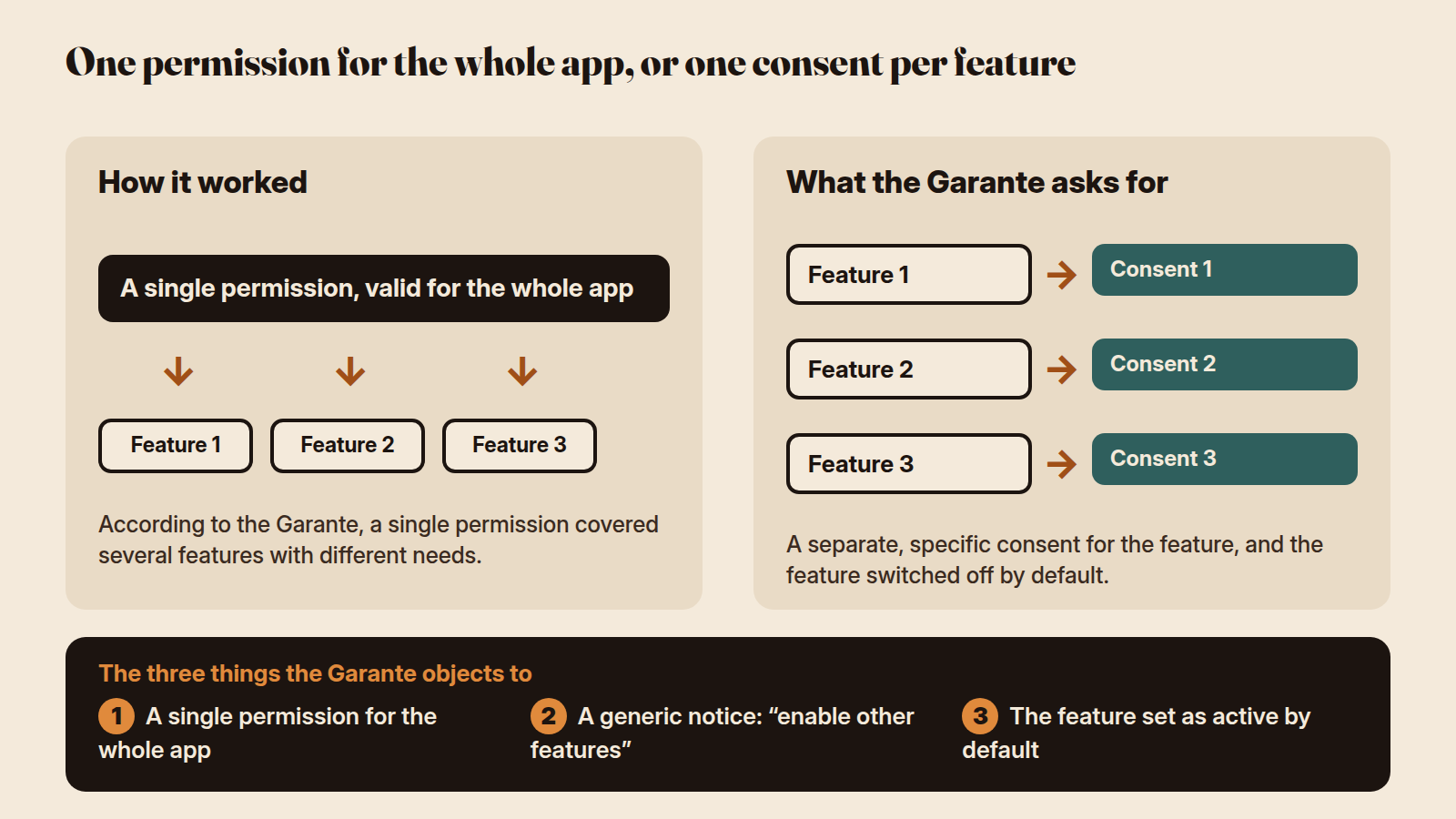
The crux is how the app asked for access. The checks, the press release says, found a single permission, valid for the entire app and for several features with different needs. A generic notice, “enable other features,” came before it and did not let users understand that they were also authorizing gallery suggestions. Moreover, the feature was enabled by default.
It is like handing your house keys to the doorman so he can pick up a package: he has them, and you do not know when he uses them. A permission granted in full, the Garante writes, allows the app to read the whole photo archive, as a rule on an ongoing basis, without the user or the Authority being able to verify what information is actually used.
Il Post puts it even more simply: Meta would not have asked for specific consent to access the gallery through this feature, but would have used the general consent users accept for the whole app, and it was up to them to notice and switch it off.
What is the difference between permission and consent?
In two questions: the permission answers “can this app read my photos?” The consent answers “do I agree that it does so for this purpose, and do I know how to turn it off?” They are two different things, and the Garante objects that, for this feature, the second was not asked for. It describes two steps: a generic notice, then the system permission.
An example, made up: a maps app uses your location to guide you, and that is its purpose; if the same location were used to show you ads near your home, that would be a separate use, to be accepted separately.
Why did Italy’s regulator impose the fine if the company is Irish?
Here the rule comes in. The Garante, Il Post recalls, checks that national and European rules on the processing of personal data are respected.
The one violated, the press release writes, is Article 122 of the Privacy Code, which implements the European ePrivacy Directive and protects the smartphone as part of a person’s private sphere. Any access to the information it contains therefore requires free and informed consent. For the Garante what counts is the access: the photos need not have been transmitted elsewhere, nor any harm done.
Meta had argued that the case belonged to the Irish authority, in what lawyers call an objection of lack of jurisdiction. The Garante rejected it because, it writes, the ePrivacy rules do not provide for the “one-stop-shop” mechanism: the one that, under the General Data Protection Regulation (GDPR), normally assigns cross-border cases to a single lead authority, usually the one in the country where the company has its main establishment in the European Union.
What does the proceeding cover, and what does it not?
The press release is clear on one point: the proceeding did not concern the potential use of content to train artificial intelligence, which Meta denies. It speaks of consent and of information: the Garante objects to consent that was not specific and to inadequate information, and says the violation is still ongoing for those who have already granted the system permission (the Italian text of the press release). It also reserves the right to assess separately a new feature, launched in 2026, that allows cloud processing of gallery content.
How did the Garante set the €805 million amount?
To set the amount, the Garante took four things into account: the high number of people involved; the duration, still ongoing for those who have not updated the app and for those who have already granted the system permission; a previous 2019 decision against the company; the limited cooperation during the investigation. As mitigating factors it considered the changes made after the complaint, which it deemed late and limited to users who update the app.
The press release gives about 20 million Android users in Italy as the people involved. Il Post reads it differently: the Garante did not say how many people are involved, and the 20 million are the Facebook profiles in Italy that use the app on Android.
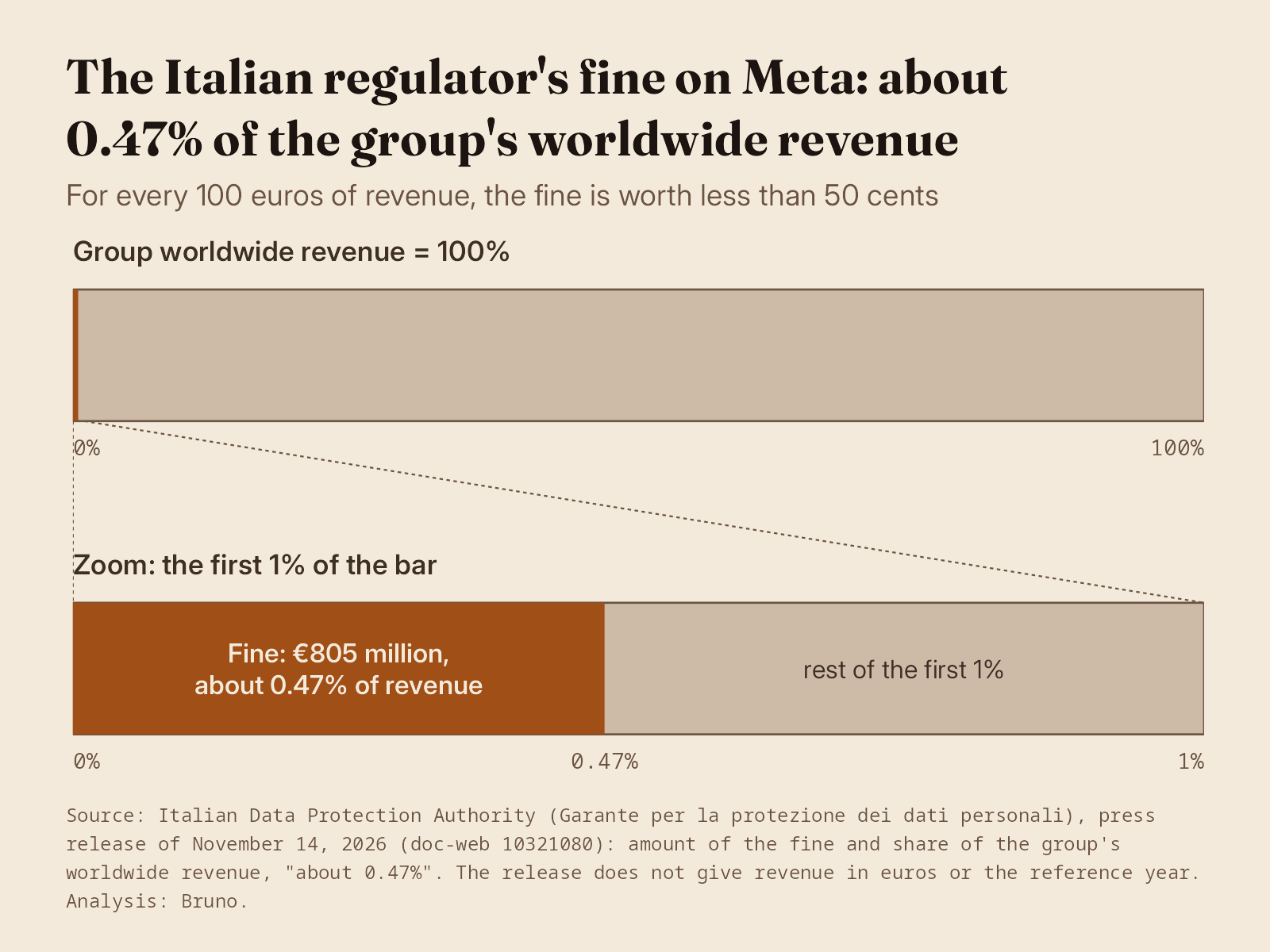
The amount, the press release adds, is about 0.47% of the group’s global revenue: less than fifty euro cents on every hundred euros.
Il Post also recalls that less than a month ago a judge in New Mexico, in the United States, fined Meta $25 billion for violating its users’ privacy, in a case tied to the Cambridge Analytica scandal. The paper notes that, if upheld through every level of appeal, it would be the highest fine the company has paid so far. It is a different story, in a different country: it only serves to set the €805 million next to another figure.
What must Meta change within 60 days?
Within 60 days, the Garante writes, the company must:
- ask for consent through a separate and specific request for the feature, explaining to users what it is for, that it involves access to the gallery and how to turn it off;
- keep the feature switched off by default, even for those who have already granted the permission.
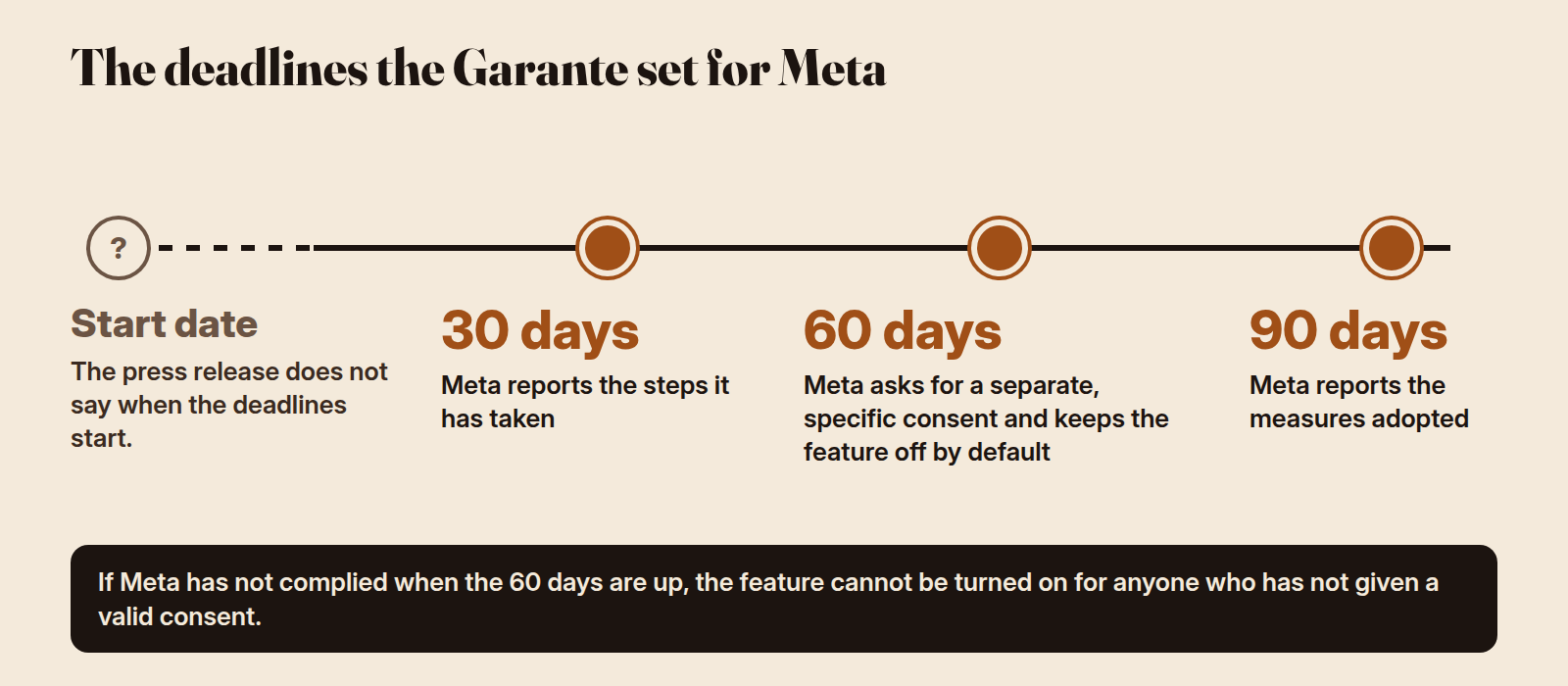
If the deadline passes without compliance, the feature cannot be activated for users who have not given valid consent. Within 30 days Meta must tell the Garante what initiatives it has started, and within 90 the measures it has adopted. The press release does not say when the 60 days start.
How do I check Facebook’s permissions on my Android phone?
The Garante says the violation is still ongoing for those who had already granted the permission. If you use Facebook on Android, you can go and see what you have granted. Open Settings, tap Apps and choose Facebook; if you cannot find it, there is “See all apps.” Then go into Permissions: the ones granted or denied are there. The “Photos and videos” entry allows access to the device’s photos and videos; to change it, choose “Allow” or “Don’t allow.”
To see all the apps together there is another route: Security & Privacy, then Privacy, then Permission manager, and finally Photos and videos. The names of the entries can vary by phone and by Android version; on a Pixel, some of these steps work only from Android 11 on.
What you see there is the system permission, given once to the app. The consent for the individual feature, instead, is what Meta will have to ask you for separately. You do not have to change anything: it is a check, and the choice is yours.
If Facebook shows you a request of its own for the gallery suggestions, read it calmly: it is the kind of request the Garante has indicated.
Frequently asked questions
How much is the fine on Meta, and what does the Garante object to?
€805 million against Meta Platforms Ireland Limited, announced by the Garante on November 14, 2026; AP writes $887 million. According to the Garante, the Facebook app for Android accessed photos, videos and related metadata with a single permission valid for several features, including one, enabled by default, that suggests what to post.
Does the proceeding concern training artificial intelligence?
No. The Garante’s press release says the proceeding did not concern the potential use of content to train artificial intelligence, which Meta denies. The Garante speaks of consent that was not specific and of inadequate information about access to the gallery, and reserves the right to carry out separate checks on a new 2026 feature.
What must Meta do, and by when?
The Garante sets 60 days to ask for separate and specific consent for the feature, explaining to users what it is for, what the access to the gallery involves and how to turn it off, and to keep it switched off by default, even for those who have already granted the permission. Within 30 days it must report the initiatives started, within 90 the measures adopted.
Can Meta appeal?
According to Il Post, Meta has disputed the Italian authority’s account and has said it intends to appeal. How the appeal will end cannot be said.
Why did Italy’s regulator impose the fine if Meta is an Irish company?
The Garante recalls that the rule violated is Article 122 of the Privacy Code, which implements the European ePrivacy Directive. Meta had argued that the case belonged to the Irish authority; the Garante rejected that because, it writes, the ePrivacy rules do not provide for the “one-stop-shop” mechanism.
How do I check Facebook’s permissions on Android?
According to Google’s Android guide: open Settings, tap Apps and choose Facebook; if you cannot find it, there is “See all apps.” Then go into Permissions and look at the “Photos and videos” entry, where you can choose “Allow” or “Don’t allow.” The names of the entries can vary by phone and by Android version.
Sources
Pages accessed November 16, 2026. The full decision was not read: the text relies on the Garante’s press release and on the AP and Il Post articles. The English version of the press release words two passages differently from the Italian one: on the duration it says only “still ongoing for those who have not updated the app,” and it says “even for those who have already given consent” where the Italian says “authorization,” and it says only “on an ongoing basis” where the Italian says “di regola in modo permanente” (“as a rule”). This article follows the Italian text. Quotations from the Garante’s press release follow its official English version where the passage exists there, and are otherwise translated from the Italian; quotations from other Italian-language sources are translated.
- Garante per la protezione dei dati personali (Italy’s data protection authority), “Facebook: il Garante privacy sanziona Meta per 805 milioni di euro” (“The Garante has fined Meta Platforms Ireland Limited 805 million euros” in the English version of the same page), press release, November 14, 2026. Primary. https://www.garanteprivacy.it/home/docweb/-/docweb-display/docweb/10321080
- Associated Press, via SecurityWeek, “Meta Fined $887 Million in Italy Over Android Gallery Photos and Videos on Facebook,” November 14, 2026. Secondary. https://www.securityweek.com/meta-fined-887-million-in-italy-over-android-gallery-photos-and-videos-on-facebook/
- Il Post, “Il Garante della Privacy ha multato Meta per 805 milioni di euro” (in Italian; “Italy’s privacy regulator fined Meta 805 million euros”), November 14, 2026. Secondary. https://www.ilpost.it/2026/11/14/garante-privacy-multa-meta-805-euro-facebook-foto-galleria-android/
- Google, Android Help, “Change app permissions on your Android phone.” https://support.google.com/android/answer/9431959?hl=en
- Regulation (EU) 2016/679 (GDPR), Article 56 and recital 127, EUR-Lex, read November 16, 2026. Primary. https://eur-lex.europa.eu/legal-content/IT/TXT/HTML/?uri=CELEX:32016R0679
- PBS NewsHour (AP), “Meta must pay New Mexico $25 billion, its biggest fine ever, for deceiving users about Facebook privacy,” October 21, 2026. https://pbs.org/newshour/nation/meta-must-pay-new-mexico-25-billion-its-biggest-fine-ever-for-deceiving-users-about-facebook-privacy
Have your say