BrainChip, an AI chip company, launched the AKD1500 kit for the Raspberry Pi 5 on October 29, 2026, according to its press release. The Raspberry Pi 5 is a small single-board computer; the kit pairs it with a BrainChip board carrying a chip that the company calls “neuromorphic,” that is, inspired by the brain.
The kit is meant, according to BrainChip, for engineers, hobbyists and product teams who already work with the Raspberry Pi. They want to develop artificial intelligence programs that run on the device itself, without an online service: edge AI.
According to BrainChip’s specifications as reported by Electronics For You, an electronics magazine, the board delivers up to 800 GOPS, that is, 800 billion operations per second, and draws less than 300 milliwatts, that is, less than a third of a watt. The price, according to CNX Software, an electronics news site, is $1,295.
What exactly do you get for that $1,295, and how much of what is promised has been measured by someone who does not sell it?
To answer, I lined up five things: what is in the kit, what BrainChip claims, what you can do with that much power, what it costs and what is still unknown.
What Is in the Kit?
The kit, CNX Software writes, includes an 8 GB Raspberry Pi 5, the official M.2 HAT+ expansion board and the AKD1500 board in a metal case, with a 32 GB SD card already loaded with the software.
The SD card holds Ubuntu Server 20.04 LTS (marked “TBC,” to be confirmed), Python 3.7 and MetaTF. Ubuntu Server is a Linux operating system for servers, Python is a programming language and MetaTF is BrainChip’s development software.
The M.2 HAT+ is the board that adds an M.2 slot to the Pi, the format used by fast expansion cards, such as solid-state drives. The AKD1500 board sits in that slot. BrainChip presents it as “event-based.” In general, an event-based chip processes events, that is, only what changes in the data, and not all the data every time.
I used the same M.2 format to boot another mini-computer from a fast drive.
The kit also requires a USB camera, instead of the Raspberry Pi camera module. CNX’s list does not include it, and the page does not say whether it is included.
The demos, CNX writes, open in the browser and all run on the device, without an online service: detecting whether people are present, and recognizing objects and faces. How the board handles the camera’s images, CNX does not say.
Anyone who already has a Pi 5 with the M.2 HAT+ can add only the production M.2 board, BrainChip writes in the press release. The kit, again according to the press release, is available now from BrainChip’s store.
What Does BrainChip Claim?
According to BrainChip’s specifications as reported by Electronics For You, the board delivers up to 800 GOPS, has 1 MB (one megabyte) of memory on the chip and works at clock speeds between 5 and 400 megahertz, the unit that measures how fast a chip runs.
On power consumption the same source gives two values: less than 300 milliwatts, and about 250 milliwatts at 400 megahertz, the highest speed. They do not contradict each other: 250 is a value at a specific speed, and 300 is the stated limit. At what speed the 800 GOPS apply, and under what conditions the 300 milliwatts, the pages do not say.
Electronics For You writes “up to” 800 GOPS and specifies that these are the manufacturer’s specifications, not measurements of a complete Raspberry Pi system, and that real speed and power consumption will depend on the model, resolution, workload and system.
The press release adds three things:
- Software: MetaTF, the development software, is free and can be downloaded from BrainChip’s Developer Hub.
- Support: Docker images, that is, preconfigured software, will be included.
- Learning: the chip can learn new keywords, gestures or objects on the device, without retraining.
What Can You Do with 800 GOPS?
An operation, here, is an addition or a multiplication. You will also see TOPS, which means a trillion operations per second: 800 GOPS is 0.8 TOPS. In AI chips the figure is often a theoretical maximum, and it says little about how fast a real program is.
In theory it is enough to recognize objects in a video at 30 frames per second. To see why, you need to know how many operations a model requires.
MobileNetV2, a lightweight AI model that recognizes what is in an image, requires, according to its authors, 300 million multiply-adds per image: a multiplication followed by an addition counts as two operations, so that is 0.6 billion operations.
With 800 billion operations per second you could process about 1,300 images per second (800 divided by 0.6), in theory.
A model that finds objects in a video, such as YOLOv8n at an image size of 640 pixels, requires 8.7 billion operations per frame, according to Ultralytics’ documentation: 800 divided by 8.7 gives about 90 frames per second, in theory. A video at 30 frames per second would fit with room to spare.
The larger model, YOLOv8s, requires 28.6 billion and would be at the limit. The documentation speaks of “FLOPs”: if they are multiply-adds and not operations, the frames per second are cut in half. The order of magnitude remains a few dozen.
These are theoretical maximums: chip used at 100%, no time to move the data, no work to prepare the input or handle the results. CNX’s demos, with people, objects and faces, are tasks of the same kind, but CNX gives neither frames per second nor power consumption. Which of these models run on the chip, and in which version, the sources do not say.
How far theory is from practice is shown by another manufacturer’s tests. Coral states 4 TOPS for its chip and publishes, for MobileNetV2, a measured time of 2.6 milliseconds: about 385 images per second.
Theory would give about 6,700 (4 trillion divided by 0.6 billion): the measured rate is about 6% of that. The comparison assumes that the model Coral used requires the same operations that the authors of MobileNetV2 indicate.
For BrainChip’s kit, no source publishes a similar measurement.
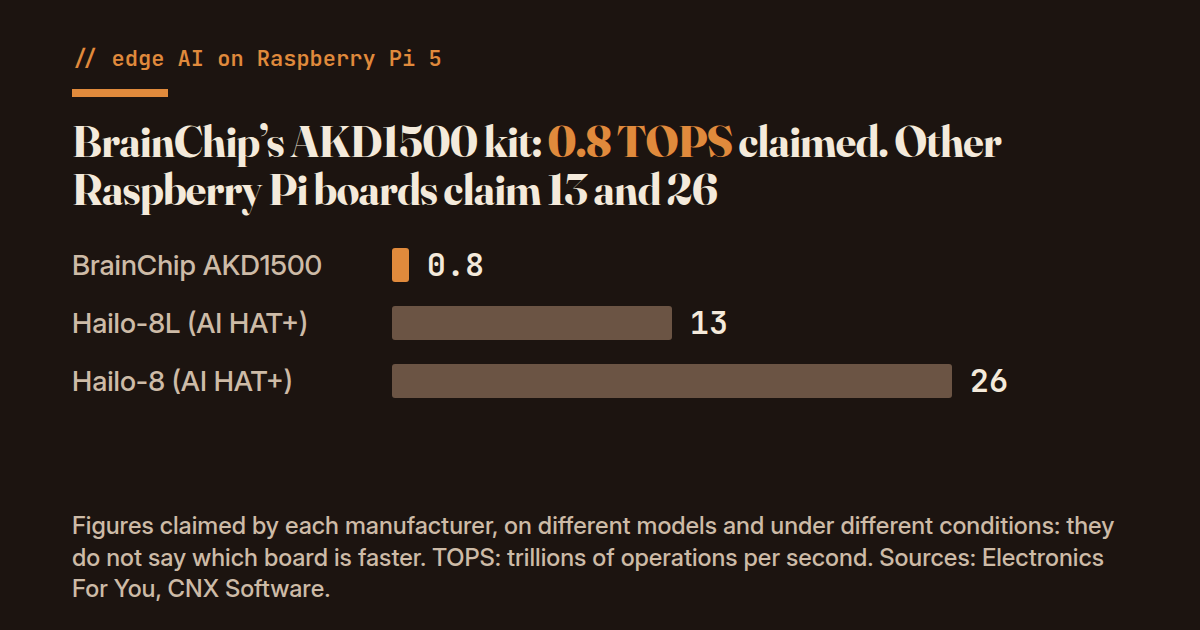
On boards for the Raspberry Pi, manufacturers state higher figures: 13 TOPS for the AI HAT+ with the Hailo-8L chip and 26 with the Hailo-8 chip, according to CNX Software (October 24, 2024). That is about 16 and 32 times the 800 GOPS. At launch they cost $70 and $110, before taxes and shipping.
These figures are stated for different AI models and under different conditions: they do not say which board is faster in practice, nor how BrainChip would perform on the same tasks.
How Much Does the Kit Cost?
BrainChip’s press release does not give a price. The $1,295 is reported by CNX Software, which links to the kit’s page in BrainChip’s store and compares it with the cost of the parts that, in its estimate, reproduce the kit:
- Raspberry Pi 5 with 8 GB: $175 list price.
- M.2 HAT+: $12.
- AKD1500 M.2 board: $129.
- Metal case: about $11.
- 32 GB microSD card: $10-$20.
That comes to about $350, plus taxes and shipping, and about two hours of assembly and software installation. The kit therefore costs more than three times that sum: 1,295 divided by about 350 is about 3.7.
CNX writes that buying the kit may make sense if an hour of your own work is worth more than about $400, and that it is a development kit, not optimized for cost. These are prices in dollars, as in the sources.
For the AKD1500 board alone, the sources give two figures that do not necessarily concern the same model: $129 for the M.2 board in CNX’s list, which does not say where its prices come from, and boards that “start at $99” according to Electronics For You, on September 22, which speaks of AKD1500 boards in general (M.2, PCIe and other variants) and adds that the final cost depends on the variant, shipping, the exchange rate and customs duties.
What Is Still Unknown?
The dates do not match: BrainChip dates the press release October 29, while HPCwire, which republishes it, dates it October 30. It is not a second source: it is the same text.
The performance figures have a single origin, the manufacturer. For now, measurements of the kit by third parties are missing.
When a third-party test comes out, it is worth looking at three things:
- Real speed: how fast the kit runs real tasks, not the maximum in GOPS.
- Power consumption: that of the whole system, not just the board.
- Comparison: with other boards for edge AI.
It remains to be seen whether, and when, someone will measure the kit under a real load.
Sources
Accessed November 2, 2026. I mark the type of each source: primary (who produces the information), secondary (who reports or analyzes it).
- BrainChip, press release “BrainChip launches AKD1500 Raspberry Pi 5 Kit giving developers a direct path from prototype to production,” October 29, 2026. Primary (the manufacturer). https://brainchip.com/press/brainchip-launches-akd1500-raspberry-pi-5-kit-giving-developers-a-direct-path-from-prototype-to-production/
- CNX Software, “BrainChip AKD1500 Raspberry Pi 5 dev kit enables users to quickly experiment with event-based neuromorphic AI,” November 2, 2026 (the page also shows November 1). Secondary, independent of the manufacturer. https://www.cnx-software.com/2026/11/02/brainchip-akd1500-raspberry-pi-5-dev-kit-enables-users-to-quickly-experiment-with-event-based-neuromorphic-ai/
- Electronics For You, “Run your own AI models on BrainChip’s $99 Akida card,” September 22, 2026 (before the kit; it discusses the AKD1500 boards). Secondary. https://www.electronicsforu.com/news/run-your-own-ai-models-on-brainchips-99-akida-card
- HPCwire, republication of BrainChip’s press release, October 30, 2026. Not an independent source. https://www.hpcwire.com/off-the-wire/brainchip-launches-akd1500-raspberry-pi-5-kit/
- Sandler et al., “MobileNetV2: Inverted Residuals and Linear Bottlenecks,” arXiv 1801.04381 (300 million multiply-adds, 224×224). Primary (the authors of the model). https://arxiv.org/abs/1801.04381
- Ultralytics, YOLOv8 documentation, model table (8.7 and 28.6 billion FLOPs at 640 pixels). Primary (on the model). https://docs.ultralytics.com/models/yolov8/
- Coral, FAQ (4 TOPS) and benchmarks page. Primary (times measured by the manufacturer). https://coral.ai/docs/edgetpu/faq/ and https://coral.ai/docs/edgetpu/benchmarks/
- CNX Software, “Raspberry Pi AI HAT+ features Hailo-8L or Hailo-8 AI accelerator with up to 26 TOPS of performance,” October 24, 2024 (13 and 26 TOPS; $70 and $110). Secondary. https://www.cnx-software.com/2024/10/24/raspberry-pi-ai-hat-plus-features-hailo-8l-or-hailo-8-ai-accelerator-with-up-to-26-tops-of-performance/
Leave a Reply