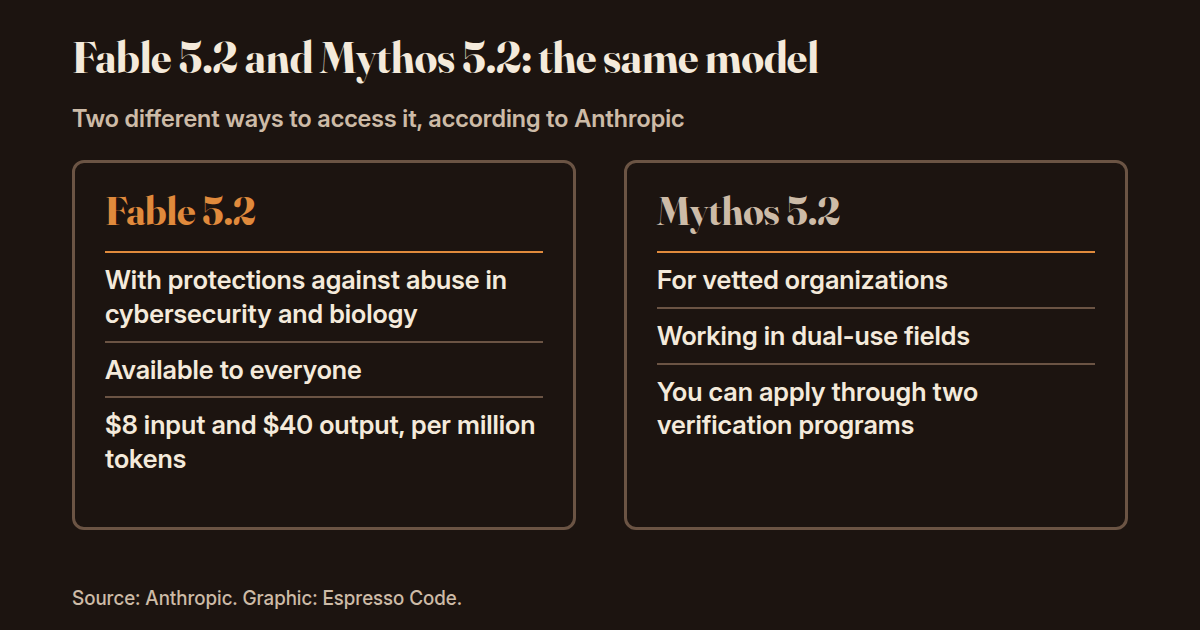
One model or two? On November 9, Anthropic, the company that develops the Claude AI assistant, presented Claude Fable 5.2 and Claude Mythos 5.2. In the same text it wrote that they are one and the same: “Claude Fable and Claude Mythos are the same underlying model.” The safeguards differ, and with them who can use each one.
Recent headlines repeat the test scores. They say less about what the model costs, how long it takes, and at what level of effort it was measured: and that is where the numbers change.
In short
Fable and Mythos are the same model: Fable has the safeguards and is for everyone, Mythos is for vetted organizations. The top score, however, is measured at the maximum effort level, that is, when the model reasons the most, while the default is Medium. What a task costs at the Medium level is not written by any source.
One model, two names
According to Anthropic’s page, Fable has protections against misuse in cybersecurity and biology, and for that reason it is available to everyone. Mythos is the same model and is reserved for vetted organizations working in dual-use fields, that is, with both useful and harmful uses.
But who really needs either one? Anthropic recommends starting with Opus 5.5, another of its models, described as the strongest for everyday work, and moving up to Fable or Mythos for the most ambitious, open-ended technical work. For a simple task you go down instead, toward the smaller models.
Fable can also act as an adviser to the smaller models or as a coordinator that hands them the simple tasks.
And what if a request touches a safeguard? Fable’s safety classifiers, programs that recognize dangerous requests, stop high-risk cyber activity, such as penetration testing, and most research biology tasks.
When a request is blocked, the answer comes from another Anthropic model: Opus 4.8 for cybersecurity, Opus 5 for biology. In early tests blocks are about 55% fewer than with the previous version.
What it really costs
Pricing is measured in tokens, small pieces of text that the model reads or writes. In Anthropic’s price list, Fable costs $8 per million tokens read and $40 per million written: 20% less than the previous version.
Opus 5.5 costs $4 per million tokens read and $20 per million written, so Fable costs twice as much per token.
But the real bill also depends on the tokens. The price list writes that models from the 4.7 series onward use a newer tokenizer, the program that splits text into tokens, and produce about 30% more tokens for the same text than earlier models. That is why the price per million is not enough to compare the spend with that of an older model.
For responses that are not immediate, in batch mode, the price is halved; for faster ones, in fast mode, it doubles: $16 and $80, with a speed up to 2.5 times higher.
According to testers cited by Anthropic, Fable 5.2 generates up to 30% faster than the previous version and is available on the main cloud platforms, including Amazon Web Services, Google Cloud and Microsoft Azure.
Results, claimed and measured
Anthropic’s tables say that Fable beats Opus 5.5 in almost all tests. These are the producer’s scores, obtained at the highest effort level available for each model, except where the row indicates otherwise.
| Test | Fable 5.2 | Opus 5.5 | Gemini 4 Carbon |
|---|---|---|---|
| FrontierCode 2.0: coding | 49.1% | 45.5% | 41.1% |
| AutomationBench: business workflows | 51.4% | 42.5% | 53.9% |
In the first row, Fable is at a very high effort level and Carbon, Google’s model, at a medium one.
The advantage, then, is not everywhere: Carbon is ahead on AutomationBench. Still, at a lower effort level, called High, Fable reaches 45.3% on FrontierCode, almost as much as Opus 5.5’s best result, at about half the cost per task.
For Mythos, Anthropic also reports an internal test on rediscovering known vulnerabilities, that is, security flaws already made public: 89.6%, against 81.3% for Opus 5.5 without safeguards.
And outside Anthropic? Artificial Analysis, an independent site that compares AI models, measures Fable at the Max level and ranks it first for intelligence.
But it also measures its price and its slowness: $26.54 and 41.1 minutes for each task in its tests, against 11.5 minutes for a typical model in a similar price tier.
Fable 5.2 also produces a lot of text: 275 million tokens, more than four times that of a typical model in that tier. The page describes it as among the most intelligent models but expensive for its price tier, slow and very verbose.
The effort level
The effort level, from Low to Max, sets how much the model reasons before answering, and in the Claude apps and the programming tools the default is Medium. So $26.54 and 41.1 minutes do not describe a normal session: they are the model at its maximum, on a set of tests.
What a task costs in dollars at the Medium level is not written by any source. Anthropic does give a ratio, though: on WANDR, a Perplexity test on data collection, at the Medium level Fable reaches Opus 5.5’s best score at about 40% of the cost per task.
At the Low level, on Humanity’s Last Exam, a test of expert-level academic knowledge and reasoning, Fable matches Opus 5.5’s best score at less than one-tenth of the cost per task.
Who can use it
For programmers there is another question as well: with what data. According to GitHub, Fable is available in GitHub Copilot, the assistant that helps write code, on the Pro+, Max, Business and Enterprise plans.
By default, however, Fable 5.2 requires Anthropic to retain the data, requests and responses included, to run the safety classifiers. The retained data is not used to train the models.
For Business and Enterprise, an administrator must also turn the setting on. For eligible business customers there is an exemption that does not retain data, valid through the end of the year: after that a system from Anthropic, the Enterprise Frontier Safeguards, with automated safety monitoring, will be required.
Mythos, on the other hand, is for vetted cybersecurity and life sciences professionals: people working in cybersecurity can apply to the Cyber Verification Program, people working in life sciences to the Life Sciences Verification Program.
But there is another route. The Register, a technology outlet, writes that Cisco and IBM have announced that they will offer Mythos’s capabilities in their products “without handing customers the model itself”: two channels that are not among those listed for Mythos. Cisco, in particular, will offer them under the licenses already in use, at no additional cost.
Anthropic had initially made Mythos available through “Project Glasswing”: it gave vetted organizations access to test the model on their own code, and since then it has widened access through other controlled programs.
Who can use Mythos is decided by Anthropic; and the highest numbers, for now, are the ones measured at a level that is not the default.
Frequently asked questions
What is the difference between Fable 5.2 and Mythos 5.2?
According to Anthropic, they are the same model. Fable has safeguards and is available to everyone; Mythos is reserved for vetted organizations working in dual-use fields.
How much does Claude Fable 5.2 cost?
Claude Fable 5.2 costs, according to the price list, $8 per million input tokens and $40 per million output tokens, twice Opus 5.5. In fast mode it costs $16 and $80.
Which effort level is the default?
The default level is Medium, in the Claude apps and the programming tools. Artificial Analysis measures the Max level instead, so its costs and times per task may differ from those of someone using the default settings.
Can you use Fable 5.2 on GitHub Copilot?
Yes: Fable 5.2 is available on the Pro+, Max, Business and Enterprise plans, and Anthropic retains the data by default. For Business and Enterprise, an administrator must turn the setting on.
Read also
- What happens when a model’s safeguards are removed, according to an Anthropic estimate: Taking the brakes off a model like GLM-5.3 costs about $1,200, Anthropic estimates: who benefits?.
Methodology note
Pages read on November 11, 2026, and reviewed on November 18: Anthropic’s page of November 9 and its API price list, the Artificial Analysis page (Max, Default Fallback), GitHub’s changelog of November 9 and The Register’s article of November 10. Quotations are in the original English. The 20% reduction is $8 against $10; “more than four times” is 275 over 65.1 million tokens. Artificial Analysis pages do not print an update date and change as the site re-measures: the readings of November 10 range from 44.1 to 46.4 minutes, and the one of November 18 gives 41.1. Anthropic’s system card was not read.
Sources
Accessed November 11, 2026. Titles are in the original English.
- Anthropic, “Introducing Claude Fable 5.2 and Claude Mythos 5.2,” November 9, 2026. Primary. https://www.anthropic.com/claude-fable-and-mythos-5-2
- Artificial Analysis, “Claude Fable 5.2 (Max, Default Fallback) Intelligence, Performance & Price Analysis,” November 9, 2026. Independent. https://artificialanalysis.ai/models/claude-fable-5-2
- GitHub, changelog, “Claude Fable 5.2 in GitHub Copilot,” November 9, 2026. Primary for Copilot. https://github.blog/changelog/2026-11-09-claude-fable-5-2-in-github-copilot
- The Register, Simon Sharwood, “Anthropic’s super bug-finding Mythos model is going into Cisco and IBM products,” November 10, 2026. Secondary. https://www.theregister.com/ai-and-ml/2026/11/10/anthropics-super-bug-finding-mythos-model-is-going-into-cisco-and-ibm-products/5308616
- Anthropic, API price list. Price list. https://platform.claude.com/docs/en/about-claude/pricing
Have your say