What must an electricity and gas seller tell you on the phone before you say yes? A €440,000 fine on Enel Energia recalls it. ARERA, Italy’s regulatory authority for energy, networks and the environment, decided it on November 10.
The figure makes the headline, but it concerns six check calls made in 2024 by Guardia di Finanza officers posing as customers: in five, according to ARERA, the operators gave incomplete or inaccurate information. What remains useful to anyone with a utility bill is the list, written in the decision, of what a seller must communicate before you sign.
In short: ARERA fined Enel Energia €440,000 for the information given in five calls by fake customers in 2024. The decision lists what a seller must say before you sign, from fixed charges to the estimated annual spend. It does not establish harm to real customers, and it can be appealed.
The fine
The decision imposes on Enel Energia a penalty of €440,000, payable within 30 days. An appeal is possible to the TAR of Lombardy, the regional administrative court, within 60 days of notification.
The calls were part of a monitoring program approved in 2024 and carried out with the Guardia di Finanza: they are calls by fake customers, known as mystery calls, like the “mystery shoppers” of stores.
There were six, three for each offer. One was interrupted without a violation being established; in the other five the decision establishes violations: three on the gas offer “Enel gas flex” and two on the electricity offer “Enel luce flex web.”
The table shows how the figure reaches €440,000. The base amount is €400,000, plus one tenth because Enel Energia had already received another penalty from ARERA in 2021.
| Item | Amount (euros) |
|---|---|
| Gas: three calls, €125,000 each, with 20% off for one of the three | 350,000 |
| Electricity: two calls, €25,000 each | 50,000 |
| Base amount | 400,000 |
| Increase of one tenth for the 2021 penalty | 40,000 |
| Total | 440,000 |
The 20% reduction applies to the call in which the estimate of the annual spend is not contested.
What a seller must tell you before the “yes”
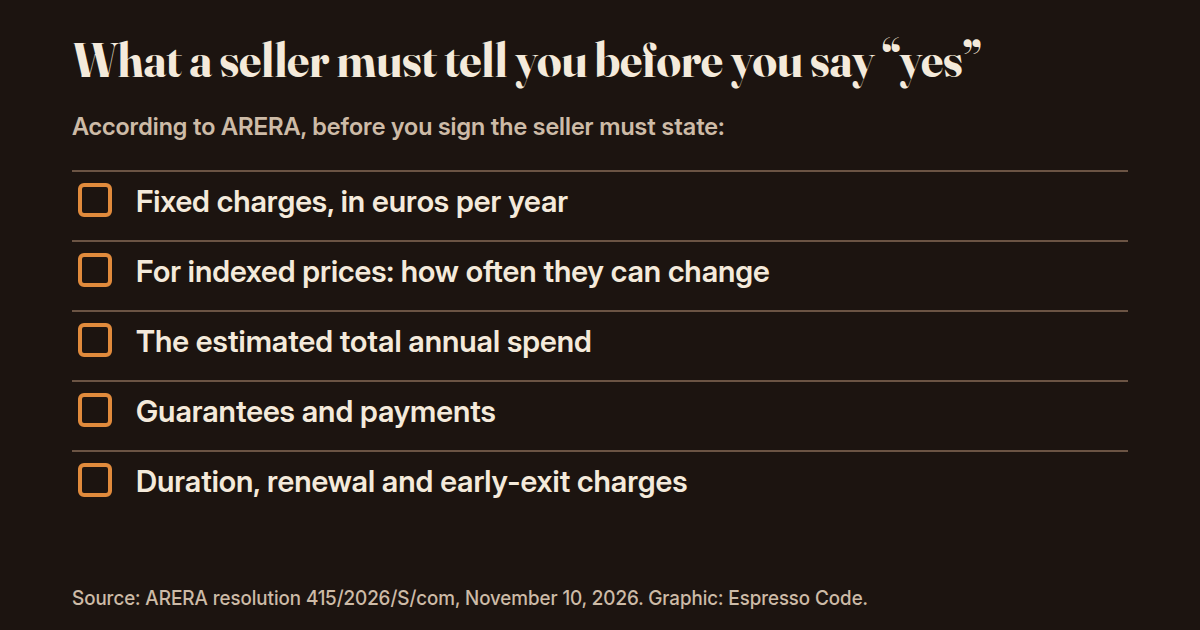
The rules are in the Commercial Conduct Code, which sellers of electricity and gas must follow with household customers and small businesses, even when they call through their agents. According to the decision, before signing the seller must communicate, among other things:
- the fixed charges, the items you pay regardless of consumption, in euros per year and not per month;
- for indexed prices, which follow a market index: how often they can change, by what criterion, and the highest value reached in the last twelve months;
- the estimated total annual spend;
- the guarantees required, for example a security deposit, and the terms of payment;
- the duration of the terms, the renewal and the charges for early withdrawal, that is, canceling before the end date.
The reason, ARERA explains, is that since 2024 the protected service, that is, the regulated price, has ended for non-vulnerable household customers. The free market has become the route for almost everyone, and choosing an offer requires “the utmost information.”
To check an offer before the “yes,” you need the Scheda sintetica, the sheet that summarizes prices and conditions, and the Portale Offerte, where sellers must publish their offers.
What happened on the phone
In one of the electricity calls, asked “the annual spend?”, the operator gave only the amount of the fixed fee: a partial figure and, for ARERA, “entirely misleading.”
In another, asked the same question, the answer was that such a simulation could not be made, because it depends on consumption; ARERA writes, instead, that the information was available, by consumption band, on the Scheda sintetica and on the Portale Offerte.
On gas, in all three calls, ARERA contests that the fixed charge was given in euros per month, alone or together with the annual figure, instead of only in euros per year. It also contests that the information on indexed prices was incomplete or inaccurate.
In one call the estimate of the annual spend was about 50% below the one available; in another the operator said that a one-year term was a legal obligation, whereas according to the decision it is not.
For the electricity offer, ARERA adds that it could be signed only online, whereas the company’s Scheda sintetica listed it, in error, as available by phone too.
Enel’s reply and the limits of the decision
Enel Energia asked for the case to be dismissed. In the briefs reported by ARERA, the company argues that five calls, against 100,000 calls handled each month, are an inadequate number to establish responsibility, and that the information was, in substance, there. Penalizing it for calls by call-center operators would be, it adds, “strict liability,” that is, liability without fault.
The company also recalls having invested so that the 14 companies that run its call centers comply with the Commercial Conduct Code.
ARERA does not accept these arguments, except in part for the two electricity calls: there the operators had said they did not know the offer, and this rules out that the caller could expect precise answers on costs and spend. For electricity, therefore, only the general duty to give correct and complete information remains contested, not the specific obligations.
The amount follows this difference: €25,000 for each electricity call, €125,000 for each gas call, where more provisions are violated.
For the rest, the law, it writes, sets no minimum threshold of relevance, and whoever sells is also answerable for the acts of those who work for it. Each call is the place where obligations toward that customer must be met.
Before the penalty, the company had proposed training, periodic checks and a payment to consumers. ARERA declared the proposal inadmissible, judging the measures “very modest” compared with the size of the company.
And what does the decision not say? It does not establish harm to real customers. According to the decision, the violations, “by the very nature of the checks,” had no harmful effects on customers: it takes this into account in setting the amount, but it is not a conclusion about what happens in calls with real customers.
Nor does it assess the clarity of the offers as a whole, because the complaint concerns what was said on the phone before the contract. And it does not say how many customers received calls like these, or whether the two offers are still on sale.
The fine concerns five calls by fake customers; what remains for anyone with a bill is the list of what a seller must say before the “yes.”
Frequently asked questions
How much is the penalty?
€440,000, according to ARERA decision 415/2026/S/com of November 10, 2026: €400,000 base amount plus one tenth, €40,000, because Enel Energia had already received a penalty from ARERA in 2021. It concerns five calls by fake customers in November 2024.
What must an electricity or gas seller tell me before the contract?
According to the decision, the fixed charges in euros per year; for indexed prices, how often they change and by what criterion; the estimated annual spend; the guarantees; the payments; the duration and the renewal.
Does ARERA say customers were harmed?
No: it writes that, because of the nature of the checks, that is, calls by fake customers, the violations did not produce harmful effects on end customers. It does not say what happens in calls with real customers.
Can Enel Energia appeal?
Yes: according to the decision, to the TAR of Lombardy within 60 days of notification.
Methodology note
Sources: ARERA decision 415/2026/S/com of November 10, 2026 and decision 45/2026/S/com of February 24, 2026, on the commitments, both from the same Authority: there is no independent source. The sums in the table are calculations on the decision’s data. The proceeding had a deadline of November 17, 2026, and the decision is dated November 10: within the deadline. The sources read on November 11, 2026 report no reply from the company other than the one contained in the decision. Quotations are translations.
Sources
Accessed November 11, 2026. Titles of Italian-language sources are given in the original Italian.
- ARERA, decision 415/2026/S/com, “Irrogazione di sanzioni amministrative pecuniarie per violazioni in materia di informazioni precontrattuali ai clienti finali,” November 10, 2026. Primary. Summary page https://www.arera.it/atti-e-provvedimenti/dettaglio/26/415-26 ; text https://www.arera.it/fileadmin/allegati/docs/26/415-2026-S-com.pdf
- ARERA, decision 45/2026/S/com, “Dichiarazione di inammissibilità della proposta di impegni presentata da Enel Energia S.p.A.,” February 24, 2026. Primary, from the same Authority. https://www.arera.it/fileadmin/allegati/docs/26/45-2026-S-com.pdf
Have your say