On November 2, Altroconsumo, an Italian consumer association, wrote, on a page about one brand’s offers, of price reductions “that reach about 37% compared with the list price.” The next day, on a page about one store’s offers, it wrote of savings “from 19% to 31%” “compared with the average price of the last three months.” Two pages, two comparisons. But compared with what, exactly, is a discount calculated?
To answer, I read article 17-bis of the Italian Consumer Code (Codice del consumo), the collection of rules on consumers’ rights, and the two Altroconsumo pages, in eight steps: from the 30-day rule to the limits of the comparison.
What does the law say about discounts?
In Italy every announcement of a price reduction must state the “prior price.” This is provided by article 17-bis of the Consumer Code, which is a legislative decree (206/2005), that is, a law issued by the government on delegation from Parliament, according to Normattiva, the official site for Italian laws.
By “prior price” the law means one specific price: the lowest price the seller applied to consumers in general in the thirty days before the reduction. Not the starting price, not the most frequent one: the lowest.
How is a discount calculated with the prior price?
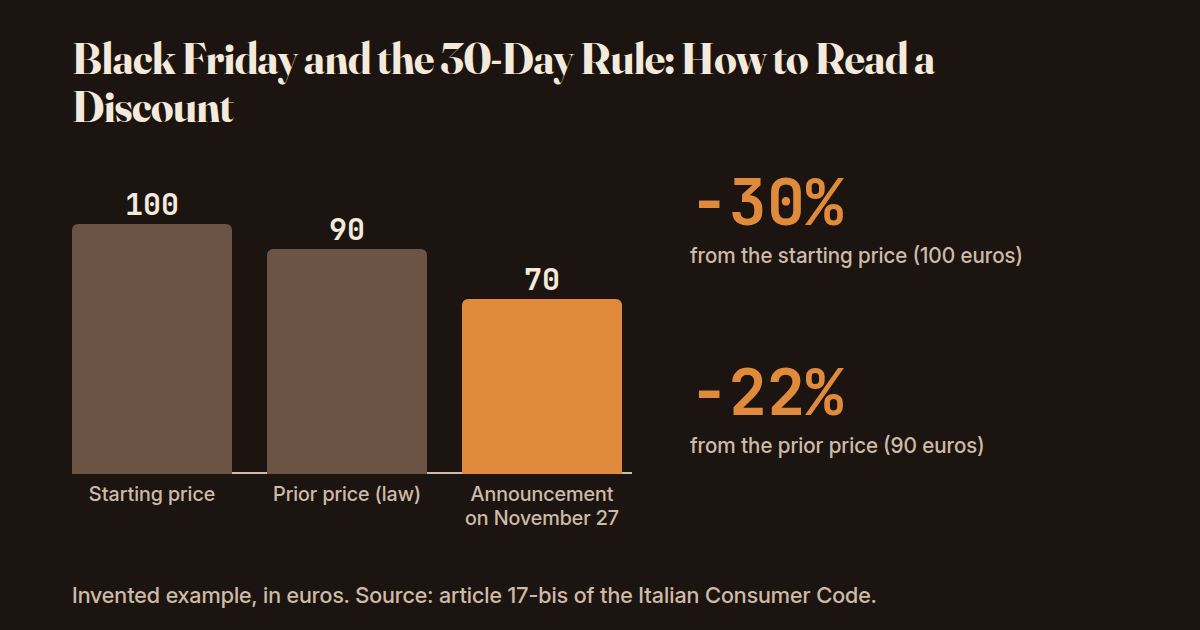
An invented example shows the difference. A product costs 100 euros throughout October. On November 10 the store lowers it to 90 euros for one week, then it goes back to 100. On November 27 it announces a reduction to 70 euros.
| Comparison | Reference price | Discount to 70 euros |
|---|---|---|
| With the price from before the week on sale | 100 euros | 30% |
| With the prior price under the law: the lowest of the thirty days before, from October 28 to November 26 | 90 euros | 22% (rounded) |
The 30% discount is not wrong as arithmetic: 70 is 30% less than 100. But the prior price, under the law’s definition, is 90 in this example, because it is the lowest applied in the thirty days before.
Here the return to 100 euros interrupts the promotion: the law does not define “interruptions,” but on this reading the lowest price of the thirty days applies, that is, 90 euros.
The calculation of a discount is always the same: subtract the discounted price from the starting price and divide by the starting price. The starting price changes, and with it the percentage.
Where does the rule come from, and since when does it apply?
The rule comes from a European Union directive, 2019/2161, which Italy transposed, that is, turned into Italian law, with legislative decree 26/2023. The rules on price reduction announcements have been in force since April 2, 2023, and they apply to promotional campaigns from July 1, 2023, the ninetieth day after the decree came into force.
Black Friday falls on the Friday after Thanksgiving, that is, after the fourth Thursday of November: in 2026 it is Friday, November 27. But the thirty-day rule does not apply only on that day: it applies to price reduction announcements at any time of the year, with the exceptions described below.
Which cases are exceptions?
Here are the concrete cases in which the rule changes.
- Perishable agricultural and food products, that is, products that can become unfit for sale in a short time, such as fruit and vegetables. For them the definition of prior price as the lowest of the thirty days does not apply (article 17-bis, paragraph 3; Italian articles are divided into numbered paragraphs, called commi).
- Products on sale for less than thirty days. The seller states which period the prior price refers to (article 17-bis, paragraph 4). “Launch prices,” that is, the prices of a product that has just come out and is then announced at a higher price, stay outside the rules.
- Stepped reductions. If the discount increases several times in the same campaign, without interruptions (for example from 100 to 90 and then to 70 euros), the thirty-day rule applies to the first reduction; for the later ones the prior price is the price from before the first reduction (article 17-bis, paragraph 5). In that case, for the discount to 70 euros, the prior price would be 100 euros and the 30% discount would be the right one.
- Below-cost sales, that is, at a price lower than the purchase price plus taxes (article 15, paragraph 7, of legislative decree 114/1998). The rule does not apply, and a below-cost price does not count as a prior price (article 17-bis, paragraph 6).
- Special sales, that is, periods of sales or promotions governed by particular rules (liquidation sales, end-of-season sales and promotional sales). The discount must be expressed as a percentage of the “normal selling price,” which must remain displayed (article 15, paragraph 5, of legislative decree 114/1998). To establish that normal price, the same thirty-day rule applies (article 17-bis, paragraph 6). Whether a Black Friday offer is a “promotional sale” in this sense, the sources read do not say.
What do Altroconsumo’s numbers compare?
The two pages are from Altroconsumo Edizioni, and they should be read with a note that the pages themselves state: Altroconsumo “may receive a commission from the store” if you buy through the links, and the content of the page about the brand is “promoted” by the brand itself, through an affiliate company, that is, a company that connects websites and stores and takes a commission on sales. I use them only to understand what comparison the numbers make; I do not name the products and I give no purchasing advice.
- Page of November 2 (about the brand): reductions “that reach about 37% compared with the list price.” The list price is the producer’s official price list. The page says the discounts “are calculated on list prices” and that the promotional prices apply from October 30 to November 30, 2026.
- Page of November 3 (about the store): savings “from 19% to 31%” “compared with the average price of the last three months,” with prices recorded on November 3. The page does not say how the three-month average was calculated.
These are three different things: the list price, the three-month average and the lowest price of the thirty days. Neither page mentions the thirty-day rule or the “prior price.” The rule concerns sellers’ price reduction announcements (article 17-bis, paragraph 1); the comparisons on the two pages are choices made by Altroconsumo’s editorial staff. Which prior price the stores’ announcements state, the pages do not report, and so they do not say whether those announcements comply with article 17-bis.
How do you check a discount announcement?
With the law in hand, a price reduction announcement can be read in four steps. They are questions to ask, not advice on what to buy. The first three can be done with the announcement in front of you; the last one requires the prices of the previous days.
- Is there a prior price? Under the law every price reduction announcement must state it.
- Is the percentage calculated on that price? Redo the calculation: prior price minus discounted price, divided by the prior price. If the result differs from the percentage written, the announcement’s comparison is a different one.
- Does the product fall under an exception? Perishable products, products on sale for less than thirty days, stepped reductions: the rules change, as seen above.
- Is the prior price the lowest of the thirty days? If the announcement speaks of the “list price,” the “suggested retail price” or an average, the comparison is a different one. To know whether the stated price really is the lowest of the thirty days, you need the prices of those days.
The last step has a limit: the law speaks of the prices the seller applied in the thirty days, and whoever looks at the announcement usually knows only today’s price. Whom to contact if an announcement does not follow the rule, the sources read do not say, and I do not address it here.
What is the penalty for not following the rule?
Paragraph 7 of article 17-bis says that anyone who violates the article is subject to an administrative monetary penalty, that is, a fine. It is the one in article 22, paragraph 3, of legislative decree 114/1998 (the law on trade), “to be imposed in the manner provided therein,” that is, to be applied with the procedures provided in that article. Among the criteria the paragraph lists are the seriousness and duration of the violation and the financial benefits obtained.
In that article 22, in the Normattiva text in force since September 14, 2012, the amount is written in lire: from 1,000,000 to 6,000,000. Converted into euros with the rules of the changeover to the euro (legislative decree 213/1998, article 51), it is from 516 to 3,098 euros: the calculation is in the method note.
What can’t the numbers say?
Four limits, to keep in mind.
- The stores’ announcements. Altroconsumo’s pages report the discount percentages, not the prior prices stated in the announcements. Whether an announcement complies with the rule therefore cannot be said from these sources.
- The price history. The rule is measured on the thirty days before the reduction; to check it you need the prices of those days, which the pages do not give.
- The penalty. The amount is the one written in article 22, in lire, converted into euros with the rule of article 51 of legislative decree 213/1998; other rules could change the amount applied in a specific case, and the sources read do not say. Who applies the penalty and how, the sources read do not say: paragraph 7 refers to the procedures of article 22, of which only paragraph 3 has been read.
- Unfair commercial practices, that is, advertising or sales that deceive or put pressure on people who buy, have a different penalty regime: whether they apply to this case, the sources read do not say.
All that remains is to see, on November 27 and the days around it, which comparisons appear in the announcements: the list price, the average, or the lowest price of the thirty days.
Frequently asked questions
What is the “prior price” in discounts?
It is the lowest price the seller applied to consumers in general in the thirty days before the reduction. Under article 17-bis of the Consumer Code, every price reduction announcement must state it; the rule has been in force since April 2, 2023, and applies to promotional campaigns from July 1, 2023.
Is a discount “off the list price” the same as a discount off the prior price?
They are two different comparisons. The list price is the producer’s official price list; the prior price under the law is the lowest price the seller applied in the thirty days before. The percentages can therefore differ. The text of article 17-bis does not mention the list price or the suggested retail price.
Does the rule also apply to fruit, vegetables and other perishable products?
In part. For perishable agricultural and food products, that is, products that can become unfit for sale in a short time, the definition of the lowest price of the thirty days does not apply (article 17-bis, paragraph 3); for other products it does.
What about a product that has just come out?
If it has been on sale for less than thirty days, the seller must state the period the prior price refers to (article 17-bis, paragraph 4). “Launch prices,” that is, the prices of a product that has just come out and is then announced at a higher price, stay outside the rules.
When is Black Friday 2026?
Friday, November 27, 2026: it is the Friday after Thanksgiving, which falls on Thursday, November 26. For a price reduction announcement on that date, the thirty days before run from October 28 to November 26. The rule applies at any time of the year, with the exceptions of article 17-bis.
What can I check myself?
Two things can be checked right away: whether the announcement states a prior price, and whether the discount percentage is calculated on that price, by recalculating it as (prior price − discounted price) / prior price. To know whether the prior price really is the lowest of the thirty days, you need the prices of those days, which whoever looks at the announcement usually does not have.
Related articles
- Italy’s Inflation at 5.4%: What Costs More in the Shopping Cart
- Perceived Inflation and Measured Inflation in Italy: What the Data Say
Method note (for those who want to check the math)
The example of 100, 90 and 70 euros is invented to show the calculation; it does not describe any store or any product. The discount with the prior price is calculated as (90 − 70) / 90 = 22.2%, rounded to 22%; the discount on the starting price as (100 − 70) / 100 = 30%.
The thirty days before November 27 run from October 28 to November 26 (4 days of October and 26 of November). November 27, 2026 is the Friday after the fourth Thursday of November (the 26th): it is a calendar calculation, because none of the sources read gives the date.
Legislative decree 26/2023 was published in the Official Gazette (Gazzetta Ufficiale) no. 66 of March 18, 2023, and came into force on April 2, 2023. Article 2, paragraph 1, says that the rules on price reduction announcements apply to promotional campaigns from the ninetieth day after that date, and July 1, 2023 is the count of those 90 days from April 2.
The criteria of paragraph 7, in full: nature, seriousness, extent and duration of the violation; remedies adopted; previous violations; financial benefits obtained or losses avoided; penalties for the same violation in other Member States; other aggravating or mitigating factors.
The conversion of the lire uses the fixed rate of 1,936.27 lire to the euro (Council Regulation (EC) No 2866/98): 1,000,000 / 1,936.27 = 516.46 and 6,000,000 / 1,936.27 = 3,098.74. For penalties, article 51, paragraph 3, of legislative decree 213/1998 says that decimals are dropped: from 516 to 3,098 euros.
For perishable products, paragraph 3 excludes paragraph 2 (the definition of prior price as the lowest of the thirty days), with the reference to legislative decree 198/2021 (article 2, paragraph 1, letter m, and article 4, paragraph 5-bis) for the definition of “perishable”; paragraph 1, which requires the prior price to be stated, is not named in paragraph 3. For stepped reductions, paragraph 5 speaks of reductions that grow “during the same sales campaign without interruptions.”
The text of European directive 2019/2161 is not among the sources: I cite it from the title of legislative decree 26/2023. The Altroconsumo pages were read on November 4, 2026, with no update date.
Sources
Accessed November 4, 2026. I mark the type of each source: primary (whoever produces the data or the rule), secondary. Titles of Italian sources are in the original, with an English translation in brackets. Quotations from Italian-language sources are my translations.
- Normattiva, Consumer Code (legislative decree of September 6, 2005, no. 206), art. 17-bis “Annunci di riduzione di prezzo” [“Price reduction announcements”], text in force since April 2, 2023. Primary. https://www.normattiva.it/uri-res/N2Ls?urn:nir:stato:decreto.legislativo:2005-09-06;206~art17bis
- Normattiva, legislative decree of March 7, 2023, no. 26, implementing directive (EU) 2019/2161 (title, Official Gazette no. 66 of March 18, 2023, in force April 2, 2023, art. 2, paragraph 1). Primary. https://www.normattiva.it/uri-res/N2Ls?urn:nir:stato:decreto.legislativo:2023-03-07;26~art2
- Normattiva, legislative decree of March 31, 1998, no. 114, art. 22, paragraph 3, text in force since September 14, 2012. Primary. https://www.normattiva.it/uri-res/N2Ls?urn:nir:stato:decreto.legislativo:1998-03-31;114~art22
- Normattiva, legislative decree of June 24, 1998, no. 213, art. 51 “Conversione delle sanzioni pecuniarie penali o amministrative” [“Conversion of criminal or administrative monetary penalties”], paragraphs 2 and 3. Primary. https://www.normattiva.it/uri-res/N2Ls?urn:nir:stato:decreto.legislativo:1998-06-24;213~art51
- Normattiva, legislative decree of March 31, 1998, no. 114, art. 15 (special sales: paragraphs 1, 5 and 7), text in force since December 31, 2023. Primary. https://www.normattiva.it/uri-res/N2Ls?urn:nir:stato:decreto.legislativo:1998-03-31;114~art15
- Altroconsumo, (original title) “Dyson, già partite le offerte Black Friday: i 5 prodotti da non perdere.” [“Dyson, Black Friday offers have already started: the 5 products not to miss.”], November 2, 2026. Secondary; the publisher declares a commercial relationship with the brand and a possible commission from the store. https://www.altroconsumo.it/soldi/black-friday/news/offerte-dyson-black-friday-2026
- Altroconsumo, “Offerte MediaWorld prima del Black Friday: 6 prodotti davvero in sconto” [“MediaWorld offers before Black Friday: 6 products really on sale”], November 3, 2026. Secondary; the publisher declares a possible commission from the store. https://www.altroconsumo.it/soldi/black-friday/news/offerte-mediaworld-novembre
Have your say