How much does it cost to run an artificial intelligence model like GLM in-house for 2,000 engineers, and would it be worth it for us too?
To answer, I started from what David Abitbol, of Revolut, said at AI Engineer in New York (a conference on artificial intelligence) on October 13, 2026. I redid the math with the list prices of November 5, 2026, in six steps: from what Abitbol said, to Revolut’s numbers, to what a small team would need.
“We” here means a company with a small team of developers. “In-house” means not with an API (the paid service for using a model on the maker’s servers), but on compute cards chosen by the company: in the calculations, rented. Anthropic and OpenAI are the companies behind Claude and ChatGPT; GLM is an artificial intelligence model from the Chinese company Z.ai, which Revolut uses so that its engineers can write programs.
Abitbol’s quotations are taken from the talk’s automatic transcript, which can contain errors; the timestamps are in the methodology note.
What did Abitbol say?
Revolut is a European digital bank. Abitbol, who says in the talk that he leads the company’s AI operations, says that around April 2026 Revolut began to self-host, on dedicated GPUs, an “open” model, meaning one with downloadable weights: the weights are the numbers that make up its “knowledge” after training. It is GLM, now in version 5.3, used to write code.
The figures he gives, from the stage:
- “to serve 2,000 engineers, we roughly need 56 B200”: 56 compute cards (GPUs, made by Nvidia, used to run AI) of the B200 type;
- an average cost of 30 cents per million tokens (the conference page says $0.30); a token is a piece of text, a word or part of a word, that the model reads or writes;
- “our invoice is one-tenth of what we were spending on Anthropic and OpenAI”;
- requests per second going from about 3 in April to more than 7 in August, with the same number of GPUs according to the conference page (in the transcript the sentence is not clear).
These are figures declared by the company, not verified by anyone else. Abitbol also says that Claude Code and Codex, the AI assistants from Anthropic and OpenAI that write programs together with engineers, stay in use “as exception” (for Claude Code this is a probable reading: the automatic transcript has “code code”).
How much do 56 cards cost, and how many tokens are needed?
In short: from $141,000 to $403,000 a month for 56 cards, depending on the contract; the calculations are consistent with what Abitbol says, but they do not prove it.
The first calculation: what 56 B200s cost to rent. Billed by the hour, that is, with no commitment, the prices published on November 5, 2026 by the companies that rent out compute cards run from $7.99 an hour per card (RunPod) to $8.60 (CoreWeave): at 730 hours a month, from $327,000 to $352,000 for 56 cards.
They are not a ceiling: they are below Lambda’s clusters (groups of cards for rent: from $9.36 to $9.86 an hour, from about $383,000 to $403,000 a month) and above the price with the discount of up to 60% that CoreWeave says it offers for committed use, under a term contract (about $141,000 a month). The prices Revolut pays are not known.
The second calculation: how many tokens are needed. The tokens are derived from the assumed cost, so they neither confirm nor refute Abitbol. First assumption: the 30 cents are the cost divided by all the tokens served, cache included (that is, text already read, which the service remembers and rereads at a reduced price). Abitbol says “blended cost of token” and does not explain how he counts it. Second assumption: today’s invoice is only the rental of the 56 GPUs. At hourly prices the cards must serve about 1.1 trillion tokens a month: with 7 requests per second, day and night, about 60,000 tokens per request.
How much did they spend before, and why isn’t it only a matter of prices?
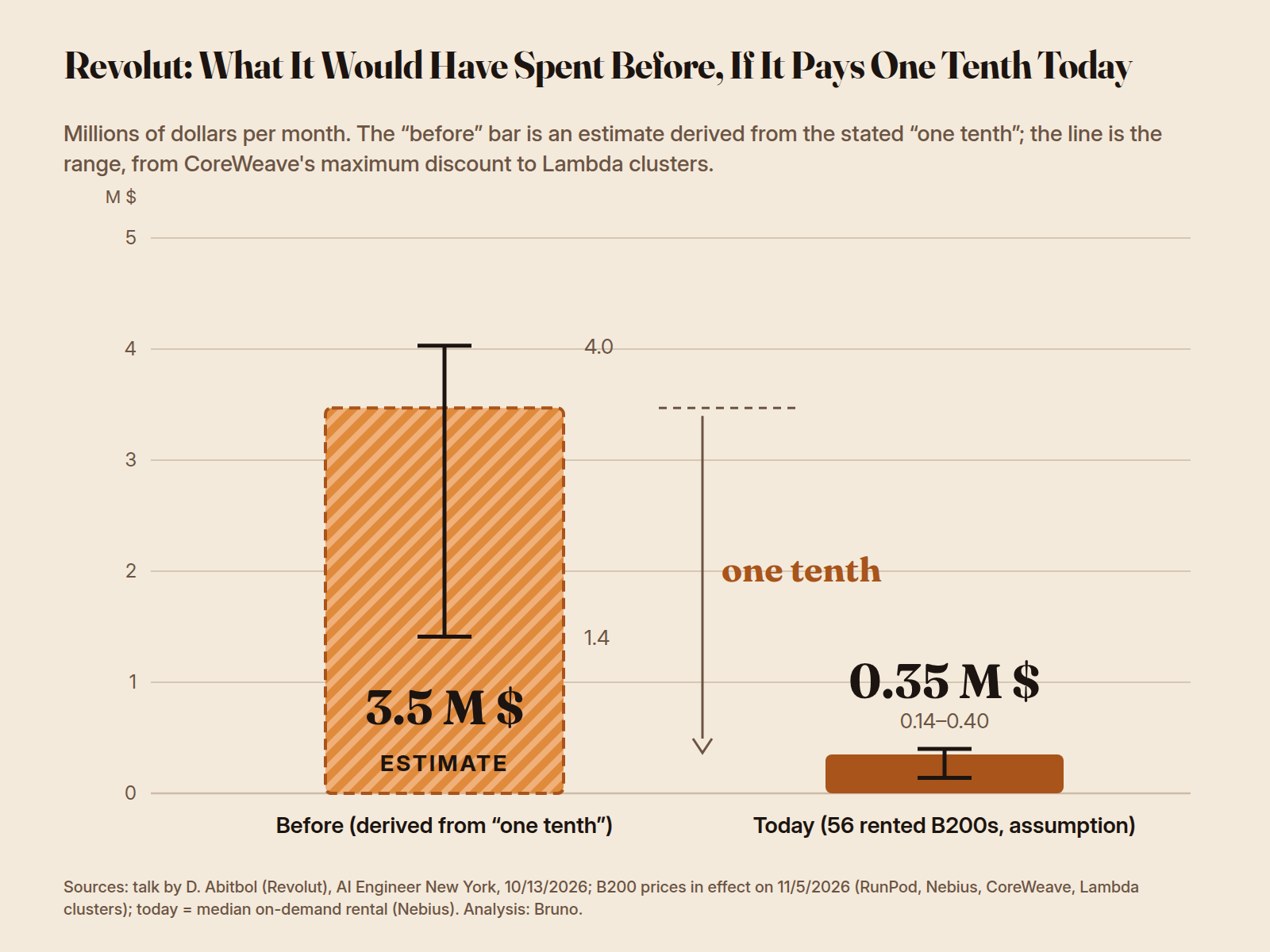
In short: if today’s invoice is one-tenth, before that Revolut was spending about $3.5 million a month (estimate); with 90% cache and today’s API prices, the “one-tenth” is not explained by prices alone.
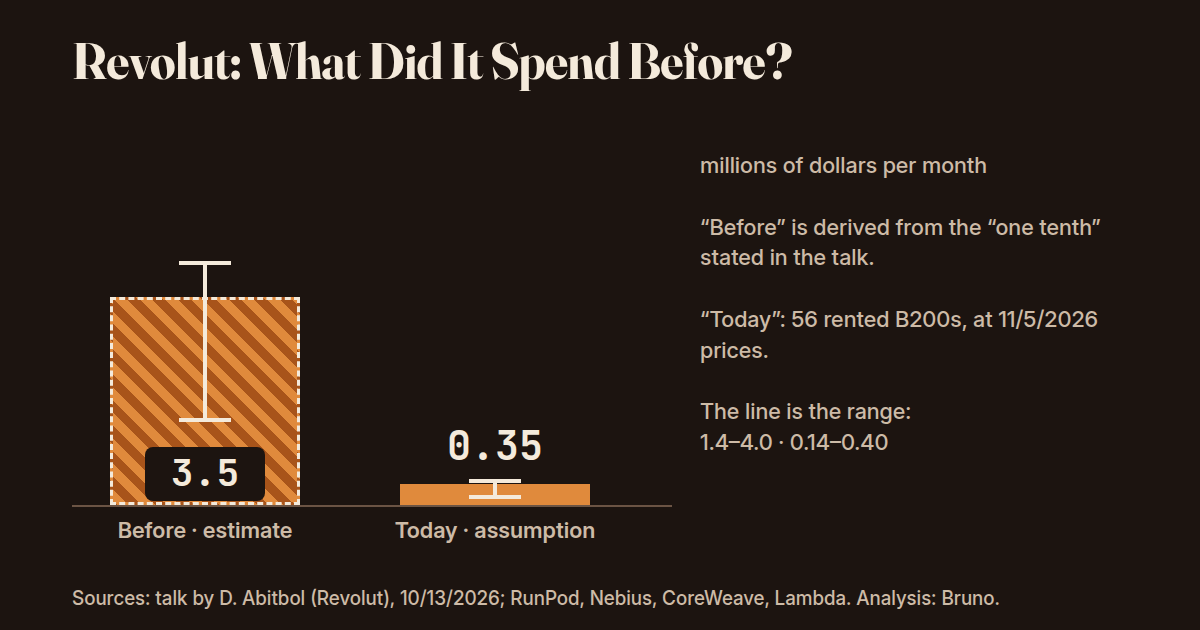
If today’s invoice is one-tenth (assumption: only the rental of the 56 GPUs), before that Revolut was spending about $3.5 million a month on the AI that writes code, about $1,700 per engineer. It is an estimate, not a figure: the range goes from 1.4 to 4.0 million depending on the price of the GPUs (from 1.2 to 5.0 if “one-tenth” is rounded, between 8% and 12%). Abitbol says that some engineers were spending “a thousand a month, 10,000 a month” (currency not stated).
The comparison with the APIs is made with the same number of tokens and at today’s list prices, with 2-10% output tokens (the part written by the model) and the cache. The 90% cache is the threshold that Abitbol gives his listeners for a server of their own (according to the automatic transcript, which is unclear), not Revolut’s share; hence the two scenarios.
How many times the $0.30 the APIs would cost for the same number of tokens, at the list prices of November 5, 2026:
| Model | Cache at 50%: times the $0.30 | Cache at 90%: times the $0.30 |
|---|---|---|
| GLM-5.3 served by Z.ai | 3.0 to 4.0 | 1.5 to 2.6 |
| Claude Sonnet 5.5 | 4.1 to 6.5 | 1.6 to 4.2 |
| gpt-5.3-codex | 4.1 to 7.6 | 2.0 to 5.7 |
| Claude Opus 5.5 | 8.2 to 13 | 3.2 to 8.4 |
For the same number of tokens and today’s list prices, with 90% cache the APIs would cost from 1.5 to 8 times the $0.30; with 50% cache, from 3 to 13 times (for Opus 5.5 from 8.2 to 13, so the 10 falls within the range).
The comparison holds the tokens fixed: Abitbol says that Claude Code was launched “with strict budget limits” and that requests have increased. If Revolut uses more tokens today than before, the ratio between the prices of then and now should exceed 10, not stay below it. The “one-tenth” is therefore compatible with several explanations: more expensive models or higher prices back then (the list prices of January-April 2026 are not among the sources read), less cache, different volumes, or an invoice that includes something else. The talk does not say which.
What if we wanted to do it ourselves? What it takes
In short: you need very powerful compute cards in a single server; an ordinary computer is not enough.
The technical guide from vLLM, the program that runs the model, indicates for the official weights, compressed in FP8 format (a format that squeezes the model’s numbers so they fit in less memory), a server with 8 H200 GPUs (1,128 GB of memory in all). For the context of one million tokens (the maximum length of text the model can read) it indicates instead 8 B200s. H200, H100 and B200 are models of Nvidia compute cards.
GLM-5.3 has about 750 billion parameters, the model’s internal numbers: the more there are, the bigger the model and the more memory it takes (743 according to vLLM’s guide, 753 counted by Hugging Face, the site where models are downloaded, from the model files). The FP8 weights come to about 755 GB: they do not fit in an ordinary computer, but in a server with 8 very powerful compute cards.
- The hardware. With 8 H100s (640 GB) they do not fit. With an even more compressed format (NVFP4, prepared by third parties) the weights drop to about 465 GB; how many cards are enough, the guide does not say.
- The license is permissive: the details, with the conditions, are in the frequently asked questions.
- A smaller variant, GLM-5.3-Flash (321 billion parameters, MIT license, which allows using the model almost without limits), still weighs about 306 GiB: it is not a model for a desktop computer.
These are figures declared by the projects: none of them has been tested on a GPU.
From how many developers is it worth it?
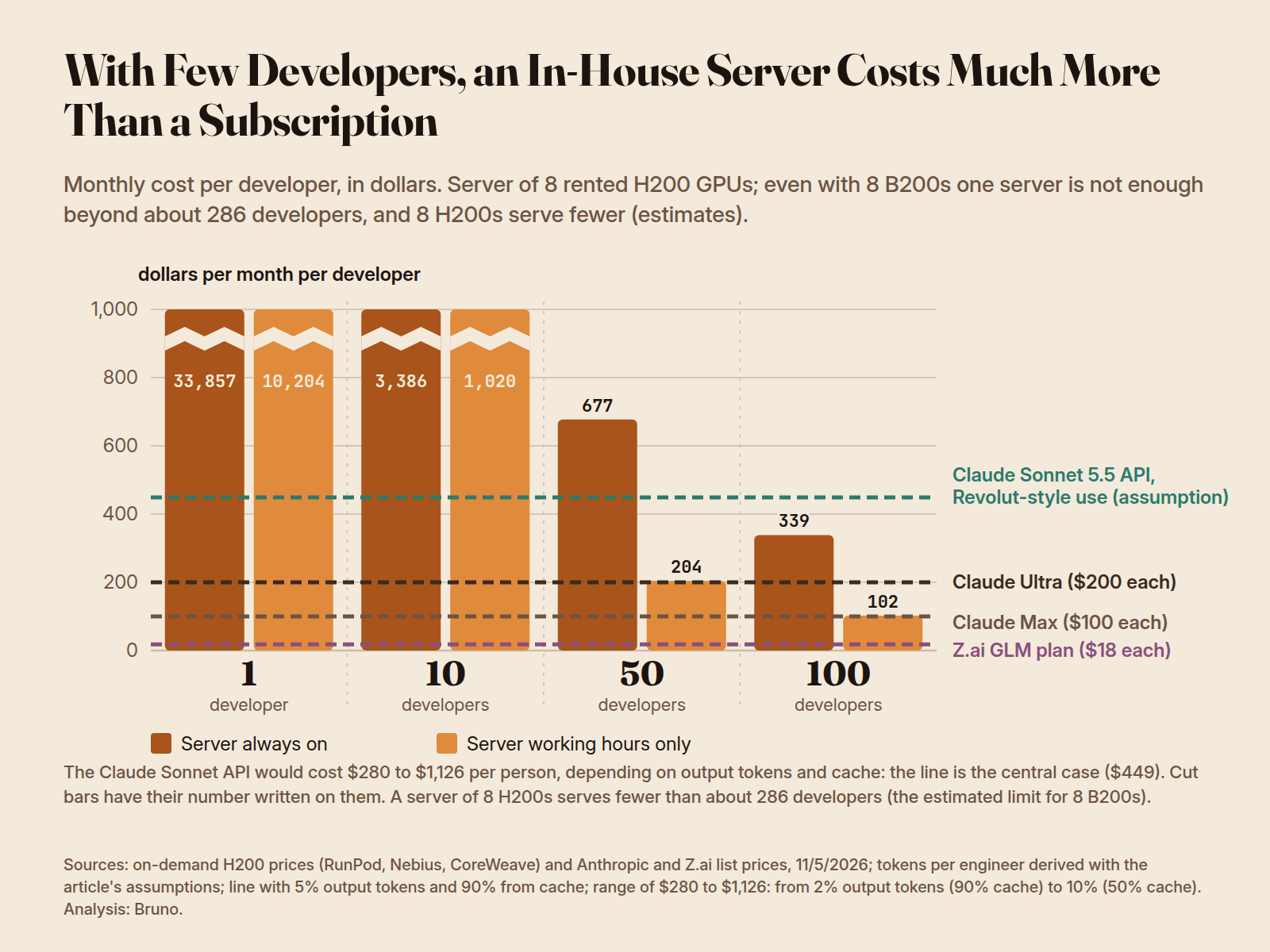
In short: with 1 or 10 developers it is never worth it; with 50 it is worth it against the APIs used the way Revolut uses them (against Opus even with the server always on, against Sonnet only with the server on during working hours); against Claude Ultra you are at the limit (47-56 developers, during working hours). For those who only want to use GLM, Z.ai’s plan costs less than the server at any team size, but the data goes to Z.ai.
A rented server with 8 H200s costs from $30,900 to $36,800 a month always on, from $9,300 to $11,100 if on only during working hours (10 hours for 22 days). With 10 developers that is $930 to $1,110 each during working hours ($3,090 to $3,680 always on); with 50, $186 to $222 ($618 to $736).
The alternatives, per developer per month:
- Z.ai’s plan for programming with GLM, $18 (the same model, without GPUs; the data goes to Z.ai);
- Claude Pro $17 (billed annually; $20 a month if monthly), Claude Max $100, Claude Ultra $200 (monthly subscriptions from Anthropic for using Claude).
With the APIs, for someone who consumes like a Revolut engineer (about 580 million tokens a month, derived with the assumptions of the calculations): GLM-5.3 from Z.ai $333, Sonnet 5.5 $449, gpt-5.3-codex $588, Opus 5.5 $898.
From how many developers the 8-H200 server costs less than the alternative:
| Against | During working hours only | Always on |
|---|---|---|
| Z.ai GLM plan ($18) | 518-617 (beyond the capacity of one server) | 1,717-2,046 (beyond the capacity) |
| Claude Max ($100) | 94-111 | 309-369 (beyond the capacity of one server) |
| Claude Ultra ($200) | 47-56 | 155-185 |
| Sonnet 5.5 API, Revolut-style use (assumption) | 21-25 | 69-82 |
| Opus 5.5 API, Revolut-style use (assumption) | 11-13 | 35-41 |
These break-even points (the number of developers from which the server costs less) hold as long as one server is enough. With Revolut’s ratio (2,000 engineers on 56 B200s, about 36 per card) an 8-B200 server handles about 286; with 8 H200s it handles fewer, but this has not been measured.
The break-even against Claude Max with the server always on (309-369) is above this capacity: two servers would be needed, and the number does not hold. Revolut’s ratio comes from a carefully tuned system (time to first token, that is, the time that passes before the first word of the answer appears, from 14.26 to 1.68 seconds, according to the page): a small team might serve fewer developers per card.
What the calculations do not count, and what the sources do not say
- What the calculation does not include. Staff, network, space, monitoring, security and tuning work: according to the page, which describes a chart shown by Abitbol, the time to first token (the time that passes before the first word of the answer appears) fell from 14.26 to 1.68 seconds with the same number of GPUs; out loud Abitbol says “over 10 seconds” and “around 1.6.” The conference page says that self-hosting leaves Revolut responsible for lower costs, for security rules (sandbox) and for telemetry (the operating data needed to understand what happened if there is an incident).
- Switching on, failures, updates and subscriptions. Shutting the server down in the evening means reloading 755 GB of weights in the morning; failures and updates are not in the calculation; subscriptions are a fixed cost per head, without comparing how much they allow you to use.
- The data. Abitbol says, in general, that using the weights on a service based in the United States does not mean using a service that goes to China: it is his own statement, under conditions he sets, for programming tasks.
- What Revolut’s invoice contains, which period it is compared with, who owns the GPUs, the tokens served. Out loud Abitbol gives about 3 requests per second in April and more than 7 in August, and also says “76% increased demand” (5:43:35); the page reports +76%. From about 3 to more than 7 would be more than double: the figures do not match and the talk does not explain why. In the sources read, no other document confirms the figures; the list prices are from November 5, 2026 and change often.
To the opening question the sources answer as follows: the calculations are consistent with Abitbol (the tokens are derived from the assumed cost), and with 90% cache the “one-tenth” is not explained by today’s prices alone. With 1 or 10 developers an in-house server costs more than the alternatives; from 50 it may be worth it against heavily used APIs; for those who only want GLM, Z.ai’s plan costs less at any team size.
These are calculations with declared assumptions, not purchase advice.
All that remains is to see whether Revolut, or others, will publish the overall cost and not just that of the tokens.
Frequently asked questions
How much does it cost to run GLM-5.3 the way Revolut does?
Rented, at the prices published on November 5, 2026, from $141,000 a month (CoreWeave’s maximum discount for committed use) to $403,000 (Lambda clusters); hourly, from $327,000 to $352,000. Revolut’s price is not known. The calculation starts from what Abitbol says: about 56 B200 GPUs for about 2,000 engineers.
From how many developers is it worth doing in-house?
With an 8-H200 server, from about 11 to 13 developers against Opus 5.5 APIs used like Revolut, and from about 94 to 111 against a Claude Max subscription, if the server is on only during working hours and handles that many (not measured). Always on, 35 to 185 developers are needed, depending on the alternative; against Claude Max (309-369) one server is not enough. With 1 or 10 developers it is never worth it.
Can GLM-5.3 be used for work?
According to the license as read on Hugging Face, yes: use, modification and fine-tuning are permitted, with the copyright notice to be kept and compliance with the law. Only those who offer an AI service to third parties with total revenue above $10 billion in 12 months must pass a security review by Z.ai. This is not legal advice.
Is Revolut’s “one-tenth” true?
It cannot be verified: it is a figure declared from the stage. The calculations make it consistent, but with 90% cache today’s prices alone do not explain it: for the same number of tokens the APIs would cost from 1.5 to 8 times the $0.30 per million, not 10 (with 50% cache, up to 13).
How many GPUs does it take to run GLM-5.3?
With the official weights in FP8 format, which come to about 755 GB, vLLM’s technical guide indicates a server with 8 H200 GPUs (Nvidia compute cards; 1,128 GB of memory in all), or 8 B200s for the context of one million tokens. With 8 H100s (640 GB) they do not fit. With an even more compressed format (NVFP4, prepared by third parties) the weights drop to about 465 GB; how many cards are enough, the guide does not say.
How much was Revolut spending before?
It is an estimate, not a figure: if today’s invoice is one-tenth (assumption: only the rental of the 56 GPUs), before that Revolut was spending about $3.5 million a month on the AI that writes code, about $1,700 per engineer, with a range from 1.4 to 4.0 million depending on the price of the GPUs. Abitbol does not say which period the “one-tenth” refers to.
Read also
- Taking the brakes off a model like GLM-5.3 costs about $1,200, Anthropic estimates: who benefits?: the same model, GLM-5.3, in another context, the versions with the refusals removed (it is not about Revolut).
- A Raspberry Pi 5 with a “Neuromorphic” Chip for $1,295: What BrainChip Promises and What Is Still Unknown: hardware for running AI locally, with the price reported by a news outlet (the manufacturer’s press release does not state it).
Methodology note (for those who want to check the calculations)
A token check: with 5% output tokens, each card would have to generate from 370 to 400 tokens per second. At the speed of 200 tokens per second per conversation that Abitbol states, that is about 110 simultaneous conversations on average, 5-6% of the 2,000 engineers: plausible, not verifiable (the vLLM and SGLang recipes do not publish the speed per card).
I read the talk’s page (https://ai.engineer/nyc/2026/talks/revolut) and its transcript on November 5, 2026; the transcript, the page says, is automatic and may contain errors. The timestamps are those of the livestream recording. The prices of GPUs, APIs and subscriptions are the list prices published on the suppliers’ pages and read on November 5, 2026. The calculations were redone in R from the input data, which I keep with source and time of reading.
Declared assumptions:
- a month of 730 hours; “during working hours” = 10 hours for 22 days = 220 hours;
- prices published on November 5, 2026: on-demand (RunPod, Nebius, CoreWeave), Lambda clusters, CoreWeave’s maximum discount; the price list for Lambda’s instances, which will take effect on November 16, 2026 (until then it can only be seen with an account), is outside the calculations; Revolut’s price is not known;
- the 30 cents are the cost divided by all the tokens served, cache included; today’s invoice is only the rental of the 56 GPUs;
- “one-tenth” also read as between 8% and 12%;
- average API price: 2-10% output tokens, cache at 50% or 90% (scenarios), cache writes not counted (the APIs come out a little cheaper than the real figure: for Opus 5.5 from 3.6 to 8.7 times instead of 3.2-8.4), today’s list prices;
- “Revolut-style use”: about 580 million tokens a month per engineer (from 230 to 670 depending on the price), total tokens derived divided by 2,000, with 5% output tokens and 90% cache;
- capacity of one server: Revolut’s ratio (about 36 developers per B200).
The 90% cache threshold is advice from Abitbol on the parameters to tune (“check your cache hit, coding test needs to be above 90% cache hit,” according to the automatic transcript, which is unclear). The quotations from the talk, with their timestamps:
- “to serve 2,000 engineers, we roughly need 56 B200” (5:41:18);
- “blended cost of token is 30 cents per million” (5:42:17-5:42:19); “And so our invoice is one-tenth of what we were spending on Anthropic and OpenAI” (5:42:22-5:42:24);
- “request per second around 3” (5:43:08); “requests per second were over 7” (5:43:28); “88% improvement in performance for 76% increased demand” (5:43:35); “time to first token over 10 seconds” (5:43:15); “we’re around 1.6” (5:43:28); “We serve, in terms of interactivity, 200 tokens per second” (5:41:48-5:41:51);
- “engineers spend a thousand a month, 10,000 a month” (5:39:36-5:39:39); “we launched it with strict budget limits” (5:39:43);
- “So obviously we keep using codex, code code… But we keep them as exception” (5:40:59-5:41:07; “code code” is read as “Claude Code” because at 5:47:04-5:47:07 the same transcript has “And the sandbox means now if you’ve used Codex Claude Code, it has all of these features of approve for me”; the reading is not confirmed by the audio);
- “you’re not using inference, dedicated endpoint that goes to China. you’re just getting the weights and putting them on a US-based service” (5:46:21-5:46:27).
Sources
Consulted on November 5, 2026. I mark the type of each source: primary (who says or produces the figure), price list (public prices), project (documentation from whoever serves the model).
- AI Engineer NYC 2026, “Shipping like a startup, regulated like a bank,” David Abitbol (Revolut), October 13, 2026: the talk’s page (summary with no author stated) and automatic transcript. Primary for the spoken word; the summary has no stated author. https://ai.engineer/nyc/2026/talks/revolut
- Livestream of the conference on YouTube, from 5:36:54 to 5:48:28 of the recording. Primary. https://www.youtube.com/watch?v=akEqiXFo3GM
- GPU rental prices: Lambda https://lambda.ai/pricing; RunPod https://www.runpod.io/pricing; Nebius https://nebius.com/prices; CoreWeave https://www.coreweave.com/pricing. Price list.
- API and subscription prices: Anthropic https://platform.claude.com/docs/en/about-claude/pricing and https://claude.com/pricing; OpenAI https://platform.openai.com/docs/pricing; Z.ai https://docs.z.ai/guides/overview/pricing and https://docs.z.ai/devpack/overview. Price list.
- Hugging Face,
zai-org/GLM-5.3(model card, configuration, license) andzai-org/GLM-5.3-Flash. Primary. https://huggingface.co/zai-org/GLM-5.3 and https://huggingface.co/zai-org/GLM-5.3-Flash - vLLM recipes, GLM-5.3: https://recipes.vllm.ai/zai-org/GLM-5.3; SGLang cookbook, GLM-5.3: https://cookbook.sglang.io/autoregressive/GLM/GLM-5.3. Project.
- NIST CAISI, “CAISI’s Assessment of Z.ai’s GLM-5.3 Cyber Capabilities,” September 17, 2026 (identifies Z.ai as a China-based company, formerly Zhipu AI, and GLM-5.3’s release on August 14, 2026). Primary, independent. https://www.nist.gov/news-events/news/2026/09/caisis-assessment-zais-glm-53-cyber-capabilities
Leave a Reply