Since July 1 there has been a European customs duty of 3 euros on packages coming from outside the European Union; since November 1 another levy of 2 euros has been added, a handling fee; a third, Italian one has been postponed. Is that 5 euros more on every Temu and Shein package?
To answer, I read the notices of the Italian Customs and Monopolies Agency (ADM), the European Commission’s pages and the decree-law, in six steps: from the three levies that get mixed up to what the sources do not yet say.
What are the three levies, and how much are they?
On packages from outside the EU there are three different levies, and the headlines mix them up. (In the table, “paragraph” translates the Italian “comma,” the numbered part of an article.)
| Levy | Amount | Since | Status |
|---|---|---|---|
| EU customs duty | 3 euros per type of item (ADM: “per item,” not per piece or per package), up to 150 euros in value | July 1, 2026, until July 1, 2028 | in force |
| EU handling fee (“Union Handling Fee,” UHF) | 2 euros per item, whatever the value | November 1, 2026, no expiration | in force |
| Italian contribution | 2 euros per shipment (law 199/2025, art. 1, paragraph 127) | postponed to January 1, 2027 | postponed; proposal to cancel it |
Temu and Shein are the names in the title: the official sources do not name any platform. The rules apply to distance sales of goods from countries outside the European Union, with some exclusions.
Altroconsumo (an Italian consumer association that also has a commercial activity: the detail is in the Sources) reports that Temu, in a reply from its legal team, declared that for extra-EU orders up to 150 euros it applies “3 euros for each different type of product plus the applicable VAT”; it also reports that Shein marks with the label “Magazzino EU” (EU warehouse) the products located in the Union. It warns, however, in general, that for marketplaces (online stores that sell other people’s goods), using warehouses in Europe “does not automatically guarantee that EU levies will not apply.” What each platform does is not verified here on their pages.
Is the 3-euro duty “per package” or “per item”?
Per item, and “item” does not mean “piece.” The tax, ADM writes, “is not determined for each individual package, but on the basis of the tariff classification of the individual items contained in the package and declared at customs” (translation mine): in Italian the word is “collo,” which means package, and the tariff classification is the code with which customs classifies each type of product. In practice, you pay per type of product.
ADM’s page gives two examples. Five identical T-shirts: 3 euros. One T-shirt and one watch: 6 euros, because they are two different types.
What changes on November 1 with the 2-euro fee?
Since November 1 there has been the “Union Handling Fee” (UHF), a handling fee. In its notice of October 23, ADM writes that it is “per item (not ad valorem),” that is, it does not depend on the price: 2 euros, set by the European Commission with delegated regulation (EU) 2026/2152, published on October 22, 2026.
Three features matter to buyers:
- It applies regardless of value. It applies even above 150 euros, where the 3-euro duty does not apply and ordinary duties do (Altroconsumo).
- It has no expiration and is not refundable: it is a measure that is “permanent and without time limits.”
- It carries VAT. ADM writes that it is “taxable for VAT purposes.” Altroconsumo writes that VAT is paid on the 2 euros “in any case”: at 22%, 2.44 euros per item; on another page, that VAT is added “if the two amounts are charged at the time of purchase.”
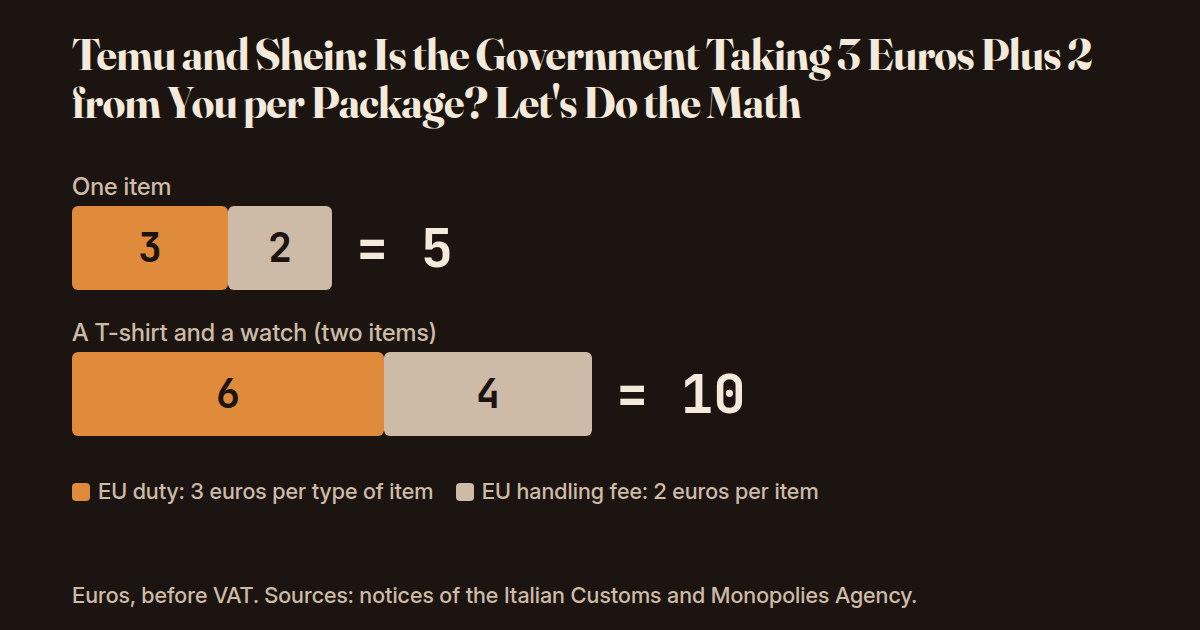
An example with different products, for which there is no doubt about the count: a T-shirt and a watch, two items, pay 6 euros of duty and 4 euros of handling fee, that is, 10 euros before VAT.
With a single item the sum is 3 plus 2: 5 euros, which Altroconsumo brings to 6.10 with 22% VAT on both; as for VAT on the duty, the report on the 2027 draft budget bill writes that the flat-rate duty of 3 euros is, “according to the Commission’s determinations,” part of the VAT taxable base (the amount on which VAT is calculated). So, in packages up to 150 euros, the “5 euros” is the minimum for one item, not a figure “per package”: with more types it grows.
Who pays: the customer or the seller?
In brief: the 3-euro duty and the 2-euro handling fee are levies of the European Union. Under European rules, the duty and the handling fee fall, as a rule, on the seller or the importer, not on the customer (for the duty, the buyer pays only in extremely rare cases). Who bears the cost is another matter: no rule prevents the seller or the importer from adding them to the price or to shipping costs, and according to a statement by Temu reported by Altroconsumo the platform “applies 3 euros for each different type of product” to orders. It is likely that the cost falls, in whole or in part, on the buyer: on a product that costs a few euros, 5 euros weighs heavily on the price and on the seller’s earnings. That is a forecast, not a fact.
For the duty, ADM writes that the party responsible for payment is the declarant of the goods (whoever files the customs declaration), “that is, the seller or the importer,” and in its frequently asked questions adds that the buyer pays “only in extremely rare cases.” The Commission writes that the duty “is not a tax on consumers.”
For the handling fee, ADM’s notice names the declarant as the “principal debtor,” that is, whoever has to pay, as for the duty. Altroconsumo writes that “no rule prevents the seller from passing the cost on,” that is, from shifting it.
In Altroconsumo’s November 1 test, a shirt of about 7 euros on Temu came to almost 12 with 6.10 euros of levies, which the platform was covering in part (20%) at the time.
A precedent, in another market: in April 2025 Temu and Shein announced price increases in the United States, while the US was applying 145% tariffs on imports from China and preparing to end the exemption for low-value packages. Shein attributed the increase to changes in global trade rules and tariffs, Temu to higher operating expenses (CBS News, April 17, 2025). It does not say what they will do in Europe.
And the Italian 2-euro contribution?
It is a third thing, Italian only: a contribution of 2 euros per shipment. A decree-law (an emergency measure of the government) postpones its application to January 1, 2027. In the 2027 draft budget bill (the government’s spending proposal, which Parliament must approve), the government proposes to cancel it. It is a proposal, not an approved law. The decree does not state the amount: the 2 euros per shipment are in the 2026 budget law (law 199/2025, article 1, paragraph 127), as the report on the 2027 draft budget bill recalls.
What do the sources not yet say?
- What an “item” is for the handling fee. ADM’s notice does not define it; for the duty, ADM and the Commission say it is counted by tariff classification. Altroconsumo writes that the fee is counted the same way (five identical T-shirts from the same origin: one item). The European text that defines it is not among the sources read.
- The Italian contribution. The text of paragraphs 126-128 of law 199/2025 is not among the sources read here; the report on the draft budget bill summarizes its content (2 euros per shipment, up to 150 euros of declared value).
All that remains is to see, from the first orders in November, how much of these levies will show up in the price paid by buyers.
Frequently asked questions
How many levies do you pay on a Temu or Shein package?
For a single item under 150 euros, 5 euros: 3 of duty and 2 of handling fee, which Altroconsumo brings to 6.10 with 22% VAT on both. With more types of product the sum grows.
Does the 2-euro fee also apply above 150 euros?
Yes: according to ADM it applies “regardless of the value of the goods,” so also to shipments of more than 150 euros. The 3-euro duty, instead, applies only up to 150 euros; beyond that, according to Altroconsumo, ordinary duties apply. The fee has no expiration and is not refundable.
Is the 3-euro duty per package or per item?
Per type of item, not per piece or per package. Five identical T-shirts: 3 euros; one T-shirt and one watch: 6 euros.
Who pays the duty and the handling fee?
As a rule, under European rules, the seller or the importer: for the duty, ADM names the declarant (whoever files the customs declaration) and the buyer pays “only in extremely rare cases”; for the handling fee, the “principal debtor” is the declarant. According to Altroconsumo, no rule prevents the seller from passing the cost on in the price. That the cost ends up with the buyer is likely, but it is a forecast.
Is the Italian 2-euro contribution being paid now?
No: it is postponed to January 1, 2027. The government, in the 2027 draft budget bill, proposes to cancel it: it is a proposal, not an approved law.
Related articles
Method note (for those who want to check the math)
The example with the T-shirt and the watch uses the two types in ADM’s example for the duty (3 euros each, so 6) and counts the handling fee per item (2 euros each, so 4): 6 plus 4 makes 10, before VAT. The 2.44 is 2 euros plus 22% (2 × 1.22); the 6.10 is, according to Altroconsumo, 5 euros plus 22%. VAT on the duty is not calculated here: the 6.10 is Altroconsumo’s. That the duty enters the taxable base is written in the technical report to A.C. 3174 (p. 257) and provided for by the VAT directive (2006/112/EC, art. 86, par. 1, letter a).
ADM’s page on duties, which has no date, still calls the handling fee a “proposal,” while the notice of October 23 gives it as set at 2 euros; the page lists the same notice among its documents.
Legal references. Handling fee: delegated regulation (EU) 2026/2152, published on October 22, 2026 (ADM dates it October 21, 2026 and calls the delegated act “of 21.09.2026”; the report on the draft budget bill gives C(2026)6694 of September 21, 2026: the official sources do not coincide); debtor: the declarant, identified among the holder of the IOSS (the EU scheme for VAT on distance sales of imported goods), those adhering to the Special Arrangements and the indirect customs representative.
Italian contribution: provided for by paragraphs 126-128 of article 1 of the law of December 30, 2025, no. 199; decree-law no. 193 of October 23, 2026, in force since October 24, in article 1, paragraph 3, replaces the date “October 1, 2026” with “January 1, 2027” in another decree-law, no. 38 of 2026; the Council of Ministers’ press release of October 22 speaks of a postponement “from December 1, 2026”: the two initial dates do not coincide: article 4 of decree-law 162/2026 had set December 1 and decree 193 removes it (art. 1, paragraph 4, letter b), while it changes the date “October 1, 2026” that was in decree-law 38/2026 (art. 5, paragraph 1). The text of the decree does not name the 2 euros.
Article 30 of the 2027 draft budget bill (A.C. 3174, presented on October 30) repeals paragraphs 126-128 “for the purpose of coordination” with article 20 of regulation (EU) 2026/2108. Altroconsumo’s pages were read on November 5, 2026.
Sources
Accessed November 5, 2026. I mark the type of each source: primary (whoever produces the rule or the act), secondary. Titles of Italian sources are in the original, with an English translation in brackets. Quotations from Italian-language sources are my translations.
- ADM, notice E-commerce – Vendite a distanza di beni importati. Le novità dal 1° novembre 2026. Union Handling Fee (UHF) e Product Identifiers (PID) [“E-commerce – Distance sales of imported goods. What’s new from November 1, 2026. Union Handling Fee (UHF) and Product Identifiers (PID)”], Rome, October 23, 2026. Primary. https://www.adm.gov.it/portale/documents/20182/6262318/Avviso+e-commerce+-+le+novit%C3%A0+dal+1+novembre++2026+-+UNION+HANDLING+FEE+%28UHF%29.pdf/cfe7b95c-e4c6-3a05-3531-3c6b26d27a7e?t=1792752176446
- ADM, press release Dal 1° luglio al via il nuovo dazio UE sulle spedizioni e-commerce sotto i 150 euro [“From July 1 the new EU duty on e-commerce shipments under 150 euros begins”], Rome, June 30, 2026. Primary. https://www.adm.gov.it/portale/documents/20182/256188545/CS-20260630-dazio+3+euro.pdf/7afd8ce9-333b-7613-da42-ee95a57499ac
- ADM, page Spedizioni di modico valore da Paesi extra-UE: le novità dal 1 luglio 2026 [“Low-value shipments from non-EU countries: what’s new from July 1, 2026”] (no update date). Primary. https://www.adm.gov.it/portale/dazi-spedizioni-modico-valore
- European Commission, “Guidance and legal text on temporary flat fee on low-value imports which will apply until 1 July 2028,” published June 8, 2026, updated July 20, 2026. Primary. https://taxation-customs.ec.europa.eu/news/guidance-and-legal-text-temporary-flat-fee-low-value-imports-which-will-apply-until-1-july-2028-2026-06-08_en
- Italian government, Comunicato stampa del Consiglio dei Ministri n. 194 [“Press release of the Council of Ministers no. 194”], meeting of October 22, 2026. Primary. https://www.governo.it/it/articolo/comunicato-stampa-del-consiglio-dei-ministri-n-194/32912
- Gazzetta Ufficiale (Official Gazette), decree-law of October 23, 2026, no. 193 (Official Gazette no. 247 of October 23, 2026), art. 1, paragraph 3. Primary. https://www.gazzettaufficiale.it/eli/id/2026/10/23/26G00216/sg
- Chamber of Deputies, A.C. 3174, Bilancio di previsione dello Stato per l’anno finanziario 2027 e bilancio pluriennale per il triennio 2027-2029 [“State budget forecast for the 2027 fiscal year and multiyear budget for the 2027-2029 three-year period”], presented October 30, 2026, art. 30. Primary. https://www.camera.it/leg19/126?tab=&leg=19&idDocumento=3174&sede=&tipo=
- Altroconsumo, Tassa pacchi extra-Ue: 2 euro dal 1° novembre, l’Italia slitta [“Extra-EU package tax: 2 euros from November 1, Italy delays”], October 30, 2026. Secondary; the association has a declared commercial activity (the company Altroconsumo Connect, an insurance broker paid with commissions on policies). https://www.altroconsumo.it/soldi/imposte-e-tasse/news/tassa-pacchi
- Altroconsumo, Pacchi extra UE: quanto bisogna risparmiare perché convengano ancora? [“Extra-EU packages: how much do you have to save for them to still be worth it?”], November 1, 2026. Secondary; same notice. https://www.altroconsumo.it/soldi/imposte-e-tasse/news/tassa-acquisti-extra-ue
- CBS News, Megan Cerullo, “Shein and Temu say they will raise prices as Trump eliminates ‘de minimis’ import loophole,” updated April 17, 2025. Secondary. https://www.cbsnews.com/news/shein-temu-tariffs-price-increase-de-minimis-loophold-trump
Leave a Reply