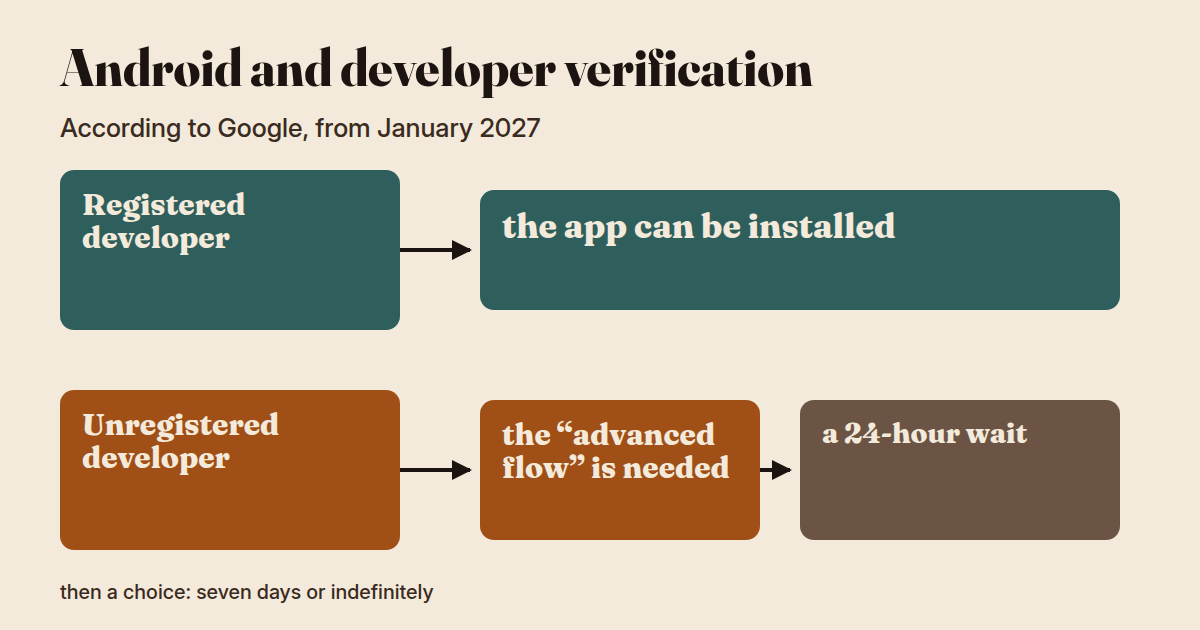
On November 19, Google wrote on the Android Developers Blog that, starting in January 2027, developer verification begins to expand worldwide. According to Google, an app will be installable on a Google-certified Android phone only if the person who wrote it has registered. The rule also applies to apps that do not come from the Play Store, Google’s app store. Anyone who still wants to install an app from an unregistered developer will have an “advanced flow,” with a 24-hour wait.
For people who install apps only from Google Play, little changes, according to Google: developers who publish on the Play Store have probably already met the requirements through the existing process, and registered apps account for more than 99% of installs.
What does this change in practice for people who install apps from outside the store, the “sideloading” that has been debated for months? And why do F-Droid, the Electronic Frontier Foundation and an open letter with 72 signatories say no to the verification? GrapheneOS, an alternative operating system based on Android but without Google’s services, says instead that the measure changes nothing for its own system, even though its foundation signed the letter.
In Short
According to Google, starting in January 2027 developer verification begins to expand worldwide: an app will be installable on a certified Android phone only if the person who wrote it has registered with Google, even when the app does not come from the Play Store. For people who still want to install an app from an unregistered developer, Google has prepared an “advanced flow” with a 24-hour wait. F-Droid, the Electronic Frontier Foundation and an open letter with 72 signatories criticize the measure; GrapheneOS says it is not affected, but criticizes the identity requirement for developers and the Play Integrity API. Google has not given a date for Italy.
What Changes, and When?
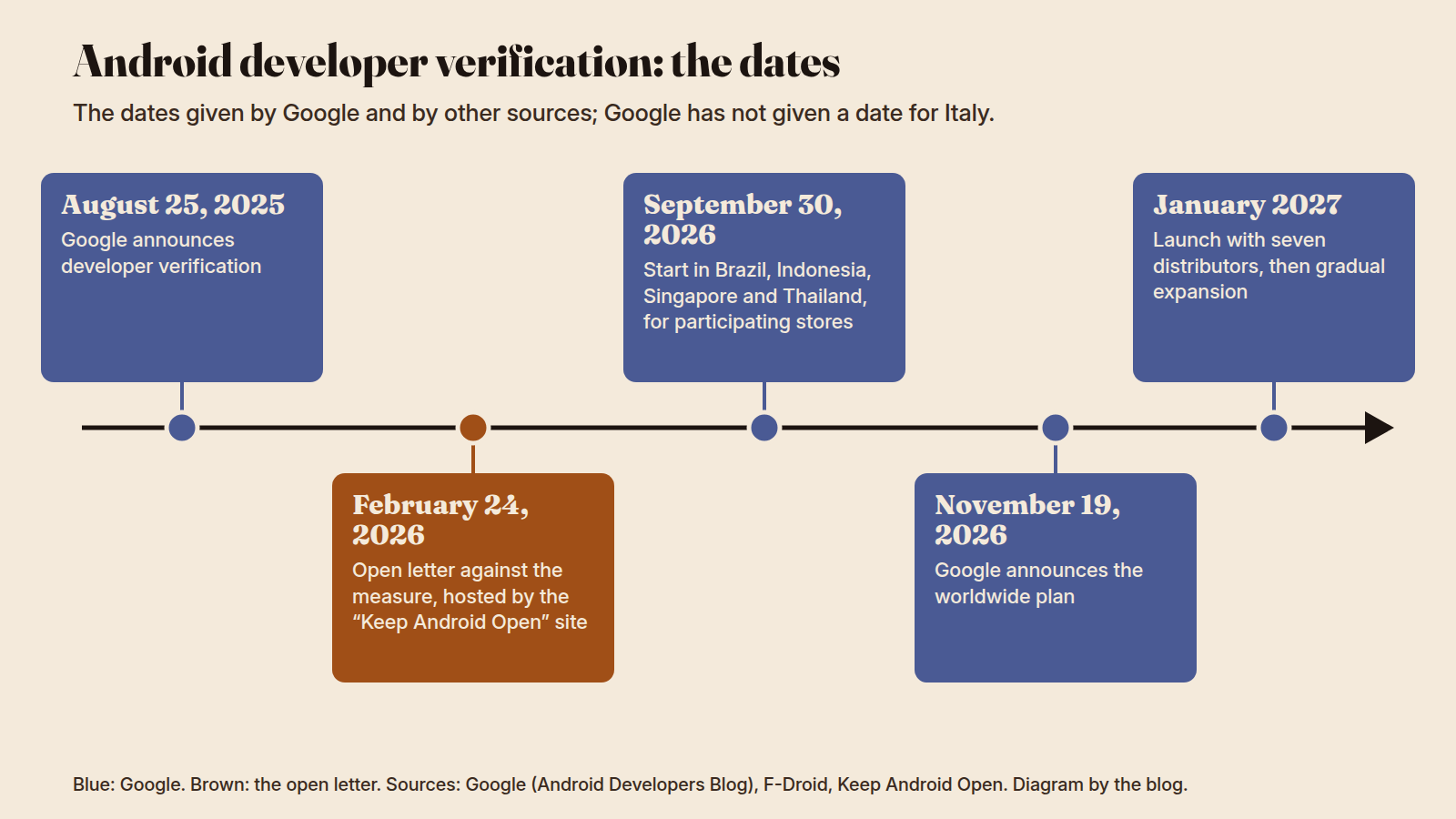
Google writes that verification went live on September 30, 2026, for participating stores in Brazil, Indonesia, Singapore and Thailand. The worldwide rollout begins in January 2027 with seven distributors: Google Play, Galaxy Store (Samsung’s store) and the stores of Honor, Oppo, Xiaomi, Transsion and Vivo. Honor, Oppo, Xiaomi, Transsion and Vivo are phone makers that run their own app stores. The protections will then expand “gradually” to all countries and to all installation sources on certified devices, over several months. Google does not give a date for Italy.
A certified device is a phone with Google Play and Google’s services, the Google Mobile Services. For developers the rule is this: anyone who distributes only outside Google Play creates an account in the Android Developer Console, Google’s platform for developers, verifies their identity and registers their apps. Google says registering an app takes less than ten minutes, and that since verification opened to everyone in March, millions of apps have been registered.
For people who work alone or as hobbyists, Google has set up a limited distribution account, with no fee and no ID document: since August it allows sharing an app with 20 authorized devices; on November 19 Google announced the extension to 50. The full account costs $25, according to Google’s FAQ of November 17.
There is one point on which the dates do not match. F-Droid, on February 24, cited Google’s page of the time: “Starting in September 2026.” The Free Software Foundation Europe, on June 15, wrote that in September Google would force every Android developer to register. For Google, September 30 covered only four countries and the stores that participate.
How Does the “Advanced Flow” Work?
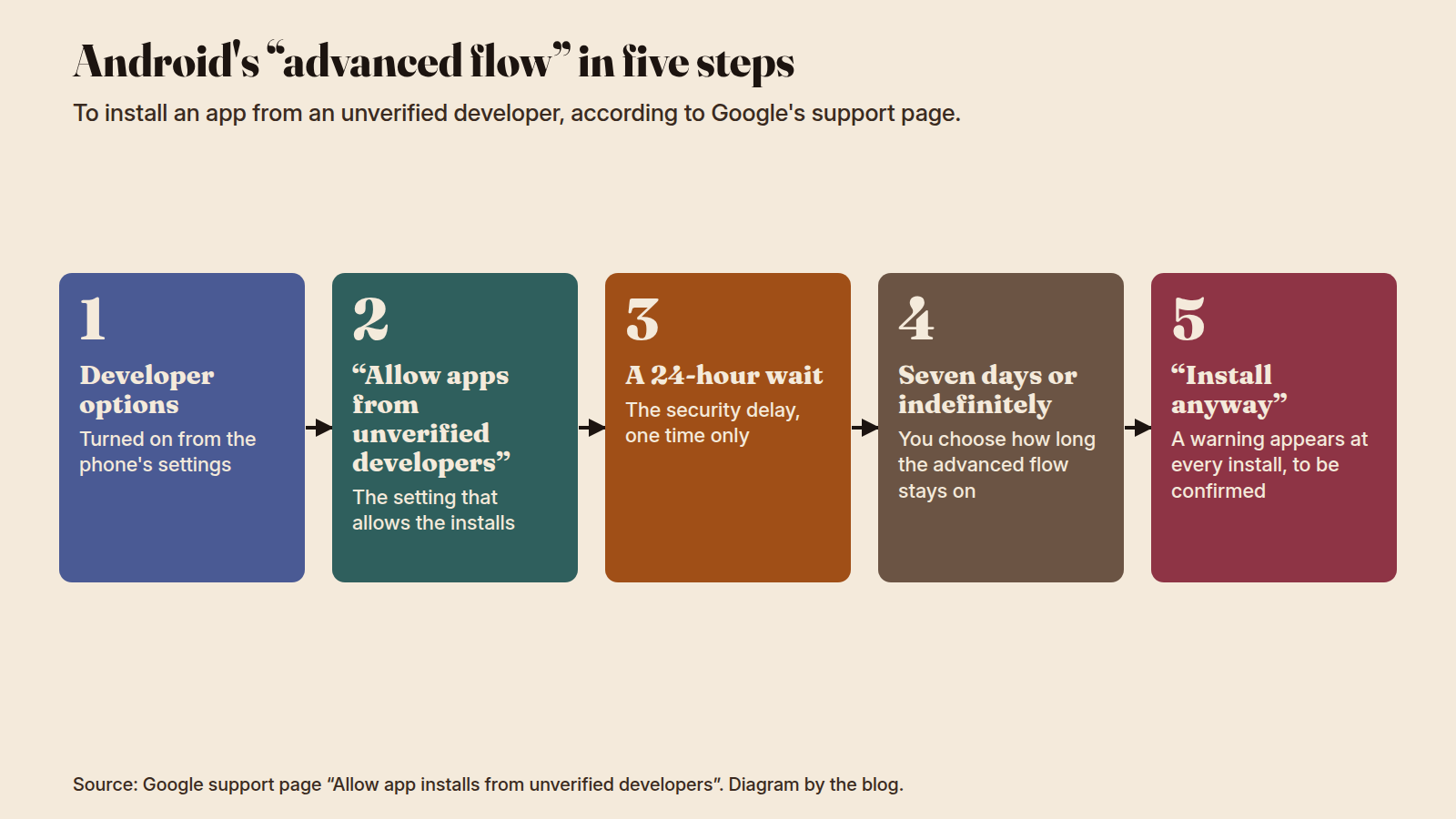
Google’s support page, which carries no date, describes the steps. The user turns on developer settings, then the “Allow apps from unverified developers” option. A 24-hour security delay follows. After the delay, the user chooses whether to keep the advanced flow on for seven days or indefinitely. A warning still appears at every installation, to be confirmed with “Install anyway.”
Google writes that the protections are meant to make the user take an informed, independent decision. The page warns that scammers often pose as bank fraud agents, tech support or delivery services and ask people to download fake apps. Samat, Google’s president of the Android ecosystem, told Ars Technica on March 19 that Google thinks that in those 24 hours it becomes much harder for an attacker to carry on with the scam.
For developers there is another route: Google writes in its FAQ that unverified apps can be installed with ADB, Android’s command-line tool. And Google published a guide for open-source apps on October 23. Developers who distribute on a repository, that is, an archive of open-source apps, are not required to register the app; if they do, users install as they do today, otherwise users must use the advanced flow. If the repository connects to the Developer Console, it can register the package name and the key on the developer’s behalf, but the developer must still have a verified account. Whoever runs a store can also join the “Registered App Stores” program. For Google, if a store chooses not to participate, “nothing changes for them” and the store “retain[s] the same experience as any other sideloaded app on Android.”
What Reason Does Google Give for the Verification?
Google gives a security reason. In its announcement of August 25, 2025, it wrote that on Android devices there is over 50 times more malware in apps downloaded from the internet than in those on Google Play; in March 2026 the same figure rose to over 90 times. Frey, of Google, added at the time that developers will have the same freedom to distribute their apps directly to users or to use any store. Forsythe, on September 30, 2025, asked whether sideloading is going away, answered: “Absolutely not. Sideloading is fundamental to Android and it is not going away.”
F-Droid, which distributes open-source apps, wrote on October 28, 2025, that it had not seen the analysis behind the “50 times” or any other supporting evidence. On July 1, 2026, it added two objections. Verification does not stop a bad actor from distributing malware, and it would only help against someone who starts over with a new account. And Google’s figure on apps already registered does not prove consent, because Google Play developers were enrolled automatically by the agreements they had already signed.
LineageOS, an alternative operating system, on July 4, 2026, reported Google’s “over 50x more malware” figure as a claim.
What Does the Open-Source World Say?
An open letter, hosted on the site “Keep Android Open,” came out on February 24, 2026, asking Google to withdraw the measure. Today the page lists 72 organizations. The site is a campaign with a thesis. Among the signatories are projects that distribute apps, such as F-Droid, and digital-rights associations. The letter says that centralizing the registration of all apps gives Google new powers to disable any app, for any reason, across the entire Android ecosystem.
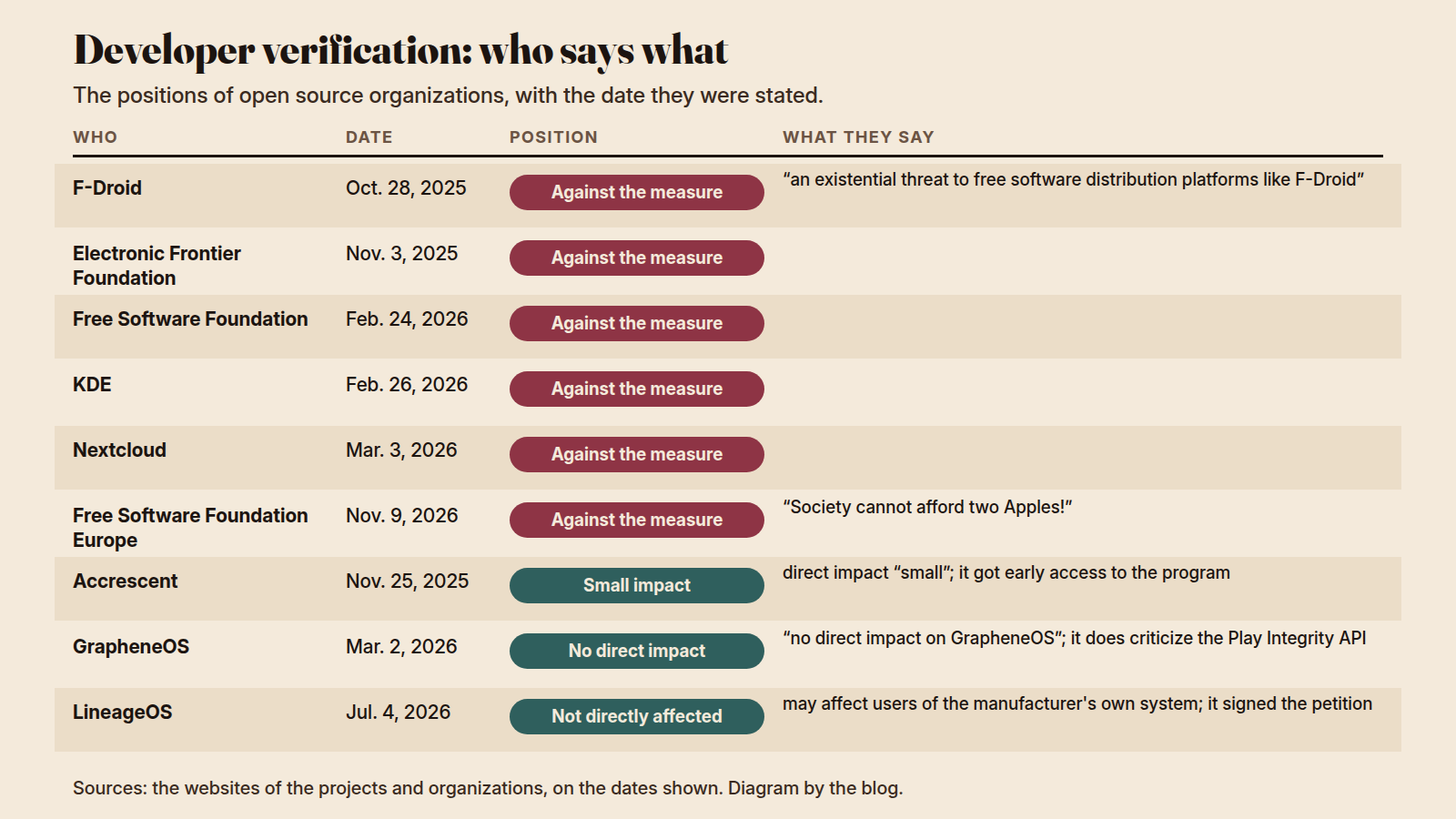
F-Droid writes in very blunt terms. On October 28, 2025, it wrote that verification is “an existential threat to free software distribution platforms like F-Droid” and that Google’s statement that “sideloading is not going away” is “simply false.” On February 24, 2026, when the advanced flow was still only an announcement, F-Droid wrote that it would disregard it until the community had seen it work and vetted it, and advised developers against signing up for the program, “now or ever.”
The FAQ of “Keep Android Open” says that the September 30 activation does not affect F-Droid or apps installed through F-Droid, and that the date when it will reach F-Droid’s users has not yet been published.
Other organizations say the same: the Electronic Frontier Foundation, which defends digital rights, the Free Software Foundation and the Free Software Foundation Europe, which promote free software, the KDE project and Nextcloud. The Free Software Foundation Europe wrote on November 9: “Society cannot afford two Apples!”
Maya Posch, in a Hackaday article of November 14, 2025, wrote that the measure tries to fix a social engineering problem with technology, and that this approach only gets you so far. F-Droid, on September 29, 2025, instead described a practical problem: it cannot register developers on their behalf, nor take over the package names of the apps it distributes, because that would mean seizing their distribution rights.
Not all voices are opposed. Accrescent, an open-source store, wrote on November 25, 2025, that the direct impact of the measure on it is “small” and that it has obtained early access to the program. LineageOS, on July 4, wrote that the measure does not affect it directly but may affect users who run the manufacturer’s original system on their phones. The project did sign the petition.
What Does GrapheneOS Say, and Why Does It Say Nothing Changes for It?
GrapheneOS is an alternative operating system based on Android, without Google’s services. Its official Mastodon account wrote on March 2, 2026: “There’s no direct impact on GrapheneOS from the Google Mobile Services changes you’re referring to…” On April 18 the account called the matter “a complete non-issue.” The reason it gives is that verification is a warning built into systems with Google’s services, and GrapheneOS does not have them; Google Play, if installed, runs as a normal app and cannot block installations. It repeated this on October 8 on the project’s forum: no impact on either GrapheneOS or sandboxed Google Play on GrapheneOS.
GrapheneOS does not say, however, that the measure is fine. On July 24 GrapheneOS wrote that forcing developers to verify their identity to avoid warnings that can be bypassed but not fully disabled is wrong: the warnings should be completely optional, and Google should not be the sole gatekeeper for bypassing them. The criticism it calls most serious concerns the Play Integrity API, the tool apps use to check that the phone is certified by Google. On November 10 the project wrote that the Play Integrity API is “much worse” than a warning. The API blocks the use of apps and services for people who do not have a certified device with the unmodified factory system, and identity verification does not make it possible to avoid that block. In its view, over time the block leaves less room for phone makers and competing systems. The GrapheneOS Foundation, however, appears among the signatories of the open letter, and the project does not explain the signing in its posts on the topic. It was not on the list in early April.
There is also a criticism of the opponents. On June 7 the project wrote that most people opposing the changes do not understand what is changing, which has played into Google’s hands. The project added that many believe that from September installing apps from outside the Play Store will bring a warning or be blocked, and that this is not the case: according to the project, after September there will be no warning for installing an alternative app store and the apps from it. That post predates the worldwide plan of November 19.
What Is Still Unknown?
For Italy and for the European Union there is no date: Google speaks of a gradual expansion to all countries, with no calendar.
The figures remain in conflict: Google speaks of over 50 times more malware in apps downloaded from the internet, then of over 90 times, and F-Droid writes that it has not seen the analysis.
Google responds to the criticism in general terms, without naming F-Droid or GrapheneOS: it writes that sideloading “is not going away” and has published a guide for open-source repositories. The advanced flow, which F-Droid has so far judged only on paper, will be seen on a real phone starting in January.
Frequently Asked Questions
What changes for Android apps outside the Play Store?
According to Google, starting in January 2027 developer verification begins to expand worldwide: an app will be installable on a certified Android phone only if the person who wrote it has registered with Google. The rule also applies to apps that do not come from the Play Store. Google will extend the protections to all countries over several months.
What is Android’s “advanced flow”?
It is the route by which, according to Google’s support page, a user can install apps from unverified developers. The user turns on developer settings and the “Allow apps from unverified developers” option, then a 24-hour security delay follows. After that, the user chooses the advanced flow for seven days or with no limit; a warning appears at every installation.
When does developer verification start in Italy?
Google has not given a date for Italy or for the European Union. According to Google, verification has been live since September 30, 2026, in participating stores in Brazil, Indonesia, Singapore and Thailand; the worldwide rollout begins in January 2027 with seven distributors, and then expands gradually to all countries and all installation sources.
What does F-Droid say about developer verification?
F-Droid, the open-source app store, wrote on October 28, 2025, that verification is “an existential threat” to free software distribution platforms. On February 24, 2026, about the advanced flow, it wrote that it would disregard it until the community had seen it work, and advised developers against signing up for the program.
Is GrapheneOS affected by developer verification?
According to GrapheneOS, on March 2, 2026, and again on October 8, verification has no direct impact on GrapheneOS, because the system does not have Google’s services. The project does criticize the identity requirement for developers and the Play Integrity API, which on November 10 it called “much worse” than a warning.
How much does it cost to register as an Android developer, according to Google?
According to Google’s FAQ of November 17, 2026, the full account costs $25. For people who work alone or as hobbyists, Google has set up a limited distribution account, with no fee and no ID document: it allows sharing an app with 50 authorized devices. It used to be 20.
Read Also
- Meta Fined €805 Million by Italy’s Privacy Regulator: another story about permissions for Android apps, access to the Facebook photo gallery.
- iCloud: From iOS 27.3, Apple Will Check Public Links — What Changes for Photos and Files: another rule changed by a company about what users can do with their own apps and files.
Sources
Documents from the parties themselves, accessed November 23, 2026, unless otherwise noted. Type of source: primary (the party making the statement), secondary (the party reporting it).
- Google, Android Developers Blog, Matthew Forsythe, “Expanding Android developer verification in 2027,” November 19, 2026. Primary (Google, an interested party). https://developer.android.com/blog/posts/android-developer-verification-2027
- Google, Android Help, “Allow app installs from unverified developers,” undated. Primary (Google, an interested party). https://support.google.com/android/answer/17588095
- Google, “Register an app on open-source registry,” updated October 23, 2026; verification FAQ, November 17, 2026; limited distribution account guide, October 28, 2026. Primary (Google, an interested party). https://developer.android.com/developer-verification
- Google, Android Developers Blog, Suzanne Frey, August 25, 2025; Matthew Forsythe, September 30, 2025, and November 12, 2025; Sameer Samat, March 4, 2026; blog posts of March 19 and March 30, 2026 (updated September 29, 2026). Primary (Google, an interested party).
- Ars Technica, interview with Sameer Samat, March 19, 2026. Secondary.
- F-Droid, “What We Talk About When We Talk About Sideloading,” October 28, 2025; “An Open Letter Opposing Android Developer Verification,” February 24, 2026; posts of September 22 and 29, 2025, and July 1, 2026. Primary (an interested party). https://f-droid.org/
- Keep Android Open, open letter of February 24, 2026, and FAQ, undated. Primary (campaign). https://keepandroidopen.org/
- Hackaday, Maya Posch, November 14, 2025 (opinion). Secondary.
- EFF, November 3, 2025; FSF, February 24, 2026; KDE, February 26, 2026; Nextcloud, March 3, 2026; FSFE, June 15 and November 9, 2026; LineageOS, July 4, 2026; Accrescent, November 25, 2025. Primary (interested parties).
- GrapheneOS, official Mastodon account (grapheneos.social), posts of March 2, June 7, April 18, July 24 and November 10, 2026; forum, October 8, 2026. Primary (the project).
Have your say