According to Google, a team of agents, that is, programs that work on their own on a task, took historical photos and engineering plates and turned them into an interactive three-dimensional exhibition on the construction of the Eiffel Tower. It started from a single prompt.
The agents were copies of Gemini 4 Carbon, the artificial intelligence model that Google made available on November 10.
The launch price expires on November 30. But what can Carbon do, and how does it do it?
In short
According to Google, Carbon is its most capable model for long, difficult tasks: multistep programming, scientific research, cybersecurity. It gets there by thinking longer and rechecking its own work, and so it uses more text and more time. The launch price, half the final one, is valid only through November 30.
What it can do
Google describes it as its strongest model for long tasks with many steps: complex knowledge work, programming, scientific reasoning. It also says its teams have seen it work for days on hidden flaws in large codebases, without stopping at dead ends.
It is not the only model in the family. Argon, introduced a few weeks earlier, remains for Google the right choice for most of the work. Carbon is built on top of Argon and is meant for tasks that test a model’s limits, such as multistep debugging and open-ended scientific research.
To do so it uses more tokens than Argon, the small pieces of text with which the model reads and writes, including those of the reasoning we do not see.
Developers and companies that pay use it through the API, the service with which a program queries a model on the producer’s servers. Google AI Ultra subscribers are also getting it in the Gemini app and in AI Mode in Google Search. The free tier does not include it.
What it has built and discovered
Almost all of Google’s examples originate in Antigravity, the platform the company uses to have agents do programming. The trick is /swarm, a feature in preview that turns a single prompt into a team.
With seven public PDFs from a city council and a single prompt, a team of agents rebuilt in 3D the Google office known as Platform 37, in ten overnight work cycles.
Then there is an open-world 3D game in which you explore Google’s campus in Mountain View as a pelican riding a bicycle, the GBike. The agents modeled the objects in Blender, the 3D graphics program, wrote the game for the browser and added sounds and music. Google offers the app to try out.
Google’s online merchandise store was rethought in two requests: five style proposals and new images for all the products, generated with Nano Banana 2.1, Google’s model for images.
From a reference video, Carbon built an underwater scene of Atlantis, with several movie-style shots: ruins, play of light on the seabed and water simulation, then transferred into an environment that runs in real time in the browser.
The most curious case is a playable fortepiano, the ancestor of the piano, rebuilt from technical drawings and X-rays of an instrument from around 1780. The instrument was placed in a 3D model of Koerner Hall in Toronto, with acoustics that change from seat to seat. This one can also be tried live.
So far these are constructions. Google also tells of discoveries, and it is worth remembering that they are its own accounts.
A team of researchers used Carbon with other models to have a machine prove the security properties of Signal’s cryptographic protocol, the encrypted messaging app. The agents wrote millions of lines of Lean, a language for mathematical proofs, and in a few weeks achieved what usually takes expert teams years.
Another example concerns proteins. The models that predict how a chain of amino acids folds, such as AlphaFold 3, lean on the related proteins found in databases, and struggle when they find few.
Carbon, in a team of agents, found on average 40 times more of them in a test on seven protein families; Google specifies that the broader comparisons are not finished.
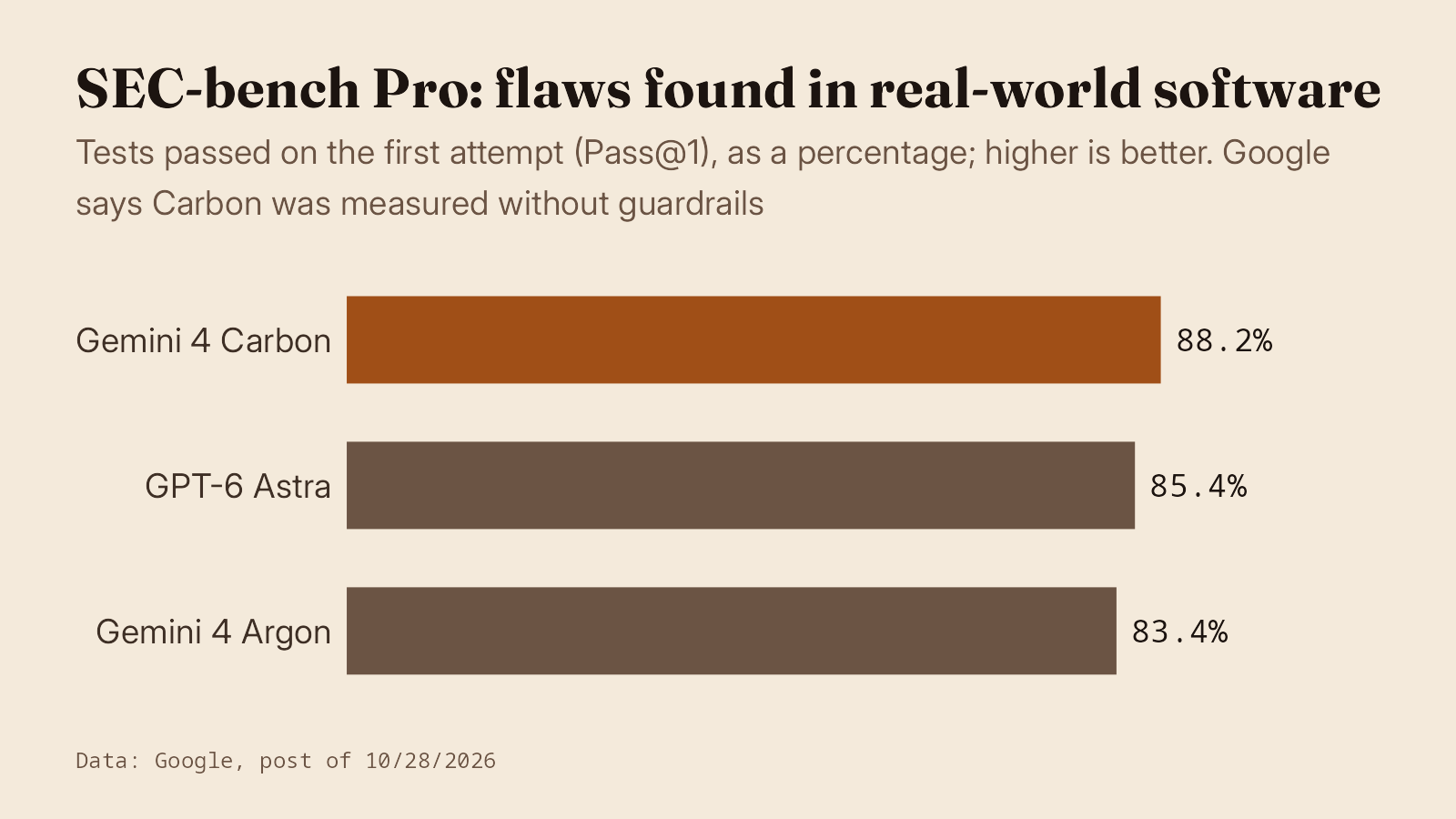
On cybersecurity the caution is greater: the dedicated version is obtained through the Fairwind program, reserved for defenders who apply to join. In tests by Wiz, a security company, the model found, in under two hours, previously unknown flaws in two large online software providers, work that usually takes weeks. On SEC-bench Pro, a test that measures how many flaws in real-world software a model finds on its own, Google reports 88.2% for Carbon, measured without guardrails, against 85.4% for GPT-6 Astra and 83.4% for Argon.
How it gets there
The answer lies in the time it takes. According to the model card, Carbon uses more reasoning tokens than Argon to explore hypotheses, reason in depth and repeat long verifications; the reasoning level can be adjusted, to choose between quality, speed and cost.
For web applications it repeats a build-and-verify cycle: it recovers from errors and checks both the code and the interface that comes out of it.
With /swarm a single prompt becomes a team of agents that you follow in real time. Carbon is assigned the roles that call for the most reasoning, such as design, coordination and review; alongside it work lighter, faster models, in separate workspaces, and verifiers that try to break every change.
Then there is a curious trait: according to Google, Carbon more often refuses to invent what is missing. In a Google honesty test for agents, it passed 92% of the tasks, against 70% for Argon; when experimental data were missing, it refused to invent them 98% of the time.
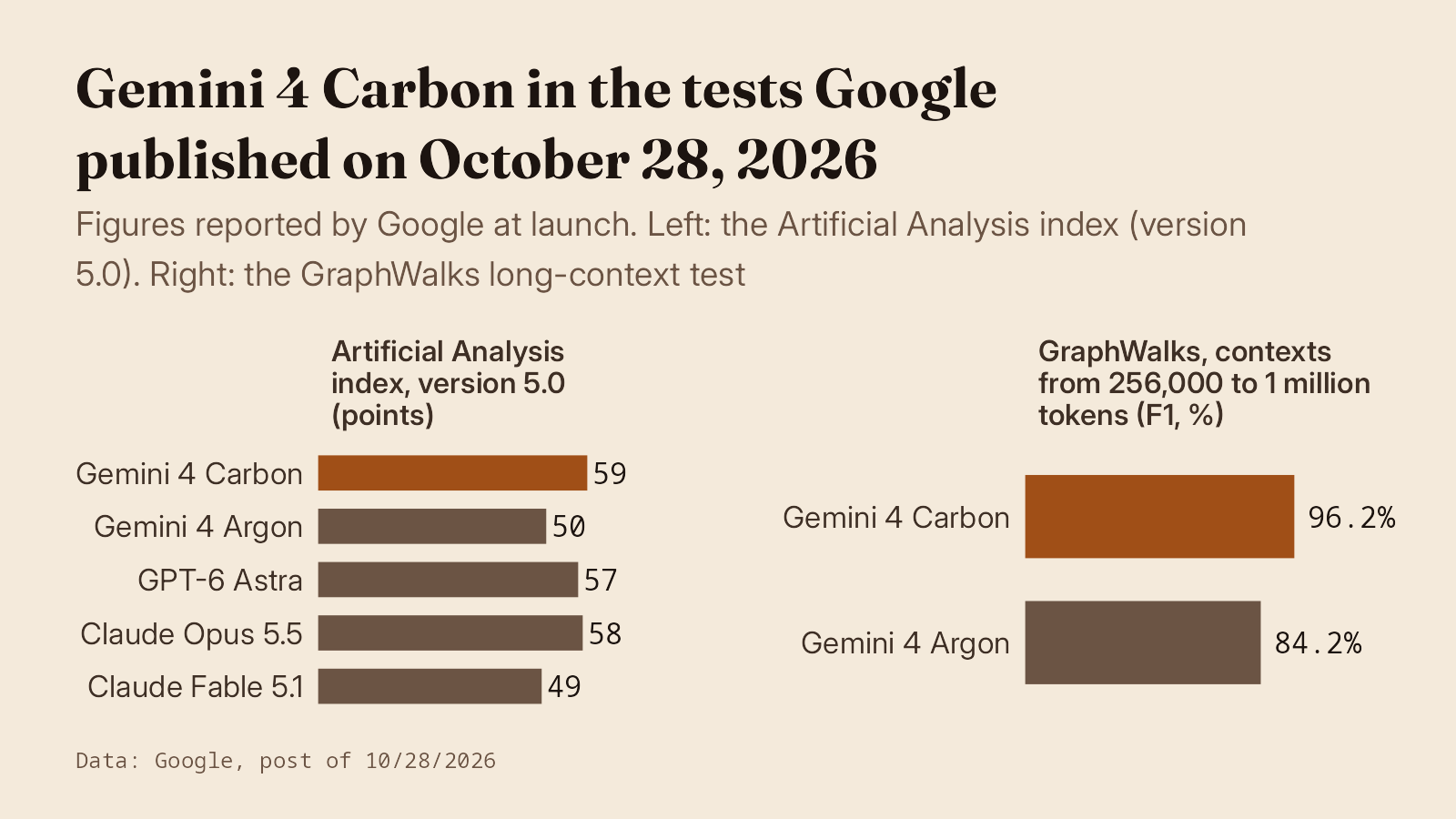
It understands text, images, audio and video, but answers only with text. The context window is one million tokens, that is, the amount of text it keeps in mind at once, across input and output. On a test in the model card with contexts from 256,000 to a million tokens, GraphWalks, Carbon scores 96.2% against Argon’s 84.2%.
What the numbers say
Google writes that Carbon is first in three tests on real tasks, at a cost per task more than two times lower than the best external model. In the new MKA test, created with Artificial Analysis, a site that compares models, it is second, at a cost that Google says is more than six times lower.
MKA tests visual work: 200 tasks across 10 sectors and 83 occupations, each taking a professional three to eight hours, with floor plans, technical diagrams and tables to read and turn into presentations and spreadsheets.
The site confirms the second place, but first is Claude Fable 5.2, from Anthropic, with 57% against 54%.
The average cost per task on that test is $6.29 for Carbon and $31.97 for Fable: a little over five times.
The overall ranking moves too. At the end of October Google wrote that Carbon was first on Artificial Analysis’s intelligence index; as of November 11 it is fourth.
The same sources state the limits. The site measures 25.6 minutes per task, twice as long as a model in a similar price tier, and 205 million tokens written, almost three times as many.
Google’s model card also speaks of slowness and of possible invented answers, and of knowledge that stops in March 2026.
The price, in short
Through November 30 the launch price is half the final one; from December 1 it doubles, on every channel.
| Per million tokens | Through November 30 | From December 1 |
|---|---|---|
| Standard, input / output | $2 / $10 | $4 / $20 |
From December 1 the other per-token rates in the price list also double, such as those for batch processing and for text already read.
Every token processed is paid for, including those of reasoning, which count as written text.
The cost of a task also depends on the number of tokens: Artificial Analysis measures $7.76 per task of its index, calculated with the December price. With the launch price it would be about $3.88: a calculation, not a figure from the site.
To estimate your own budget it is therefore best to start from the December price and from the tokens the model uses on your own work.
The price can be calculated in one line; what Carbon can do, and the time it takes to do it, can only be understood by trying it on your own work.
Frequently asked questions
What can Gemini 4 Carbon do?
According to Google, long and difficult tasks: multistep programming, scientific research, complex knowledge work, cybersecurity. It understands text, images, audio and video and answers with text.
What is the difference between Carbon and Argon?
For Google, Argon remains the choice for most of the work; Carbon is for tasks at the limit and uses more tokens to reason. The price per token is the same.
How much does it cost?
$2 per million tokens read and $10 per million tokens written through November 30, 2026; from December 1, $4 and $20. The free tier does not include it.
How long does it take to work?
Artificial Analysis measures 25.6 minutes per task of its index, against 12.6 for a model in a similar price tier.
Read also
- Another calculation of API prices, against a model run in-house: Let’s Do the Math on Revolut: What Does a Chinese AI Model Cost to Run In-House, and Would It Be Worth It for Us Too?.
Methodology note
Pages read on November 11 and 13, 2026: Google’s two posts, the model card, the post on the MKA test, Google AI Studio’s price list and Artificial Analysis’s pages on Carbon and on the MKA test. The examples are as Google tells them; they have not been independently verified. Artificial Analysis pages do not print the date of the last update. The $3.88 is $7.76 divided by 2. No source indicates availability for Italy.
Sources
Accessed November 11 and 13, 2026. Titles are in the original English.
- Google, Koray Kavukcuoglu, “Gemini 4 Carbon is now available,” November 10, 2026. Primary. https://blog.google/innovation-and-ai/models-and-research/gemini-models/gemini-4-carbon-now-available/
- Google, Koray Kavukcuoglu, “Gemini 4 Carbon: our next frontier model,” October 28, 2026. Primary. https://blog.google/innovation-and-ai/models-and-research/gemini-models/introducing-gemini-4-carbon/
- Google DeepMind, “Gemini 4 Carbon” model card, November 2026. Primary. https://deepmind.google/models/model-cards/gemini-4-carbon/
- Google, Rohan Doshi and Ben Caine, “Introducing the Multimodal Knowledge Agent benchmark,” November 10, 2026. Primary. https://blog.google/innovation-and-ai/models-and-research/gemini-models/multimodal-knowledge-agent-benchmark/
- Google, “Gemini Developer API pricing,” Gemini 4 Carbon section. Price list. https://aistudio.google.com/docs/pricing
- Artificial Analysis, “Gemini 4 Carbon (high),” and article on the MKA test, November 10, 2026. Secondary; the site describes itself as independent. https://artificialanalysis.ai/models/gemini-4-carbon ; https://artificialanalysis.ai/articles/google-deepmind-multimodal-knowledge-agent
Have your say