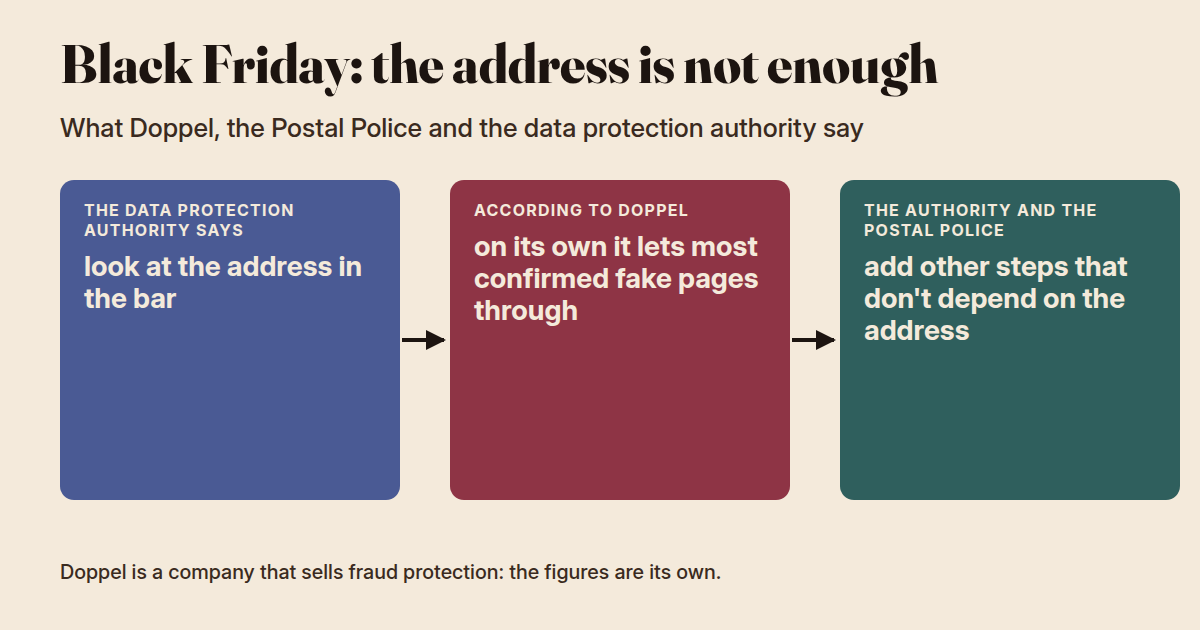
Italy’s data protection authority, the Garante, among its tips for Black Friday, points to one check for fake shopping sites: look at the address in the bar. Does it match the company’s name? Does it have unusual letters or characters, even when it looks like the real one? According to Help Net Security, a cybersecurity news site, checking the address is the habit of most shoppers; according to Doppel, a company that defends brands against online impersonation, looking for the brand’s name in the address is not enough on its own.
Doppel’s report on holiday scams, picked up on November 23 by Help Net Security, concerns the fake pages the company confirmed this season. According to Doppel, most of these pages pass that check. They are pages that impersonate brands, and more than one in three aims to steal a login; the Garante’s advice concerns fake shopping sites.
According to Doppel, the likeliest lure is a post in a Facebook group or a page on Google Sites. The Polizia Postale, Italy’s police unit for online crime, and the Garante point to checks that do not depend on how the address is written.
In brief
According to Doppel, this year’s fake Black Friday deals started appearing on September 1, more than a month earlier than last year, and most of them do not mention the holiday or use an address that imitates the real one. Also according to Doppel, half of the confirmed cases of brand impersonation on social media are in Facebook groups, and about one impersonation page in four is on legitimate platforms such as Google Sites. The Polizia Postale and the Garante give advice and no figures: the Garante says to reach the site by typing the address instead of clicking the link received, and writes that the “https” padlock alone does not guarantee that the site is trustworthy. All the figures come from Doppel, an interested party, and Help Net Security reports them as stated by Doppel.
Who Produced the Numbers, and What Do They Leave Out?
All the figures come from Doppel, which is an interested party: the company sells brands a service that defends them against impersonation and phishing, that is, against the messages and pages that steal data by posing as a company. Help Net Security reports the figures as stated by Doppel. Doppel publishes the full report only behind a form.
The percentages from Help Net Security and from the report’s presentation page do not say how many sites or cases they are calculated on, and Help Net reports that the cases are “confirmed” by Doppel without explaining by what criterion.
The Polizia Postale and the Garante give advice and no figures. Neither of the two pages cites Doppel’s report.
Where Are the Black Friday Fakes, According to Doppel?
According to Doppel, the likeliest lure is “a post in a Facebook group or a page on Google Sites, carrying a retailer’s sale language on behalf of a software, payment, travel, or crypto brand, and asking for a login.”
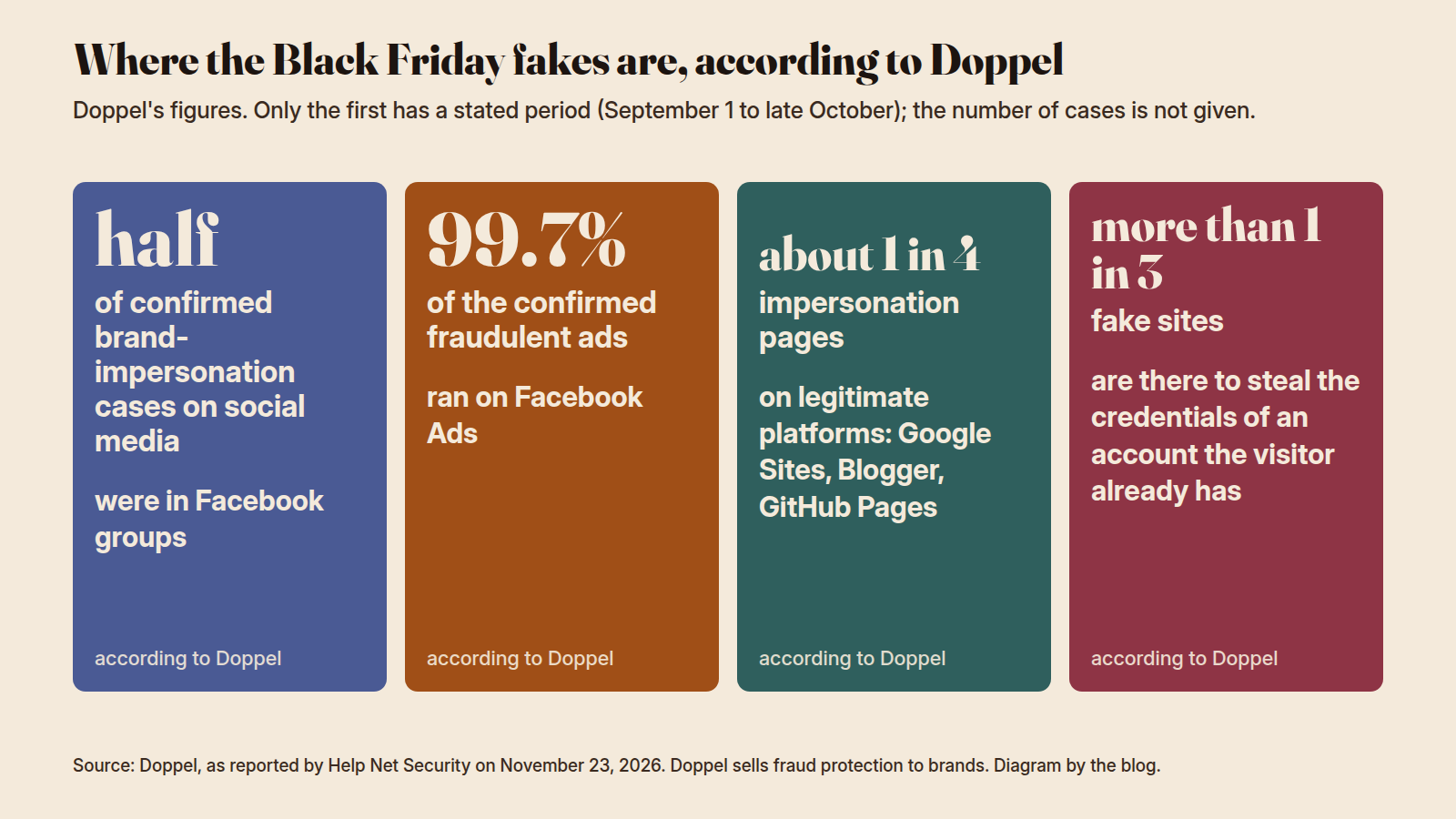
According to Doppel, between September 1 and late October half of the confirmed cases of brand impersonation on social media were in Facebook groups. Also according to Doppel, 99.7% of the confirmed fraudulent ads ran on Facebook Ads. Help Net Security writes that bargain and buy-and-sell groups are where people go hunting for discounts; a scam post in one of them, according to Doppel, “carries the group’s implied vetting.”
According to Doppel, a fake site does not need a strange address: about one impersonation page in four is on legitimate platforms such as Google Sites, Blogger and GitHub Pages, services for building web pages. Pages with their own address usually use a generic term, such as “deal” or “outlet,” and put the brand’s logo on the page.
More than one site in three, also according to Doppel, exists to steal the credentials of accounts the visitor already holds, not to collect a payment. About one site in three “cloaks”: a scanner, a reviewer or the brand’s staff see something harmless, while the shopper being targeted sees the lure. Doppel cites a sale scam that showed its checkout only to visitors on phones.
Who Is Impersonated, and Since When, According to Doppel?
According to Doppel, this year’s fake deals started appearing on September 1, more than a month earlier than last year, and most of them do not name the holiday or imitate an address. Stores, moreover, are not the most impersonated brands: according to Doppel, retailers were under a tenth of the confirmed sale-themed impersonations in 2025 and are about a tenth this year. In 2026 business software brands lead, followed by travel, crypto, retail and payments; last year it was airlines, then cryptocurrency exchanges and digital banks.
According to Doppel’s researchers, quoted by Help Net Security, “A holiday discount is a credible pretext for any brand a shopper has an account with.” Someone who receives a page with a login is not buying anything: they are entering an account they already have.
Travel is a case apart. According to Doppel, most of the sites with “Black Friday” in the name confirmed between September 1 and October 15 posed as a fare or booking page for travel, while in the two previous seasons no travel page with “Black Friday” in the address had appeared. A trip costs a lot, and people buy it quickly when the fare looks about to disappear: for Doppel, “the holiday supplies the scarcity.”
Cyber Monday, Doppel writes, has not appeared in the address of a single confirmed impersonation aimed at a Doppel client brand in three seasons: “When actors name the holiday, they name Black Friday.” A quarter of the confirmed impersonation texts, Doppel adds, arrived through iMessage and RCS, the standard that upgrades SMS; Help Net specifies that SMS spam filters do not cover them.
What Do the Polizia Postale and the Garante Advise?
The Polizia Postale opened the Black Friday week on November 23 with an invitation not to be swept up by the frenzy of shopping, and with three rules:
- Sites and links: beware of clone sites and of links received by e-mail or messaging or sponsored on social media.
- Payments: avoid bank transfers and direct transfers, preferring prepaid or rechargeable cards.
- Offers: distrust offers that are too good, check them on the official sites and, if you do not know the seller, look for reviews from other users.
For reports, the Polizia Postale points to commissariatodips.it.
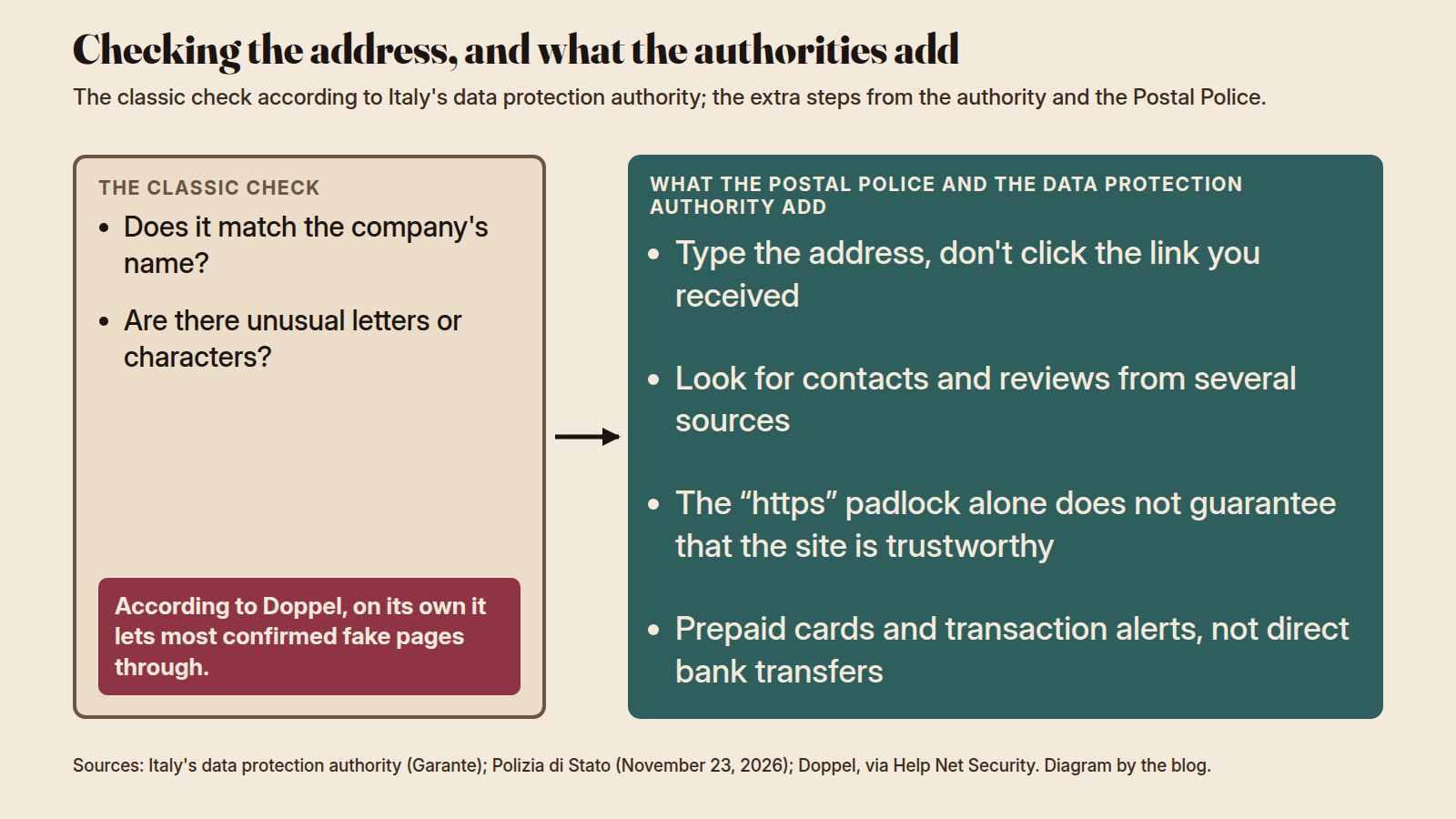
The Garante gives more detail. The advice to check the address is there: does it match the company’s name? Are there unusual letters or characters? Next to it, however, are steps that do not depend on how the address is written:
- The link received: if the offer arrives by e-mail, SMS or social media, you reach the site by typing the address directly, without clicking the link.
- The look: the Garante urges paying attention to errors, graphic anomalies and unclear information, and reminds that even a professional-looking site can be fraudulent.
- Contacts and reviews: you look online for the company’s contact channels and use them if in doubt; reviews should be sought from several sources, because they can be fake.
- The padlock: an address with “https” and the padlock does not, on its own, guarantee that the site or the seller is trustworthy; browser security warnings should be heeded.
- Payments: prepaid cards or other systems that avoid giving bank details to the seller, and real-time alerts on transactions.
The Garante also warns against extraordinary discounts that ask you to click a link, give personal or bank details, or answer polls and questionnaires. Behind them there may be e-mails, SMS messages or other messages that try to extract information, obtain fraudulent payments or get viruses installed. The Garante adds a warning for the season, fake shipping notifications, which arrive even to people who really did buy something and should be checked on the seller’s or the carrier’s site or app, not from the link in the message. It also advises two-factor authentication for accounts, and stopping a moment to think before instinctively doing what is asked.
What Can’t Doppel’s Numbers Say?
Doppel’s data reach late October at most, and October 15 for the domains with “Black Friday”: they do not describe the week of the 27th. The numbers reported do not say how many fake sites there are or whether Italy is in the sample, and the Cyber Monday figure concerns only brands that are Doppel’s clients.
Checking the address remains one of the steps the Garante indicates. According to Doppel, on its own it lets most of this year’s confirmed fake pages through; the steps that the Garante and the Polizia Postale put next to it do not depend on how the address is written.
Whether a discount is real or fake is another check: the one in the 30-day rule. Black Friday is Friday, November 27, and Cyber Monday is Monday, November 30.
Frequently Asked Questions
Why Is Checking the Address Not Enough Anymore, According to Doppel?
According to Doppel, looking for the brand’s name in the address lets most of the confirmed fake pages of this season through. About one impersonation page in four, according to Doppel, is on legitimate platforms such as Google Sites, Blogger and GitHub Pages, and most of them do not mention the holiday or use an address that imitates the real one.
Where Are the Black Friday Scams, According to Doppel?
According to Doppel, between September 1 and late October half of the confirmed cases of brand impersonation on social media were in Facebook groups. Also according to Doppel, 99.7% of the confirmed fraudulent ads ran on Facebook Ads. More than one site in three exists to steal the credentials of accounts the visitor already holds.
What Does the Polizia Postale Advise for Black Friday?
On November 23 the Polizia Postale gave three rules: beware of clone sites and of links received by e-mail, messaging or social media; pay with prepaid or rechargeable cards, avoiding bank transfers and direct transfers; distrust offers that are too good and look for reviews from other users if you do not know the seller.
What Does the Garante Advise, and Is the “https” Padlock Enough?
The Garante advises checking the address, but also reaching the site by typing the address instead of clicking the link received, and looking for reviews from several sources. It writes that an address with “https” and the padlock does not, on its own, guarantee that the site or the seller is trustworthy, and recommends heeding browser security warnings.
Are Doppel’s Numbers Independent?
No. Doppel sells brands a service that defends them against impersonation and phishing: it is an interested party. Help Net Security reports the numbers as stated by Doppel, and the pages cited do not give the number of cases or the base of the percentages. Neither Help Net nor the presentation page says in which country the data were collected.
When Are Black Friday and Cyber Monday 2026?
Black Friday 2026 is Friday, November 27, and Cyber Monday is Monday, November 30. According to Doppel, this year’s fake deals started appearing on September 1, more than a month earlier than last year, and its data reach late October at most: they do not describe the week of November 27.
Read Also
- Black Friday and the 30-Day Rule: How to Read a Discount: another check for Black Friday, the previous price of the thirty days.
- Cyberattacks in Italy: ACN Counts Events, Not Attacks: another look at what the numbers on online security mean, read from the official sources.
Sources
Documents from the parties themselves, accessed November 24, 2026. Type of source: primary (the party making the statement), secondary (the party reporting it). Titles of Italian sources are in the original, with an English translation in brackets.
- Doppel, report “An Early Start to Black Friday: 2026 Holiday Scam Threat Intelligence Report,” presentation page. Primary (Doppel, an interested party); the full report is behind a form. https://www.doppel.com/resources/report/threat-intel-early-start-black-friday
- Doppel, home page, for the description of the company. Primary (Doppel). https://www.doppel.com/
- Help Net Security, Sinisa Markovic, “Black Friday scams started earlier this year without the usual red flags,” November 23, 2026. Secondary. https://www.helpnetsecurity.com/2026/11/23/black-friday-scams-doppel-report/
- Polizia di Stato, Commissariato di PS online, “Black Friday attenti alle truffe” [“Black Friday, beware of scams”], November 23, 2026. Primary (Italian authority). https://www.commissariatodips.it/notizie/articolo/black-friday-attenti-alle-truffe-1/index.html
- Garante per la protezione dei dati personali [Italy’s data protection authority], “Black Friday: i suggerimenti del Garante privacy per acquisti più sicuri” [“Black Friday: the Garante’s tips for safer shopping”], undated. Primary (Italian authority). https://www.garanteprivacy.it/black-friday
The Doppel quotations, taken from Help Net Security, are in the original English.
Have your say